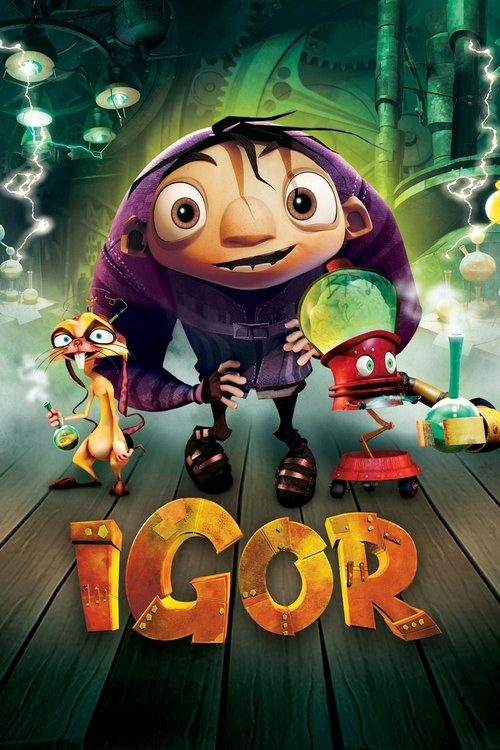
Igor (2008)
Directed by Tony Leondis
No — Igor is not woke, scoring 11 out of 100 on our wokeness meter.
Igor arrives as a curiosity of independent animation, the first feature-length cartoon financed entirely with private equity, which is the sort of detail that sounds like a boast until we sit through it.
Consciousness Markers
King Malbert is exposed for manufacturing the storm to extort 100 billion dollars and enrich himself, giving a mild greedy-ruler critique, though it reads as generic villainy rather than systemic anti-capitalism.
A 2008 animated feature voiced largely by white A-list talent (Cusack, Buscemi, Cleese, Leno, Izzard, Coolidge, Shannon), with Arsenio Hall in a minor supporting role. No deliberate diversity-driven casting agenda.
The film carries a light moral about choosing good over evil and ends with Malaria becoming a benevolent republic, but it preaches gently rather than lecturing.
Eva is a female monster with her own aspirations and Jaclyn is revealed to be a female Igor, but the film offers no feminist thesis or gender critique.
Eva is a 'hideous' monster whose sweet nature is valued over her appearance, offering a faint inner-beauty message, but no real body-positivity framework.
No LGBTQ+ themes or characters. Eddie Izzard's flamboyant villain and a shapeshifting girlfriend are genre tropes, not queer representation.
The 'Igor' underclass is defined by hunchback status, not race. No racial consciousness or commentary present.
The perpetual storm is a tyrant's extortion device, not an environmental allegory. No climate messaging.
Brain is merely dim-witted for comic effect and Scamper is suicidal for gags; no neurodivergence themes or representation.
No historical events or figures are revised or reinterpreted; the setting is a wholly invented fantasy kingdom.
Why it received this score
Igor arrives as a curiosity of independent animation, the first feature-length cartoon financed entirely with private equity, which is the sort of detail that sounds like a boast until we sit through it. The premise is genuinely clever. A hunchbacked assistant in the kingdom of Malaria wants to be a mad scientist instead of a servant, and the tropes of the Frankenstein cycle are inverted with some care. The monster is sweet. The scientist is a fool. The brain in the jar is not bright. It is a modest, well-mannered inversion, and it holds for about as long as the setup does.
The film's cultural ambitions are equally modest. Eva, the stitched-together actress, is valued for her gentle temperament over her hideous exterior, which gestures at an inner-beauty lesson without ever committing to a framework for it. King Malbert's weather machine is exposed as an extortion racket, a greedy-ruler reveal that plays as generic villainy. Jaclyn's unmasking as a female Igor is a pleasant wrinkle and nothing more. The film does not lecture. It ends with a benevolent republic and a musical showcase, having preached gently and moved along.
The voice cast is a wall of white A-list talent, with Arsenio Hall tucked into a supporting turn as an invisible talk show host who declines to wear pants. Nothing here is arranged to make a point. This is a 2008 family picture that wanted to be a little edgier than a preschool property, and it mostly succeeds at being harmless. We classify it, we nod, we move along to the next one.
Analysis generated by our Consciousness Algorithm


Synopsis
A cliché hunchbacked evil scientist's assistant aspires to become a scientist himself, much to the displeasure of the rest of the evil science community.
Questions about Igor
Is Igor woke?
No — Igor is not woke, scoring 11 out of 100 on our wokeness meter. That earns it a verdict of Ultra Based.
Does Igor have any woke elements?
Very few. None of the 10 markers reaches 30, the level where a marker counts as present; the highest is Eat the Rich at 20.
How does Igor compare to other 2008 movies?
It ranks #83 of the 212 films from 2008 we've scored; their average is 12. The wokest is Milk (68).
How is the Woke Score calculated?
An AI-assisted process researches the film and its reception, scores it 0–100 on ten markers, then combines those into one 0–100 Woke Score. It measures a specific set of 2020s cultural themes, not film quality.