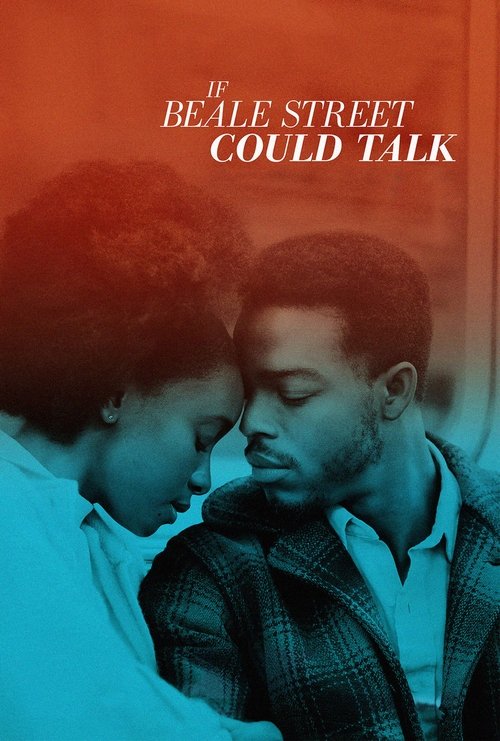
If Beale Street Could Talk (2018)
Directed by Barry Jenkins
Yes — If Beale Street Could Talk is woke, scoring 70 out of 100 on our wokeness meter.
Barry Jenkins follows Moonlight with an adaptation of James Baldwin's 1974 novel, a film that arrives wrapped in the softest possible lighting and the heaviest possible subject matter.
Consciousness Markers
The film directly confronts systemic racism, false imprisonment of Black men, and racial discrimination in housing and policing.
The film features a nearly all-Black principal cast and centers Black characters and experiences, directed by Barry Jenkins.
The narrative is driven by a pregnant Black woman's perspective and features strong female family members, though it is not explicitly framed as a feminist polemic.
The film conveys its social critiques through emotional storytelling and dialogue rather than preachy monologues, though some scenes discuss racism explicitly.
The film touches on economic hardship and the carceral system, but it does not offer a sustained anti-capitalist critique.
No LGBTQ+ themes or characters are present in the film.
There is no engagement with climate change or environmental themes.
No body positivity themes are present.
No neurodivergence themes are present.
The film is a fictional period piece, not a historical revision.
Why it received this score
Barry Jenkins follows Moonlight with an adaptation of James Baldwin's 1974 novel, a film that arrives wrapped in the softest possible lighting and the heaviest possible subject matter. A pregnant young woman named Tish watches her fiance Fonny sit in a cell for a crime we know he did not commit, and the machinery that placed him there is not subtle. Landlords who will not rent to Black couples. A police officer whose testimony is accepted at face value. A lineup in which the victim is told whom to identify. The film lays all of this out with patience and beauty, and the beauty does a great deal of the arguing. Nearly every face on screen is Black, and Jenkins photographs those faces as though they were the entire purpose of cinema, which for him they may be.
The perspective belongs to Tish, and to the women around her. Her mother flies to Puerto Rico to beg a stranger for her son-in-law's freedom. Her sister holds the family together while the men absorb their grief in bars. A matriarchal engine drives a story about a man in a cage, and it works without ever pausing to announce itself as such. The social critique lives in every frame and is rarely spoken aloud, which is its own form of restraint. When characters do discuss race, they do it in kitchens and doorways, tired, not triumphant.
There are gestures toward the economic desperation beneath the injustice, though the film cares more about love than about systems. It is a romance first. It is a Baldwin adaptation second. It is a sermon almost never. The result is a work of enormous feeling and almost no scolding, which in this decade of cinema amounts to a miracle of manners.
Analysis generated by our Consciousness Algorithm


Synopsis
After her fiance is falsely imprisoned, a pregnant African-American woman sets out to clear his name and prove his innocence.
Questions about If Beale Street Could Talk
Is If Beale Street Could Talk woke?
Yes — If Beale Street Could Talk is woke, scoring 70 out of 100 on our wokeness meter. That earns it a verdict of Woke.
What makes If Beale Street Could Talk woke?
4 of the 10 markers register at 30 or above, led by Racial Consciousness (95), Representation Casting (85) and Feminist Agenda (60). On Racial Consciousness: The film directly confronts systemic racism, false imprisonment of Black men, and racial discrimination in housing and policing.
How does If Beale Street Could Talk compare to other 2018 movies?
It ranks #10 of the 325 films from 2018 we've scored; their average is 20. The wokest is Return (92).
How is the Woke Score calculated?
An AI-assisted process researches the film and its reception, scores it 0–100 on ten markers, then combines those into one 0–100 Woke Score. It measures a specific set of 2020s cultural themes, not film quality.