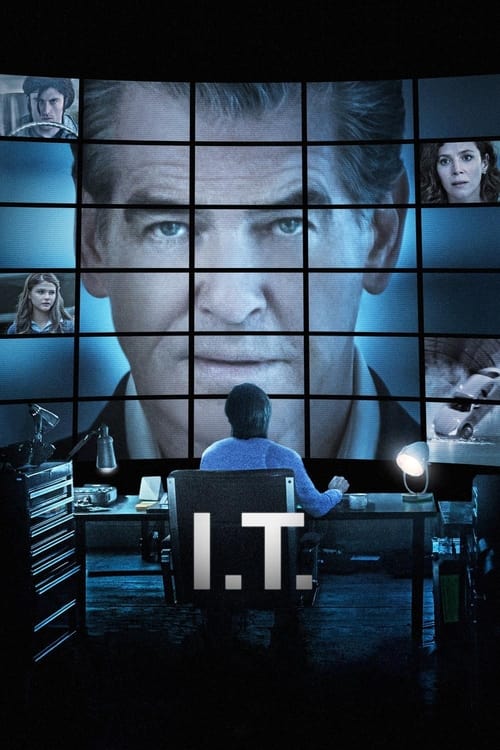
I.T. (2016)
Directed by John Moore
No — I.T. is not woke, scoring 7 out of 100 on our wokeness meter.
I.T. arrives as a 2016 thriller in which Pierce Brosnan plays an aviation tycoon whose smart home turns against him, and it conducts itself with the grim efficiency of a thermostat set to mild disapproval.
Consciousness Markers
The cast includes a Black detective (Eric Kofi Abrefa) and a Black colleague (Clare-Hope Ashitey), plus a Swedish actor, but their presence is unremarked and incidental to a story about a wealthy white family.
There is a mild hand-wringing message about surveillance and privacy in a hyper-connected smart-home world, but it is delivered through plot mechanics rather than explicit preaching.
Diverse supporting roles exist but the film never engages race as a theme; the conflict is entirely personal and technological.
The film centers on and largely celebrates a self-made aviation tycoon; the antagonist's resentment is a personal grudge, not a class critique, and the wealthy family is the sympathetic party.
The wife and daughter are purely passive victims to be stalked, filmed, and rescued; the film offers no feminist critique or agency.
No LGBTQ+ characters, themes, or subtext whatsoever.
No environmental or climate content.
No body positivity themes; the daughter's body is exploited as a tool of humiliation rather than celebrated.
The antagonist's abusive childhood and disturbed behavior are framed as villainy, not neurodivergence.
No historical revisionism; the film is a contemporary tech thriller.
Why it received this score
I.T. arrives as a 2016 thriller in which Pierce Brosnan plays an aviation tycoon whose smart home turns against him, and it conducts itself with the grim efficiency of a thermostat set to mild disapproval. The film's cultural ambitions are modest and mostly accidental. A Black detective and a Black colleague drift through the frame, unremarked, doing their jobs. A Swedish actor appears as a helpful hacker. None of this is staged as a statement, which is its own kind of honesty, and it leaves the diversity ledger looking less like a commitment and more like a casting director's quiet Tuesday.
The women fare worse. Rose and Kaitlyn exist to be stalked, filmed, gagged, and rescued, and the screenplay never once considers granting them a thought of their own. Kaitlyn's violation becomes a humiliation device, her body a lever for the villain's cruelty. The film gazes at her through the antagonist's camera and never turns the lens around to ask what she might be feeling. This is not a feminist text. It is barely a text.
Where the movie does gesture toward significance, it does so through machinery. There is a faint, foggy worry about surveillance and the connected home, a murmur that our devices might betray us, delivered by way of a car whose brakes stop working. The villain is a resentful former employee with a traumatic childhood, framed as pure menace. The tycoon is the sympathetic party, his wealth treated as a virtue. Any critique of capital here is a rumor. The result is a film that wants credit for noticing the internet exists, and earns about as much as a doorbell camera.
Analysis generated by our Consciousness Algorithm


Synopsis
Mike Regan is a successful, self-made man who has it all: a gorgeous wife, a beautiful teenage daughter and a sleek, state-of-the-art “smart home”. But he soon finds himself in a deadly, high-stakes game of cat-and-mouse when his I.T. consultant, Ed, starts using his skills to stalk Mike’s daughter and endanger his family, his business, and his life. In a world where there is no privacy, and personal secrets can go viral by the click of a mouse, Mike needs to rely on his old connections to defeat a new kind of nemesis.
Questions about I.T.
Is I.T. woke?
No — I.T. is not woke, scoring 7 out of 100 on our wokeness meter. That earns it a verdict of Ultra Based.
Does I.T. have any woke elements?
Very few. None of the 10 markers reaches 30, the level where a marker counts as present; the highest is Representation Casting at 25.
How does I.T. compare to other 2016 movies?
It ranks #190 of the 285 films from 2016 we've scored; their average is 16. The wokest is 13th (92).
How is the Woke Score calculated?
An AI-assisted process researches the film and its reception, scores it 0–100 on ten markers, then combines those into one 0–100 Woke Score. It measures a specific set of 2020s cultural themes, not film quality.