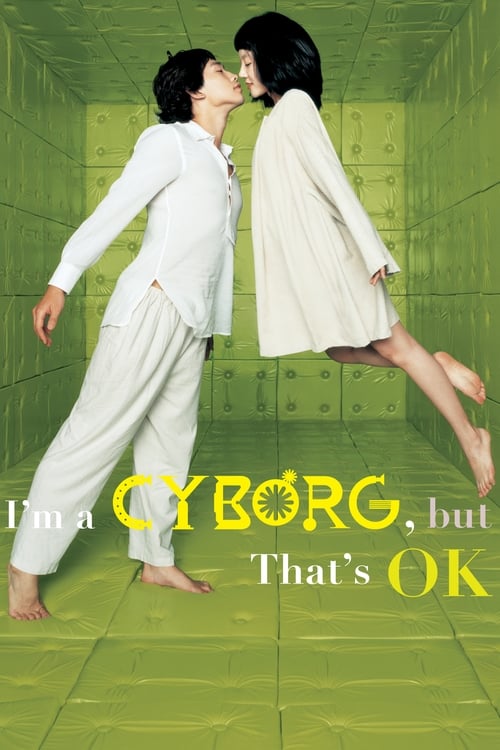
I'm a Cyborg, But That's OK (2006)
Directed by Park Chan-wook
No — I'm a Cyborg, But That's OK is not woke, scoring 12 out of 100 on our wokeness meter.
Park Chan-wook's 2006 curio arrived from a moment when the Korean director was best known for vengeance and scalpels, and it chooses instead to spend two hours inside a psychiatric ward with a young woman who believes she is a cyborg and a kleptomaniac who believes he can steal souls.
Consciousness Markers
The film is set entirely among psychiatric patients and depicts schizophrenia, delusion, and kleptomania with unusual empathy and dignity, humanizing neurodivergent characters rather than villainizing them.
Young-goon is a female protagonist with agency, but the film frames her story through mental illness and romance rather than any feminist thesis.
An all-Korean cast in a Korean production is simply the natural composition of the film's setting; there is no deliberate diverse-casting agenda at play.
Park Chan-wook favors whimsical surrealism and visual invention over didactic messaging; whatever theme about mental illness exists is shown, not preached.
Young-goon's factory job assembling radios is incidental backstory; the film contains no critique of wealth, capital, or class.
No LGBTQ+ characters, themes, or subtext appear anywhere in the film.
The film engages no racial or ethnic themes whatsoever.
There is no environmental or climate-related content; the climactic storm is a romantic set piece, not an ecological statement.
The protagonist's refusal to eat stems from a cyborg delusion, not from any body-acceptance or body-positivity message.
The film is a fictional surrealist romance with no historical revisionism.
Why it received this score
Park Chan-wook's 2006 curio arrived from a moment when the Korean director was best known for vengeance and scalpels, and it chooses instead to spend two hours inside a psychiatric ward with a young woman who believes she is a cyborg and a kleptomaniac who believes he can steal souls. The film's treatment of its patients is its most distinctive quality. They are not monsters, not punchlines, not case studies. They are roommates. Young-goon refuses food because a machine does not require it. Il-soon brushes his teeth compulsively and wears a rabbit mask he made himself. The camera observes these rituals with affection and no editorializing whatsoever. That is a genuine achievement, and it is achieved by showing, never by telling.
What the film declines to do is argue. There is no thesis about the pharmaceutical industry, no indictment of the mother who failed Young-goon, no scene in which a wise patient explains the true meaning of sanity to a chastened doctor. Her mother's neglect registers as sadness, not as a systemic complaint. The factory where Young-goon assembled radios is a fact of her biography and nothing more; the film has no interest in labor or capital. The refusal to eat, which a later decade might have recruited for a body-acceptance parable, is here simply a delusion with a body count of one. The movie is too busy being strange to be instructive.
The female protagonist has will and a plan, which is more than the genre typically allowed in 2006, though the film routes her interiority through romance and illness instead of any argument about her place in the world. The cast is Korean because the story is Korean. There is no other kind of character here, no other kind of story. What remains is a delicate, uneven, occasionally baffling romance that treats the mentally ill as people worth loving. It was, as a Korean critic later suggested, early. Being early is not the same as being preachy, and this film knows the difference.
Analysis generated by our Consciousness Algorithm
Synopsis
Young-goon, mentally deranged and frequently electro-charging herself with a transistor radio, has been admitted into a mental institution. Firmly believing herself to be a cyborg, she refuses to consume like a human being. Il-soon is another patient, who catches the eye of Young-goon and soon becomes a close friend. Il-soon is now confronted with the biggest task: to cure Young-goon's mental problem and have her eat real food.
Questions about I'm a Cyborg, But That's OK
Is I'm a Cyborg, But That's OK woke?
No — I'm a Cyborg, But That's OK is not woke, scoring 12 out of 100 on our wokeness meter. That earns it a verdict of Ultra Based.
Does I'm a Cyborg, But That's OK have any woke elements?
1 of the 10 markers register at 30 or above, led by Neurodivergence (45). On Neurodivergence: The film is set entirely among psychiatric patients and depicts schizophrenia, delusion, and kleptomania with unusual empathy and dignity, humanizing neurodivergent characters rather than villainizing them.
How does I'm a Cyborg, But That's OK compare to other 2006 movies?
It ranks #60 of the 211 films from 2006 we've scored; their average is 11. The wokest is An Inconvenient Truth (92).
How is the Woke Score calculated?
An AI-assisted process researches the film and its reception, scores it 0–100 on ten markers, then combines those into one 0–100 Woke Score. It measures a specific set of 2020s cultural themes, not film quality.