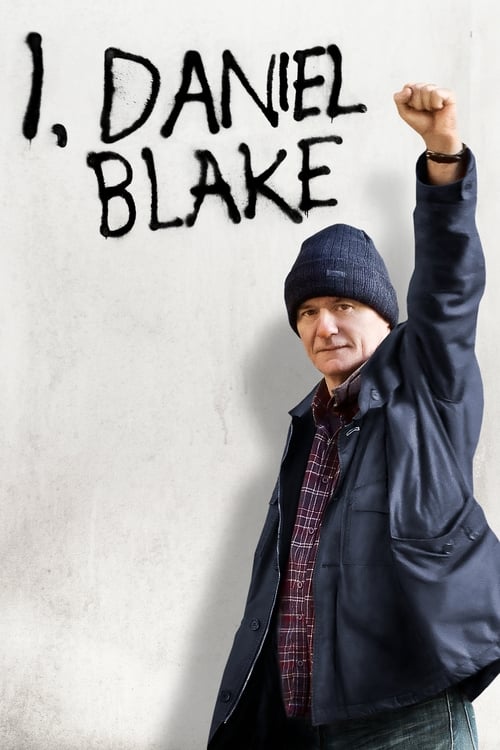
I, Daniel Blake (2016)
Directed by Ken Loach
Partly — I, Daniel Blake is somewhat woke, scoring 40 out of 100 on our wokeness meter.
Ken Loach has been making this film for fifty years and shows no intention of stopping until the last food bank shutters.
Consciousness Markers
A blistering indictment of the neoliberal welfare state, sanctions, food banks, and the dehumanizing machinery of austerity — squarely in the 'system crushes the poor' tradition.
The film is an unabashed political polemic, culminating in Daniel's posthumous eulogy speech ('I am not a blip on a computer screen... I am a man') delivered as a direct moral address to the audience.
Katie's arc as a single mother driven to sex work and hunger indicts how the system fails women, but the film frames this through class solidarity rather than an explicit feminist lens.
The cast is overwhelmingly white working-class British, with Kema Sikazwe as the notable Black supporting character 'China'; diversity is incidental rather than a stated aim.
No LGBTQ+ characters, themes, or subtext appear anywhere in the film.
The film's critique is entirely about class, austerity, and bureaucracy; race is never a subject of commentary.
No environmental or climate themes are present.
No body-positivity themes or messaging.
Daniel's lack of computer literacy is a generational/class barrier, not framed as neurodivergence.
A contemporary fictional drama with no historical revisionism.
Why it received this score
Ken Loach has been making this film for fifty years and shows no intention of stopping until the last food bank shutters. I, Daniel Blake follows a 59-year-old Newcastle joiner who survives a heart attack, fails a Work Capability Assessment he should have passed, and then spends the remainder of his life apologizing to a computer for existing. The target is not a villain but a machine: sanctions, online-only forms, work coaches reading from scripts, a welfare state rebuilt as a collections agency. This is the system-crushes-the-poor tradition, executed with the patience of a man who has read every tribunal transcript.
What the picture declines to do is as instructive as what it does. Race never becomes a subject of commentary; the cast is white working-class Britain, with Kema Sikazwe drifting through as a mate, present without annotation. Katie's descent into sex work indicts the state, though the lens stays on class solidarity instead of gender grievance. There is no environmental sermon, no body politics, no neurodivergence framing. Daniel's trouble with a mouse is generational and economic, a man defeated by a portal, not a diagnosis. Loach's sympathies are old-fashioned, rooted in labor and hunger, and they do not require the newer liturgies to make their case.
The sermonizing arrives anyway, and at full volume. Daniel spray-paints his demand on the Jobcentre wall, then delivers his eulogy from beyond the grave: not a blip on a computer screen, not a national insurance number, a man. It is a direct moral address to the audience, and it lands because the film has earned every syllable. Iain Duncan Smith called the film unfair. The producer said he lived in cloud cuckoo land. Both parties behaved exactly as the screenplay predicted, which is its own kind of review.
Analysis generated by our Consciousness Algorithm


Synopsis
A 59-year-old carpenter recovering from a heart attack befriends a single mother and her two kids as they navigate the impersonal, Kafkaesque benefits system. With equal amounts of humour, warmth and despair, the journey is heartfelt and emotional until the end.
Questions about I, Daniel Blake
Is I, Daniel Blake woke?
Partly — I, Daniel Blake is somewhat woke, scoring 40 out of 100 on our wokeness meter. That earns it a verdict of Woke-Adjacent.
What makes I, Daniel Blake woke?
2 of the 10 markers register at 30 or above, led by Eat the Rich (70) and Lecture Energy (70). On Eat the Rich: A blistering indictment of the neoliberal welfare state, sanctions, food banks, and the dehumanizing machinery of austerity — squarely in the 'system crushes the poor' tradition.
How does I, Daniel Blake compare to other 2016 movies?
It ranks #25 of the 285 films from 2016 we've scored; their average is 16. The wokest is 13th (92).
How is the Woke Score calculated?
An AI-assisted process researches the film and its reception, scores it 0–100 on ten markers, then combines those into one 0–100 Woke Score. It measures a specific set of 2020s cultural themes, not film quality.