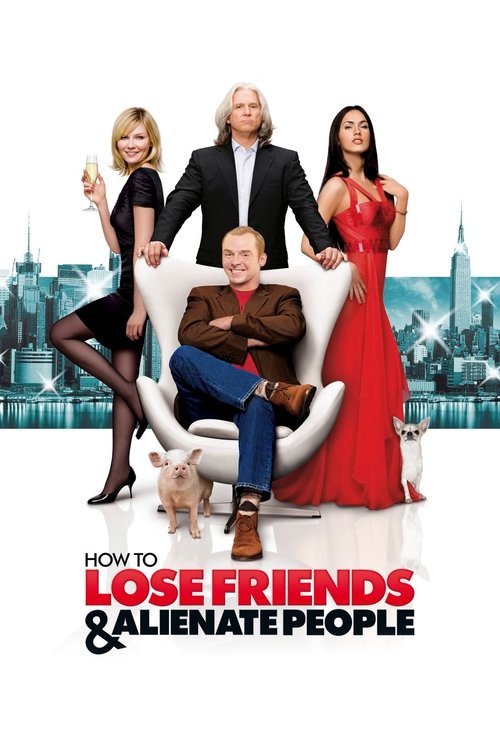
How to Lose Friends & Alienate People (2008)
Directed by Robert B. Weide
No — How to Lose Friends & Alienate People is not woke, scoring 10 out of 100 on our wokeness meter.
Robert Weide's 2008 adaptation of Toby Young's memoir arrives with a self-description attached: a testosterone-laced Devil Wears Prada.
Consciousness Markers
The film satirizes the celebrity-industrial complex, publicists, and the compromising of journalistic integrity for access, but its critique is aimed at personal vanity and media culture rather than systemic capitalism.
The cast is overwhelmingly white and British/American, with only incidental diversity such as a Thandiwe Newton cameo and Max Minghella in a supporting role; no deliberate inclusive casting agenda is present.
A transgender character (Bobbie) appears, but she is played entirely as a punchline — Sidney brings her home and then parades her to strip for his boss — which is mockery rather than affirming LGBTQ+ themes.
The film was pitched as a 'testosterone-laced' Devil Wears Prada, and its female characters are largely defined by objectification (Megan Fox's starlet) or as romantic prizes; no feminist critique is advanced.
The film gestures at a moral about selling out one's principles, but it delivers this through slapstick and farce rather than preachy sermonizing.
Race is essentially absent as a theme; the story is a white British man's culture-clash comedy in New York with no engagement with racial dynamics.
No environmental or climate content whatsoever.
The protagonist's 'general unattractiveness' is repeatedly mocked, and the film trades in conventional appearance-based humor with no body-positive messaging.
No neurodivergent characters or themes are present.
The film is a contemporary satire with no historical subject matter to revise.
Why it received this score
Robert Weide's 2008 adaptation of Toby Young's memoir arrives with a self-description attached: a testosterone-laced Devil Wears Prada. That phrase does a great deal of work, and none of it flattering. Simon Pegg plays Sidney Young, a British polemicist who stumbles into a job at a glossy New York magazine and proceeds to insult, grope, and offend his way through the celebrity-industrial complex. The film wants to be a satire of access journalism. It settles for a man falling over furniture.
On the matter of social consciousness, the ledger is thin. The cast is white, British, and well-tailored, with Thandiwe Newton appearing as herself and Max Minghella hovering at the edge of the frame. A transgender character named Bobbie turns up for a single sequence, in which Sidney brings her to the office and has her strip for his boss to obtain blackmail material. This is the film's entire engagement with trans life, and it is played for laughs. Women fare little better: Megan Fox's starlet exists to be desired, and Kirsten Dunst's Alison exists to be won. The satire aims at publicists and celebrity vanity, which is a soft target, and it never extends its contempt to the economic machinery that produces them.
There is a moral buried in the third act, something about the cost of selling your principles for a good table at the awards show. The film delivers it by having Pegg tackle a starlet on stage and confess to killing her dog. This is not sermonizing. It is farce with a conscience it cannot quite articulate. The result is a comedy that mocks the worship of fame while remaining entirely in thrall to it, a position the film never examines and possibly never notices. We are left with a modest, sour little picture that wants credit for seeing through the velvet rope while standing firmly on the correct side of it.
Analysis generated by our Consciousness Algorithm
Synopsis
Sidney Young is a down-on-his-luck journalist. Thanks to a stint involving a pig and a glitzy awards ceremony, Sidney turns his fortunes around, attracting the attention of Clayton Harding, editor of New York-based glossy magazine 'Sharps', and landing the holy grail of journalism jobs. The Brit jets off to the Big Apple and moves from one blunder to the next.
Questions about How to Lose Friends & Alienate People
Is How to Lose Friends & Alienate People woke?
No — How to Lose Friends & Alienate People is not woke, scoring 10 out of 100 on our wokeness meter. That earns it a verdict of Ultra Based.
Does How to Lose Friends & Alienate People have any woke elements?
Very few. None of the 10 markers reaches 30, the level where a marker counts as present; the highest is Eat the Rich at 20.
How does How to Lose Friends & Alienate People compare to other 2008 movies?
It ranks #98 of the 212 films from 2008 we've scored; their average is 12. The wokest is Milk (68).
How is the Woke Score calculated?
An AI-assisted process researches the film and its reception, scores it 0–100 on ten markers, then combines those into one 0–100 Woke Score. It measures a specific set of 2020s cultural themes, not film quality.