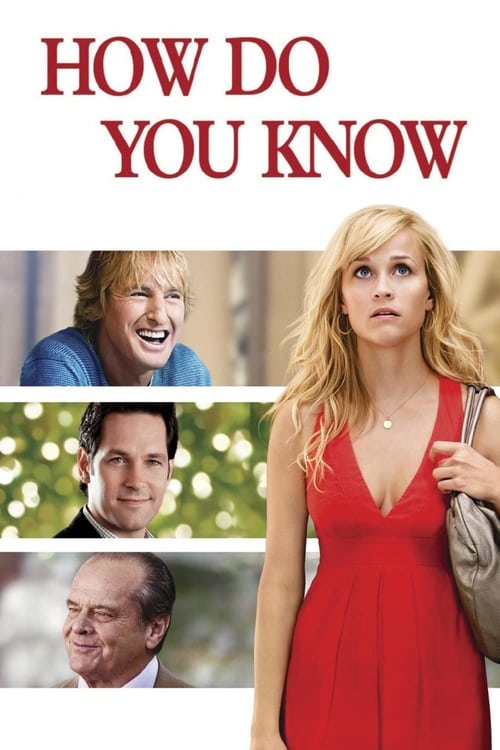
How Do You Know (2010)
Directed by James L. Brooks
No — How Do You Know is not woke, scoring 3 out of 100 on our wokeness meter.
How Do You Know arrived in December of 2010 with a hundred and twenty million dollars of studio money behind it and the quiet confidence of a director who had, at one time, been James L. Brooks.
Consciousness Markers
The protagonist is a professional female athlete, but the film uses this only as rom-com texture within a conventional love-triangle plot, with no feminist argument or critique.
The cast is a standard quartet of white Hollywood leads (Witherspoon, Rudd, Wilson, Nicholson) with no meaningful or commented-upon diversity.
No LGBTQ+ characters or themes appear anywhere in the film.
Race is entirely absent as a subject; the film is a white, affluent romantic comedy with no racial commentary.
No environmental or climate themes whatsoever.
A corporate SEC fraud subplot exists, but it is treated as personal misfortune for a sympathetic executive rather than a critique of capitalism or wealth.
No body-positivity themes; the film's concerns are romantic and professional, not about body image or acceptance.
No neurodivergent characters or themes are present.
The film is a contemporary fictional romance with no historical subject matter to revise.
A gentle, meandering James L. Brooks rom-com that preaches nothing; critics noted it lacks even a thesis, let alone a sermon.
Why it received this score
How Do You Know arrived in December of 2010 with a hundred and twenty million dollars of studio money behind it and the quiet confidence of a director who had, at one time, been James L. Brooks. What he built was a love triangle among affluent white people in Philadelphia, played by Reese Witherspoon, Paul Rudd, Owen Wilson, and Jack Nicholson, the last of whom would shortly retire from the business, presumably to avoid further assignments of this kind. The film grossed forty-eight million dollars and was later listed among the great box office failures of its era. The Los Angeles Times keeps such a list. Somebody has to.
The protagonist is a professional softball player, which the production notes treat as an act of daring. She is cut from the national team and spends the remainder of the running time deciding between two men. No argument is made about her, no critique is lodged on her behalf, and no larger point about women in sport is attempted. The corporate subplot concerns an executive wrongly accused of securities fraud, and the film's sympathies rest entirely with him, a wealthy man having a difficult quarter. Wealth is a setting here, not a subject.
There is nothing to lecture about, which is its own small mercy. No climate anxieties, no reckonings with race, no body image discourse, no neurodivergent coding, no historical revision, and no sermon of any kind, because the film has no thesis to preach. Critics at the time complained that it lacked even a point of view. That complaint stands. The picture is a long, soft, well-lit shrug, and we are left to classify it accordingly.
Analysis generated by our Consciousness Algorithm


Synopsis
After being cut from the USA softball team and feeling a bit past her prime, Lisa finds herself evaluating her life and in the middle of a love triangle, as a corporate guy in crisis competes with her current, baseball-playing beau.
Questions about How Do You Know
Is How Do You Know woke?
No — How Do You Know is not woke, scoring 3 out of 100 on our wokeness meter. That earns it a verdict of Ultra Based.
Does How Do You Know have any woke elements?
Very few. None of the 10 markers reaches 30, the level where a marker counts as present; the highest is Feminist Agenda at 5.
How does How Do You Know compare to other 2010 movies?
It ranks #186 of the 238 films from 2010 we've scored; their average is 11. The wokest is My Name Is Khan (84).
How is the Woke Score calculated?
An AI-assisted process researches the film and its reception, scores it 0–100 on ten markers, then combines those into one 0–100 Woke Score. It measures a specific set of 2020s cultural themes, not film quality.