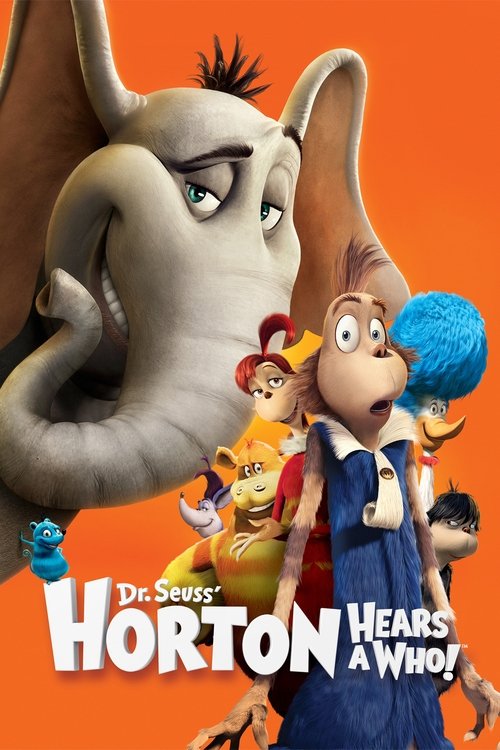
Horton Hears a Who! (2008)
Directed by Steve Martino
No — Horton Hears a Who! is not woke, scoring 6 out of 100 on our wokeness meter.
Horton Hears a Who! arrives from 2008, a CGI adaptation of Dr. Seuss's 1954 book, and it carries itself with the unbothered confidence of a children's fable that knows exactly which lessons it wants to teach.
Consciousness Markers
The film carries a clear moral about tolerance and standing up for the voiceless, but it is delivered through whimsical Seussian storytelling rather than explicit preaching.
The voice cast is overwhelmingly white, with Niecy Nash and Selena Gomez in minor supporting roles; casting reflects standard 2008 animation practice rather than any deliberate representation agenda.
The 'a person's a person, no matter how small' theme concerns size and belief in unseen worlds, not race; it is universalist humanism rather than racial consciousness.
The Sour Kangaroo is a female authority figure and Sally O'Malley is a present mother, but neither is framed through a feminist lens; the story's moral is about tolerance, not gender.
JoJo is a silent, anxious teen who eventually finds his voice through music, which could loosely read as an anxiety/selective-mutism arc, but it is framed as generic coming-of-age shyness.
The Chairman is depicted as a condescending traditionalist bureaucrat, but the film offers no critique of wealth, capitalism, or class.
Tommy Cow-Bear is described as a 'fat bear cub,' but his size is incidental comic detail rather than a body-positivity statement.
No LGBTQ+ characters, themes, or subtext of any kind appear in the film.
There is no environmental or climate messaging in the film.
The film is a fantasy fable with no historical subject matter to revise.
Why it received this score
Horton Hears a Who! arrives from 2008, a CGI adaptation of Dr. Seuss's 1954 book, and it carries itself with the unbothered confidence of a children's fable that knows exactly which lessons it wants to teach. Those lessons concern tolerance, faith in the unseen, and the moral obligation to protect the small and voiceless. The film's cultural consciousness is present but mild. Its voice cast is drawn from standard animation practice of the era, which is to say overwhelmingly white, with Niecy Nash and Selena Gomez tucked into minor supporting roles. There is no LGBTQ+ content, no climate parable, and no historical revisionism, because the story takes place in a fantastical jungle and on a dust speck, where such concerns have no purchase.
The feminist reading is thin. The Sour Kangaroo is a female authority figure, and Sally O'Malley is a present mother, but the film does not examine gender. It examines power, fear, and the herd instinct. Racial consciousness is similarly absent. The famous line about a person being a person no matter how small is universalist humanism, not a statement about race. The Chairman is a condescending traditionalist bureaucrat, yet the film never turns toward class or capitalism. Tommy Cow-Bear is called a fat bear cub, and the detail is played for incidental comedy, not body positivity. JoJo's silence and eventual musical outburst can be read as an anxiety arc, but the film frames it as ordinary coming-of-age shyness.
The lecture energy is real but gentle. Horton's defense of Whoville is a moral lesson, and the jungle's mob mentality is clearly meant to instruct. Still, the delivery is whimsical, musical, and Seussian, so the sermon never hardens into a scolding. The result is a film with a warm humanist center and very little of the modern cultural signaling that would later become a battlefield. It wants us to believe the tiny voices. It does not want to argue about representation, economics, or the climate. That restraint is not a flaw. It is simply the film's temperament, and it has aged into a curious kind of modesty.
Analysis generated by our Consciousness Algorithm


Synopsis
An imaginative elephant named Horton hears a faint cry for help coming from a tiny speck of dust floating through the air. Horton suspects there may be life on that speck and despite a surrounding community, who thinks he has lost his mind, he is determined to save the tiny particle.
Questions about Horton Hears a Who!
Is Horton Hears a Who! woke?
No — Horton Hears a Who! is not woke, scoring 6 out of 100 on our wokeness meter. That earns it a verdict of Ultra Based.
Does Horton Hears a Who! have any woke elements?
Very few. None of the 10 markers reaches 30, the level where a marker counts as present; the highest is Lecture Energy at 22.
How does Horton Hears a Who! compare to other 2008 movies?
It ranks #129 of the 212 films from 2008 we've scored; their average is 12. The wokest is Milk (68).
How is the Woke Score calculated?
An AI-assisted process researches the film and its reception, scores it 0–100 on ten markers, then combines those into one 0–100 Woke Score. It measures a specific set of 2020s cultural themes, not film quality.