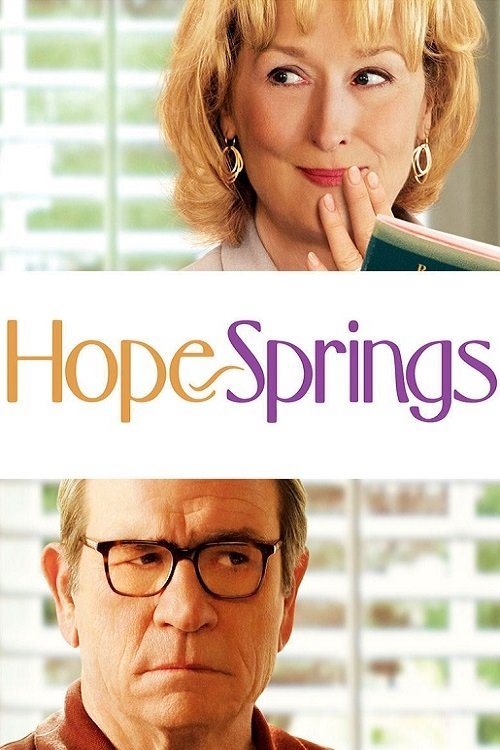
Hope Springs (2012)
Directed by David Frankel
No — Hope Springs is not woke, scoring 11 out of 100 on our wokeness meter.
Hope Springs arrives in 2012, directed by David Frankel, starring Meryl Streep, Tommy Lee Jones, Steve Carell.
Consciousness Markers
The story centers on a wife's unmet emotional and physical needs and her willingness to leave a stagnant marriage, giving a woman's interior life narrative priority, though it is framed as a mature relationship drama rather than an explicit feminist statement.
The film gently normalizes the sexuality and intimacy of older, aging bodies, treating middle-aged desire as legitimate, though this is incidental to the plot rather than an advocacy stance.
Therapy sessions provide some didactic dialogue about communication and honesty, but the film is a character-driven drama rather than a preachy social lecture.
The cast is overwhelmingly white, led by Meryl Streep, Tommy Lee Jones, and Steve Carell, with no meaningful racial or ethnic diversity in the ensemble.
There are no LGBTQ+ characters, relationships, or themes anywhere in the film.
Race is entirely absent as a subject; the film concerns a white middle-class couple and their marital troubles.
No environmental or climate themes appear in the film.
No economic critique or class-based commentary is present; the couple's struggles are purely relational.
No neurodivergent characters or themes are depicted.
The film is a contemporary relationship drama with no historical subject matter to revise.
Why it received this score
Hope Springs arrives in 2012, directed by David Frankel, starring Meryl Streep, Tommy Lee Jones, Steve Carell. A study of a long marriage gone quiet. The film treats Kay's dissatisfaction with dignity. It gives a woman's interior life narrative priority. But this is mature relationship drama, not a manifesto. The cultural markers we inventory are mostly absent. The cast is white, the concerns are domestic, and the movie has no interest in racial, economic, or environmental commentary. It is a film about a couple in Maine, and Maine remains Maine.
Where the film registers at all on our scale, it does so softly. Kay's emotional and physical needs are taken seriously, which earns a modest feminist note. The movie also treats middle-aged desire as legitimate, showing aging bodies as capable of intimacy and even passion. That is body positivity by default, not by advocacy. The therapy sessions with Dr. Feld supply the only lecture energy, as he asks frank questions about sex and communication. The dialogue can be on-the-nose, but it serves the characters. There is no LGBTQ content, no neurodivergent characterization, no revisionist history, no anti-capitalist anger. The couple's problems are relational.
The film's pleasures are performance and restraint. Streep and Jones find the ache in routine. Carell underplays the counselor. The ending is warm, conventional, and resolutely small. As a cultural document, Hope Springs is a relic of an older Hollywood mode: adult, literate, and uninterested in the progressive shibboleths that would soon dominate studio discourse. It wants us to feel for two people in a motel room. It succeeds. That is not a political achievement. It is a human achievement, which is a different ledger.
Analysis generated by our Consciousness Algorithm


Synopsis
After thirty years of marriage, a middle-aged couple attends an intense, week-long counseling session to work on their relationship.
Questions about Hope Springs
Is Hope Springs woke?
No — Hope Springs is not woke, scoring 11 out of 100 on our wokeness meter. That earns it a verdict of Ultra Based.
Does Hope Springs have any woke elements?
Very few. None of the 10 markers reaches 30, the level where a marker counts as present; the highest is Feminist Agenda at 20.
How does Hope Springs compare to other 2012 movies?
It ranks #78 of the 230 films from 2012 we've scored; their average is 12. The wokest is Killing Them Softly (92).
How is the Woke Score calculated?
An AI-assisted process researches the film and its reception, scores it 0–100 on ten markers, then combines those into one 0–100 Woke Score. It measures a specific set of 2020s cultural themes, not film quality.