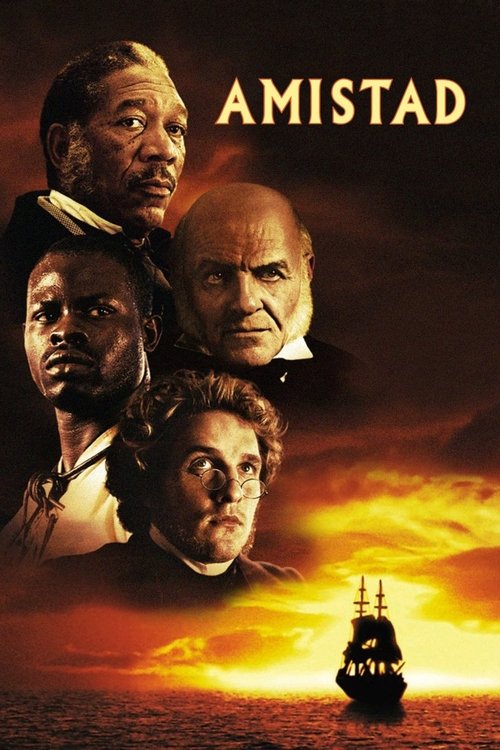
Amistad (1997)
Directed by Steven Spielberg
Yes — Amistad is woke, scoring 60 out of 100 on our wokeness meter.
The Amistad of 1997 arrives with the full Spielberg apparatus: tall ships, a John Williams score, and a legal thriller stitched into a moral reckoning.
Consciousness Markers
The film is explicitly about the transatlantic slave trade, the Middle Passage, and the legal struggle for Black freedom, making racial injustice its central subject.
Centered on African captives with a largely Black principal cast, including Djimon Hounsou's breakout as Cinqué and Morgan Freeman as a fictional Black abolitionist; however, the narrative still relies on white lawyer/savior figures.
Courtroom speeches and moral appeals about freedom and slavery give it a didactic historical-drama quality, but reviews note it avoids overt preachiness.
Based on true events but includes a fictional composite character (Joadson) and historical simplifications/anachronisms criticized by historians, though not a modern ideological rewrite.
No LGBTQ+ themes or characters are present.
No feminist agenda; women are largely absent or peripheral to the story.
No climate or environmental themes are present.
No anti-capitalist critique; the focus is on slavery and law, not economic systems.
No body positivity themes are present.
No neurodivergence themes are present.
Why it received this score
The Amistad of 1997 arrives with the full Spielberg apparatus: tall ships, a John Williams score, and a legal thriller stitched into a moral reckoning. The film puts African captives at the center of its own frame, and Djimon Hounsou's Cinqué carries the first act without a translator, without a word of English, and largely without dialogue. That is a genuine achievement. Morgan Freeman trades his usual authority for the fictional Theodore Joadson, a composite abolitionist, and the production held open auditions across three continents before casting Hounsou. Still, the rescue architecture runs through Roger Baldwin and John Quincy Adams, two white men with law degrees and a taste for speeches.
The film's central subject is the slave trade itself. The Middle Passage sequence is brief and almost unbearable, and the court case turns on whether these men are Cuban-born property or African kidnapping victims. Racial injustice is not a subplot here. It is the entire engine, and the film never pretends otherwise. The history, however, is tidied for the running time. Joadson never existed in the form Freeman gives him, and historians have objected to the framing of the case as a turning point in American attitudes toward slavery, when it concerned only the already outlawed Atlantic trade. A whistle-stop campaign appears twenty years early. These are dramatic conveniences, not an ideological rewrite of the record.
The speeches carry some sermon weight, though most reviewers found the film heartfelt without tipping into preachiness. The rest of the ledger sits empty. There is no environmental concern, no economic critique of the system that commodified human beings, no body politics, and no interest in neurodivergence. Women appear at the edges and stay there. What we are left with is a serious, well-mounted historical drama about a grave subject, which is not the same thing as a film carrying modern progressive sensibilities. It wants to move us. It mostly does.
Analysis generated by our Consciousness Algorithm


Synopsis
In 1839, the slave ship Amistad set sail from Cuba to America. During the long trip, Cinque leads the slaves in an unprecedented uprising. They are then held prisoner in Connecticut, and their release becomes the subject of heated debate. Freed slave Theodore Joadson wants Cinque and the others exonerated and recruits property lawyer Roger Baldwin to help his case. Eventually, John Quincy Adams also becomes an ally.
Questions about Amistad
Is Amistad woke?
Yes — Amistad is woke, scoring 60 out of 100 on our wokeness meter. That earns it a verdict of Woke.
What makes Amistad woke?
4 of the 10 markers register at 30 or above, led by Racial Consciousness (85), Representation Casting (70) and Lecture Energy (45). On Racial Consciousness: The film is explicitly about the transatlantic slave trade, the Middle Passage, and the legal struggle for Black freedom, making racial injustice its central subject.
How does Amistad compare to other 1997 movies?
It ranks #2 of the 109 films from 1997 we've scored; their average is 12. The wokest is Happy Together (65).
How is the Woke Score calculated?
An AI-assisted process researches the film and its reception, scores it 0–100 on ten markers, then combines those into one 0–100 Woke Score. It measures a specific set of 2020s cultural themes, not film quality.