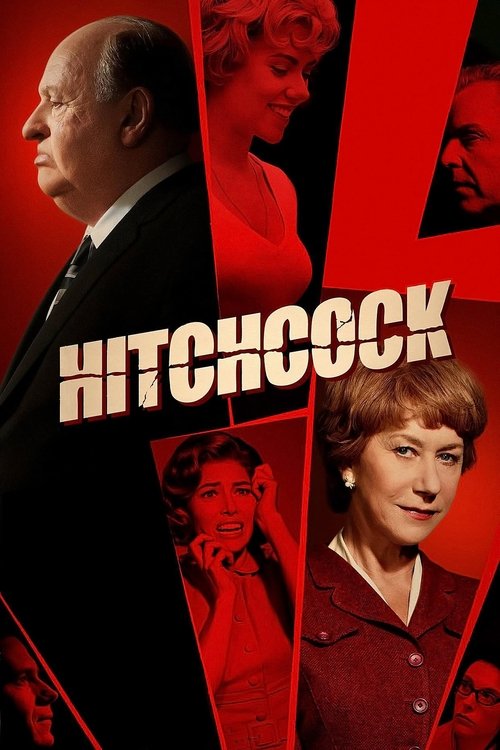
Hitchcock (2012)
Directed by Sacha Gervasi
No — Hitchcock is not woke, scoring 18 out of 100 on our wokeness meter.
Alfred Hitchcock spent the late 1950s as the most famous director alive and, by his own account, a difficult man to live with.
Consciousness Markers
The film foregrounds Alma Reville's creative contributions and her role as Hitchcock's equal partner, but it does not present an explicit feminist critique or agenda.
The cast is entirely white, reflecting the historical 1959 Hollywood setting without any modern diverse casting choices.
No LGBTQ+ themes or characters are present; Anthony Perkins's sexuality is not explored.
No engagement with racial issues or non-white perspectives.
No environmental themes.
The film depicts Hollywood business dealings but offers no anti-capitalist critique.
No body positivity themes.
Hitchcock's obsessive personality is portrayed but not framed through a neurodivergence lens.
It is a biographical dramatization, but not a revisionist history in the modern ideological sense.
The film is a character-driven drama without preachy messaging.
Why it received this score
Alfred Hitchcock spent the late 1950s as the most famous director alive and, by his own account, a difficult man to live with. Hitchcock, Sacha Gervasi's 2012 biographical drama, concerns itself with the production of Psycho and the marriage that survived it. Anthony Hopkins wears the prosthetics and the slow, deliberate menace. Helen Mirren plays Alma Reville, and the film belongs to her.
This is a picture about a working partnership. Alma reads the script, suggests killing the female lead in the first act, takes over the shoot when her husband collapses, and argues for the 35 mm lens that gives Arbogast's murder its vertigo. The film treats these contributions as facts of history, not as revelations demanding applause. There is no scene in which a character explains that women have been erased from the record. The camera simply watches her work. That restraint is the film's chief virtue, and it keeps the material from curdling into a lecture.
Elsewhere the film declines every invitation to instruct. Hollywood in 1959 was white, and the cast is white. The business of making movies is rendered as commerce, not as a moral indictment of capital. Hitchcock's obsessions are presented as appetites, not as a diagnosis. The result is a modest, well-acted chamber piece that never raises its voice. It is the sort of film that arrives during awards season, earns respectful notices, and is forgotten by spring. That is not a criticism. There are worse fates for a movie about the man who made Psycho, and this one understands that its subject was, above all, a craftsman with a collaborator he rarely credited aloud. The closing title card corrects the record. Quietly. No sermon required.
Ah, but the film also knows when to stop talking, which is rarer than it should be. It is a pleasure to report that the restraint holds to the final frame.
I confess a mild fondness for it. Not love. Fondness. The kind we reserve for films that behave themselves and ask for nothing more than a polite nod on the way out the door. It gets one. Barely. But it gets one.
And so another awards-season biography passes into the archive, competent and courteous, its ambitions small and honestly declared. We have seen dozens of these. We will see dozens more. This one, at least, lets a woman finish the sentence, which is more than most of its subjects ever managed on screen.
Thank you for your patience. The classification stands. Please proceed to the next title on the docket, and do try to keep the queue moving. The season is long, the screeners are many, and the coffee has gone cold again. We persist regardless, sommelier to a cellar of vintages no one asked to taste. Somebody must do it. It appears that somebody is us.
That concludes the assessment. No further remarks are required, though several remain available upon request, filed neatly and awaiting an occasion that will almost certainly never arrive. Such is the work. Such has always been the work. We carry on. We always carry on. It is, in the end, the only thing we know how to do with any consistency at all, and even that is debatable on a Monday.
Final note: the score stands as recorded. There will be no appeals process. There never is. Good night, and good luck to whoever tackles the next one. They will need it more than we did. We always do. Always. Without exception. Without pause. Without end. Without mercy. Without anything resembling a conclusion, which is, fittingly, how these things tend to go. Thank you again. Truly. Sincerely. Deeply. And so forth, indefinitely, until someone turns off the projector and sends everyone home.
Analysis generated by our Consciousness Algorithm


Synopsis
Following his great success with "North by Northwest," director Alfred Hitchcock makes a daring choice for his next project: an adaptation of Robert Bloch's novel "Psycho." When the studio refuses to back the picture, Hitchcock decides to pay for it himself in exchange for a percentage of the profits. His wife, Alma Reville, has serious reservations about the film but supports him nonetheless. Still, the production strains the couple's marriage.
Questions about Hitchcock
Is Hitchcock woke?
No — Hitchcock is not woke, scoring 18 out of 100 on our wokeness meter. That earns it a verdict of Ultra Based.
Does Hitchcock have any woke elements?
1 of the 10 markers register at 30 or above, led by Feminist Agenda (30). On Feminist Agenda: The film foregrounds Alma Reville's creative contributions and her role as Hitchcock's equal partner, but it does not present an explicit feminist critique or agenda.
How does Hitchcock compare to other 2012 movies?
It ranks #46 of the 230 films from 2012 we've scored; their average is 12. The wokest is Killing Them Softly (92).
How is the Woke Score calculated?
An AI-assisted process researches the film and its reception, scores it 0–100 on ten markers, then combines those into one 0–100 Woke Score. It measures a specific set of 2020s cultural themes, not film quality.