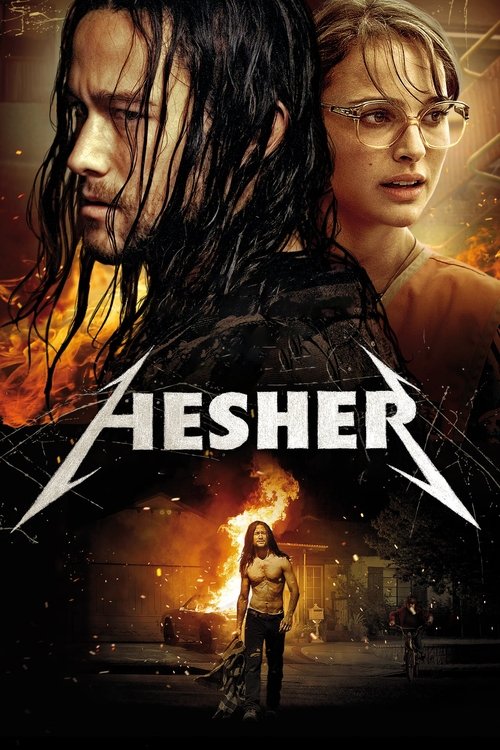
Hesher (2010)
Directed by Spencer Susser
No — Hesher is not woke, scoring 0 out of 100 on our wokeness meter.
Hesher arrives from 2010 with the confidence of a film that has nothing to sell.
Consciousness Markers
The cast is overwhelmingly white, with no meaningful representation casting choices or diverse ensemble assembled for the film.
There are no LGBTQ+ characters, themes, or subtext anywhere in the film.
Natalie Portman's Nicole functions as a love interest and object of T.J.'s crush; the film advances no feminist agenda or commentary.
The film engages no racial themes or consciousness whatsoever.
There is no environmental or climate-related content in the film.
Nicole's financial troubles are a minor plot point, but the film offers no anti-capitalist or eat-the-rich critique.
The film contains no body positivity themes or messaging.
No neurodivergence is depicted or addressed in the film.
The film is a fictional narrative and makes no revisionist historical claims.
Hesher's funeral monologue is a personal, crude anecdote about loss rather than a social-issue lecture; the film preaches nothing.
Why it received this score
Hesher arrives from 2010 with the confidence of a film that has nothing to sell. A boy named T.J. loses his mother in a car crash. His father dissolves into pills. His grandmother dies quietly in her chair. Into this house walks a foul-smelling metalhead who sleeps on the couch, sets a tow truck driver's car on fire, and offers no wisdom whatsoever. The cast is white, the setting is a Los Angeles suburb, and the film's concerns are entirely domestic. Nobody in this story is assembled to represent anyone.
Consider the funeral. Hesher, drunk, delivers a monologue about the time he blew up a gas tank and lost a testicle, then explains that he spent so long mourning the testicle that he forgot he still had another one, plus a working penis. It is a crude, intimate, oddly effective piece of consolation. It is not a lecture. The film contains no lecture. Nicole, the grocery clerk played by Natalie Portman, has money problems, and the screenplay treats them as money problems, not as evidence of a broken system. Nothing is diagnosed. Nothing is prescribed.
There is a kind of relief in a film this indifferent to instruction. It premiered at Sundance, collected mixed reviews, and lost money. It has no sequel, no franchise, no message. The title character was modeled on Metallica's late bassist, a detail the film offers without comment. It offers Joseph Gordon-Levitt committing fully to a greasy, unlikable creation, and a final image of spray paint on a roof. We are left to classify it, and the classification is simple: a small, sad, funny film about grief, made before anyone expected movies to teach.
Analysis generated by our Consciousness Algorithm


Synopsis
A young boy has lost his mother and is losing touch with his father and the world around him. Then he meets Hesher who manages to make his life even more chaotic.
Questions about Hesher
Is Hesher woke?
No — Hesher is not woke, scoring 0 out of 100 on our wokeness meter. That earns it a verdict of Ultra Based.
Does Hesher have any woke elements?
No. All 10 markers score zero.
How does Hesher compare to other 2010 movies?
It ranks #204 of the 238 films from 2010 we've scored; their average is 11. The wokest is My Name Is Khan (84).
How is the Woke Score calculated?
An AI-assisted process researches the film and its reception, scores it 0–100 on ten markers, then combines those into one 0–100 Woke Score. It measures a specific set of 2020s cultural themes, not film quality.