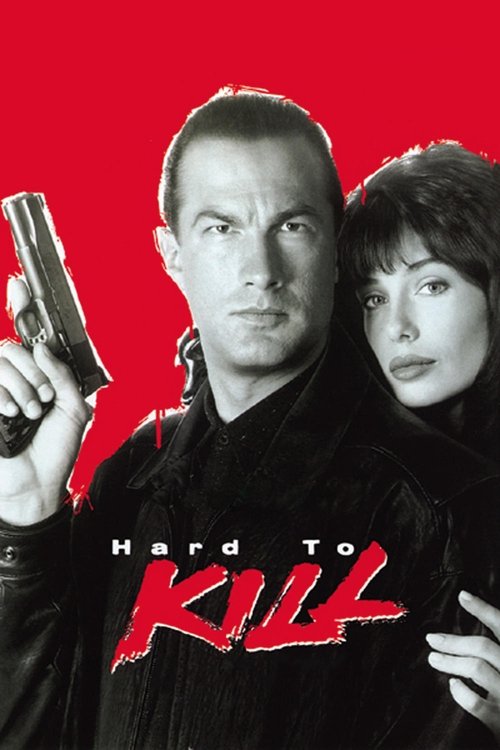
Hard to Kill (1990)
Directed by Bruce Malmuth
No — Hard to Kill is not woke, scoring 3 out of 100 on our wokeness meter.
Hard to Kill arrives from 1990 with the confidence of a man who has just discovered acupuncture.
Consciousness Markers
The cast is overwhelmingly white, with only minor supporting players (Lou Beatty Jr., Branscombe Richmond) providing any diversity, and the film makes no comment on it whatsoever.
No LGBTQ+ characters, themes, or subtext of any kind appear in this 1990 vigilante action film.
The wife is fridged in the opening act to motivate the hero, and the female lead (Kelly LeBrock) functions as a nurse/helper and romantic reward. No feminist framework is present.
Corruption is framed purely as individual villainy by a senator and his henchmen; there is no engagement with race, systemic injustice, or racial consciousness.
No environmental or climate themes appear anywhere in the film.
The villain is a corrupt politician, not a capitalist class; the film's politics are standard law-and-order revenge fantasy rather than economic critique.
No body positivity themes; the hero's atrophied physique is treated as a temporary obstacle to be overcome through training, not as a subject of acceptance.
The coma and recovery are framed as physical rehabilitation and mystical discipline, not as neurodivergence or mental health representation.
A straightforward revenge narrative with no historical revisionism or reframing of established events.
The film delivers its revenge fantasy through fists and pool cues rather than speeches; there is no didactic messaging or moralizing.
Why it received this score
Hard to Kill arrives from 1990 with the confidence of a man who has just discovered acupuncture. Steven Seagal plays Mason Storm, a detective who records a corrupt senator on videotape, loses his wife to a hit squad, and spends seven years in a coma before waking to seek vengeance. The film is a revenge machine, oiled and functional, and it holds no interest in anything resembling contemporary social consciousness. The wife exists for roughly eleven minutes, most of them posthumous, which is the sort of narrative economy that would keep a modern audience relations department occupied for a fiscal quarter. The film does not care, and neither, apparently, did 1990.
The supporting cast is a study in demographic uniformity. A few minority performers appear in small roles, and the film offers no remark on their presence, which is either refreshing or merely indifferent. Kelly LeBrock's nurse begins as a caregiver and ends as a romantic acquisition, a trajectory the screenplay treats as inevitable. The villain is a senator, which locates the film's anxieties in political corruption instead of economic structure. There is no class critique here, only the firm belief that a broken pool cue applied to the correct neck resolves most institutional problems.
The coma remains. Storm's atrophied body is not a subject for acceptance or accommodation. It is an obstacle, and he dismantles it with meditation, needles, and sheer application. That is not representation of any kind. It is a training montage. The film preaches nothing. It has no speeches, no moral instruction, no lesson about the way we live now. It has a man, a grievance, and a billiard room. In an era of relentless sermonizing, there is something almost restful about a picture that solves its problems with furniture. The classification is straightforward, and the ledger is nearly empty. Some vintages are simply quiet. This one is silent, and it punches a man in the throat on the way out.
Thematic tags: box_office_number_one.
Analysis generated by our Consciousness Algorithm
Part of


Synopsis
Mason Storm, a 'go it alone' cop, is gunned down at home. The intruders kill his wife, and think they've killed both Mason and his son too. Mason is secretly taken to a hospital where he spends several years in a coma. His son meanwhile is growing up thinking his father is dead. When Mason wakes up, everyone is in danger - himself, his son, his best friend, his nurse - but most of all those who arranged for his death
Questions about Hard to Kill
Is Hard to Kill woke?
No — Hard to Kill is not woke, scoring 3 out of 100 on our wokeness meter. That earns it a verdict of Ultra Based.
Does Hard to Kill have any woke elements?
Very few. None of the 10 markers reaches 30, the level where a marker counts as present; the highest is Representation Casting at 8.
How does Hard to Kill compare to other 1990 movies?
It ranks #46 of the 68 films from 1990 we've scored; their average is 9. The wokest is Nightbreed (60).
How is the Woke Score calculated?
An AI-assisted process researches the film and its reception, scores it 0–100 on ten markers, then combines those into one 0–100 Woke Score. It measures a specific set of 2020s cultural themes, not film quality.