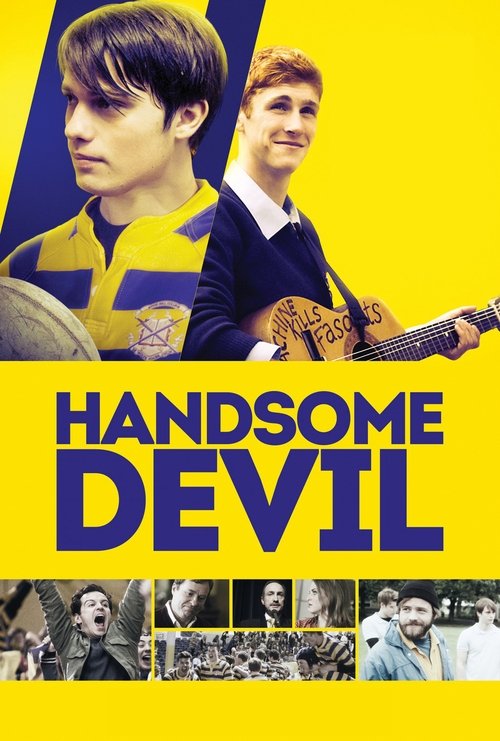
Handsome Devil (2017)
Directed by John Butler
Yes — Handsome Devil is woke, scoring 60 out of 100 on our wokeness meter.
Handsome Devil arrives from Ireland carrying the familiar luggage of the coming-of-age drama: an elite all-boys boarding school, a rugby-mad student body, and a sensitive outcast who would rather listen to music.
Consciousness Markers
Homosexuality and homophobia are central to the plot, including a gay protagonist, a closeted rugby star, and a gay teacher navigating an oppressive school culture.
The film carries clear messages about tolerance, homophobia, and being true to oneself, culminating in an explicit speech about being gay and a good rugby player.
The film centers gay characters and experiences, but its cast is otherwise uniformly white and male-dominated, with limited broader representation.
The film critiques toxic masculinity and homophobic rugby culture, but it is set in an all-boys school and offers little female perspective or feminist framing.
It mildly critiques the snobbery and hypocrisy of an elite private school system, but this is not framed as an economic or anti-capitalist argument.
There is no meaningful engagement with race or racial identity in the film.
The film contains no climate or environmental themes.
The film does not address body image or body positivity.
There is no exploration of neurodivergence or neurodiverse identity.
The story is inspired by the director's school experiences, but it does not revise or reinterpret historical events.
Why it received this score
Handsome Devil arrives from Ireland carrying the familiar luggage of the coming-of-age drama: an elite all-boys boarding school, a rugby-mad student body, and a sensitive outcast who would rather listen to music. John Butler directs with a light touch, and the film is charming in the way that well-worn things often are. It also has something on its mind. Homosexuality sits at the center of the narrative, from Ned's quiet self-possession to Conor's closeted panic to the English teacher Mr Sherry, who is discovered at a gay bar and subsequently reported to the headmaster by a coach who fears his influence. The film treats this material with genuine stakes, and the central friendship is rendered without sentimentality. On the matter of social consciousness, this is a film with a clear and specific project: to argue that a young man can be gay and still be good at rugby. It says so out loud, more than once, usually at a stadium.
The representation on offer is narrow. The cast is white, the school is male, and the handful of female characters exist mostly to be mothers or, in one case, a sympathetic presence with limited screen time. There is no engagement with race. The film's critique of the private school system glances at snobbery and hypocrisy, though it never builds toward an economic argument, and the target is the institution's manners, not its money. Body image, neurodiversity, and the natural world are absent concerns.
The messaging, however, is not subtle. The final act assembles the team, the coach, and the closeted star for an explicit declaration of principle, and the film is better for its conviction even as the seams show. It is a decent film about a specific injustice, delivered with warmth and a firm hand on the shoulder. The hand stays there a beat too long.
Analysis generated by our Consciousness Algorithm


Synopsis
A music-mad 16-year-old outcast at a rugby-mad boarding school forms an unlikely friendship with his dashing new roommate.
Questions about Handsome Devil
Is Handsome Devil woke?
Yes — Handsome Devil is woke, scoring 60 out of 100 on our wokeness meter. That earns it a verdict of Woke.
What makes Handsome Devil woke?
3 of the 10 markers register at 30 or above, led by LGBTQ+ Themes (88), Lecture Energy (45) and Representation Casting (30). On LGBTQ+ Themes: Homosexuality and homophobia are central to the plot, including a gay protagonist, a closeted rugby star, and a gay teacher navigating an oppressive school culture.
How does Handsome Devil compare to other 2017 movies?
It ranks #18 of the 309 films from 2017 we've scored; their average is 19. The wokest is I Am Not Your Negro (92).
How is the Woke Score calculated?
An AI-assisted process researches the film and its reception, scores it 0–100 on ten markers, then combines those into one 0–100 Woke Score. It measures a specific set of 2020s cultural themes, not film quality.