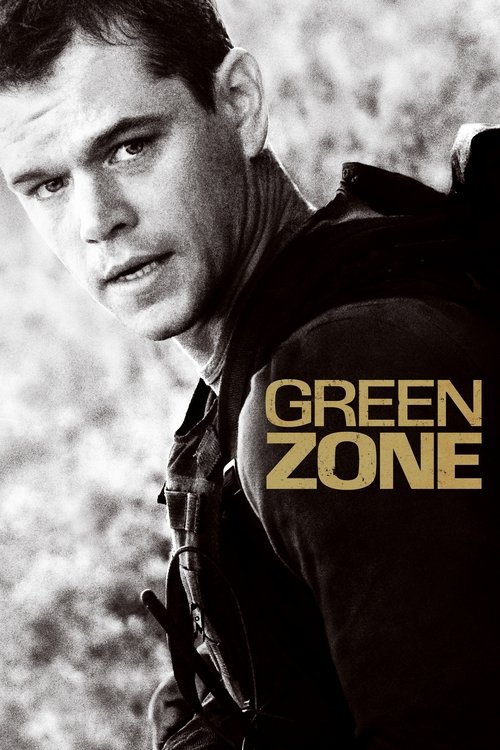
Green Zone (2010)
Directed by Paul Greengrass
Partly — Green Zone is somewhat woke, scoring 40 out of 100 on our wokeness meter.
Paul Greengrass's Green Zone arrives with the sober weight of a congressional hearing and the handheld urgency of a Bourne sequel.
Consciousness Markers
The film dramatizes a revisionist account of the Iraq War's casus belli, asserting that WMD intelligence was fabricated to justify invasion and that the media amplified it. It is adapted from Rajiv Chandrasekaran's non-fiction book and real figures like 'Curveball.'
Greengrass explicitly framed the film as an intervention in the national conversation about the Iraq War, and the ending has Miller email his report to news agencies worldwide as a lesson on truth and accountability. The message is delivered through a thriller chassis rather than a soapbox.
The film casts Middle Eastern and North African actors (Khalid Abdalla, Said Faraj, Raad Rawi, Igal Naor) in the Iraqi roles, and gives the Iraqi character Freddy real agency and the film's final moral word. This is largely accurate casting for the setting rather than a deliberate diversity initiative.
The film critiques the American occupation, the treatment of Iraqis as puppets, and the disbanding of the Iraqi army, culminating in Freddy's rebuke that Iraqis decide their own fate. This is anti-imperialist political consciousness rather than a domestic racial-justice agenda.
The film indicts government deception and the machinery of war, but its target is political manipulation and the military-industrial apparatus rather than capitalism or class inequality as such.
Amy Ryan's journalist Lawrie Dayne is a substantive character, but the film is a male-dominated military thriller with no feminist framing or commentary on gender.
No LGBTQ+ characters, themes, or subtext appear anywhere in the film.
No environmental or climate themes are present; the conflict is entirely about WMD intelligence and political cover-up.
Freddy's amputated leg is a war wound used for character and pathos, not a body-positivity statement.
No neurodivergent characters or themes are depicted.
Why it received this score
Paul Greengrass's Green Zone arrives with the sober weight of a congressional hearing and the handheld urgency of a Bourne sequel. The film follows Chief Warrant Officer Roy Miller as he discovers that the intelligence justifying the Iraq invasion was less a mistake than a construction. Greengrass treats this as a national conversation, which means the thriller machinery is always carrying a message in its satchel. The result is a war picture that wants to be both a chase and a correction of the record. It succeeds at the chase more often than the correction.
The film's account of fabricated WMD evidence and a credulous press is a revisionist exercise with a straight face, adapted from Rajiv Chandrasekaran's nonfiction book and peopled with figures who resemble real officials and informants. It is history with a screenplay's sharp elbows. The Iraqi roles are filled with Middle Eastern and North African actors, and Freddy, the veteran who loses a leg and later takes the film's final moral action, is given genuine agency. That agency lands as narrative decency, not a diversity campaign. The film's political consciousness is anti-imperialist: it indicts the occupation, the treatment of Iraqis as puppets, and the disbanding of the army. This is not a domestic racial-justice sermon, and the film does not pretend otherwise.
Amy Ryan's journalist has substance, but the film remains a male-dominated military thriller with no real gender argument. The target of its anger is government deception and the war apparatus, not capital as such. There is no climate crusade, no LGBTQ material, no body-positivity statement in Freddy's amputation, and no neurodivergent thread. The film closes as a lecture delivered through gunfire and edits, an intervention in the national conversation that ends with an email to news agencies worldwide. The sermon is there, but the chassis is loud enough to drown out some of the preaching.
Analysis generated by our Consciousness Algorithm
Part of


Synopsis
During the U.S.-led occupation of Baghdad in 2003, Chief Warrant Officer Roy Miller and his team of Army inspectors are dispatched to find weapons of mass destruction believed to be stockpiled in the Iraqi desert. Rocketing from one booby-trapped and treacherous site to the next, the men search for deadly chemical agents but stumble instead upon an elaborate cover-up that threatens to invert the purpose of their mission.
Questions about Green Zone
Is Green Zone woke?
Partly — Green Zone is somewhat woke, scoring 40 out of 100 on our wokeness meter. That earns it a verdict of Woke-Adjacent.
What makes Green Zone woke?
4 of the 10 markers register at 30 or above, led by Revisionist History (60), Lecture Energy (45) and Racial Consciousness (35). On Revisionist History: The film dramatizes a revisionist account of the Iraq War's casus belli, asserting that WMD intelligence was fabricated to justify invasion and that the media amplified it.
How does Green Zone compare to other 2010 movies?
It ranks #11 of the 238 films from 2010 we've scored; their average is 11. The wokest is My Name Is Khan (84).
How is the Woke Score calculated?
An AI-assisted process researches the film and its reception, scores it 0–100 on ten markers, then combines those into one 0–100 Woke Score. It measures a specific set of 2020s cultural themes, not film quality.