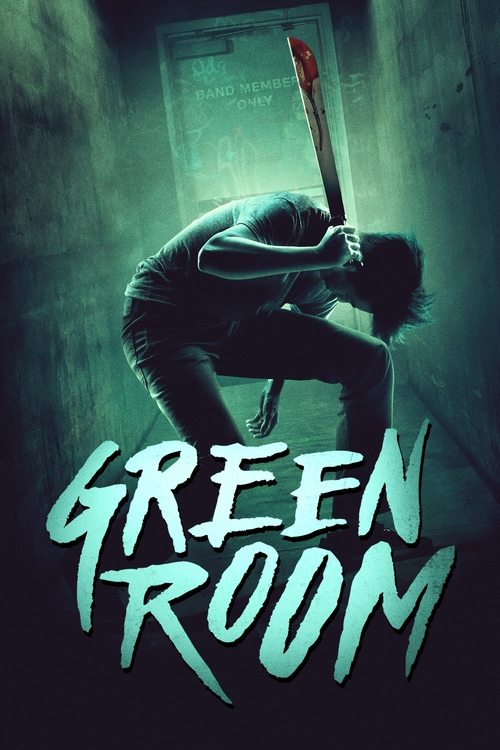
Green Room (2016)
Directed by Jeremy Saulnier
No — Green Room is not woke, scoring 16 out of 100 on our wokeness meter.
Jeremy Saulnier's Green Room arrives with a premise that sounds engineered for a seminar and an execution that is anything but.
Consciousness Markers
The antagonists are explicitly neo-Nazi white supremacists, making race a central conflict. However, the film is a survival thriller rather than an exploration of systemic racism or racial justice.
Amber and Sam are capable women who fight and survive, but the film offers no explicit feminist critique or agenda. Their strength is a genre convention, not a statement.
The cast is predominantly white, though Alia Shawkat, an actor of Iraqi descent, plays a band member. The film makes no narrative point of this diversity, treating it as incidental.
The film clearly condemns neo-Nazism through its villains, but it delivers this through genre violence rather than preachy monologues or lectures.
No LGBTQ+ characters, themes, or subtext are present.
No environmental or climate-related themes appear.
The villains run a criminal drug operation, but the film contains no critique of capitalism or economic inequality.
No body positivity themes or diverse body representation are present.
No neurodivergent characters or themes are depicted.
The film is a fictional thriller with no historical revisionism.
Why it received this score
Jeremy Saulnier's Green Room arrives with a premise that sounds engineered for a seminar and an execution that is anything but. A punk band plays a skinhead bar in the Oregon woods, witnesses a murder, and spends the rest of the runtime trying not to be killed. The villains are neo-Nazis, which puts race at the center of the conflict, and the film never pretends otherwise. Yet the ideology is scenery, not argument. These are white supremacists as a logistical hazard, a hostile terrain with swastikas on the wall. The movie has no interest in diagnosing American racism. It wants to get four musicians out of a locked room, and it pursues that goal with a fire extinguisher and a box cutter.
The cast includes Alia Shawkat, an actor of Iraqi descent, among an otherwise white ensemble, and the film makes no narrative point of it whatsoever. She is a band member who happens to be there, which is the least a film can do and, in 2015, still counted as something. Imogen Poots's Amber is the more instructive case. She fights, survives, and cuts a man open to confirm he is dead, all without a single speech about her place in the world. That is capability as genre convention, not as statement. The picture condemns neo-Nazism the only way it knows how, by having its heroes kill them one at a time. No monologue required.
Elsewhere the cupboard is bare. No LGBTQ characters or subtext. No environmental concern. No economic critique, since the villains run a drug operation and the film views them as predators instead of capitalists. No body diversity, no neurodivergent figures, no revisionist history. That leaves a lean and genuinely vicious piece of craft, ninety minutes of pressure and arterial spray, with a moral position that amounts to: these people are bad, and they should lose. A reasonable position. It is also not a lecture, and the film knows better than to give one.
Analysis generated by our Consciousness Algorithm


Synopsis
Members of a punk rock band and a tough young woman are forced to fight for survival after witnessing an act of violence at a skinhead bar.
Questions about Green Room
Is Green Room woke?
No — Green Room is not woke, scoring 16 out of 100 on our wokeness meter. That earns it a verdict of Ultra Based.
Does Green Room have any woke elements?
1 of the 10 markers register at 30 or above, led by Racial Consciousness (30). On Racial Consciousness: The antagonists are explicitly neo-Nazi white supremacists, making race a central conflict.
How does Green Room compare to other 2016 movies?
It ranks #102 of the 285 films from 2016 we've scored; their average is 16. The wokest is 13th (92).
How is the Woke Score calculated?
An AI-assisted process researches the film and its reception, scores it 0–100 on ten markers, then combines those into one 0–100 Woke Score. It measures a specific set of 2020s cultural themes, not film quality.