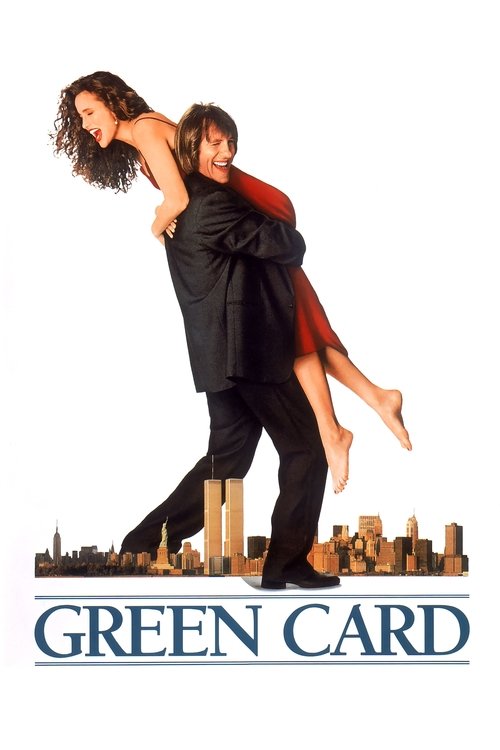
Green Card (1990)
Directed by Peter Weir
No — Green Card is not woke, scoring 8 out of 100 on our wokeness meter.
Peter Weir's Green Card arrives from 1990, a year in which a romantic comedy could still be assembled from a Frenchman, an apartment, and a federal immigration interview.
Consciousness Markers
Brontë is characterized as an environmentalist obsessed with plants, and a subplot involves donating trees to inner-city gardens, but this is gentle gardening enthusiasm rather than a climate crusade.
Brontë is an independent career woman with her own professional ambitions as a horticulturalist, but the film remains a traditional opposites-attract romance with no feminist critique.
The environmentalist characterization is present but never preachy; the film is a breezy romantic comedy that avoids moralizing.
The cast is overwhelmingly white, led by Andie MacDowell and Gérard Depardieu, with no meaningful racial or ethnic diversity casting choices.
There are no LGBTQ+ characters, themes, or subtext anywhere in this conventional heterosexual romance.
The film engages no racial themes whatsoever; the inner-city garden subplot is framed around plants and community, not race.
No critique of wealth, capitalism, or class structures; the plot's conflicts are personal and romantic.
No body positivity themes or messaging present.
No neurodivergent characters or themes are depicted.
The film is an original contemporary story with no historical revisionism.
Why it received this score
Peter Weir's Green Card arrives from 1990, a year in which a romantic comedy could still be assembled from a Frenchman, an apartment, and a federal immigration interview. Gérard Depardieu plays Georges Fauré, a waiter whose visa is expiring. Andie MacDowell plays Brontë Parrish, a horticulturalist who requires a husband on paper to secure the lease of her dreams. The arrangement is fraudulent, the chemistry is eventual, and the enterprise coasts on charm for ninety minutes. Weir wrote the role specifically to introduce Depardieu to English-speaking audiences, and the film carries the relaxed confidence of a director who knows the machinery works.
The social content is thin, and the film seems content to leave it that way. Brontë keeps a greenhouse, frets about trees, and helps arrange a donation of plants to inner-city gardens overseen by the Green Guerrillas. This is gardening as character texture, not as sermon. She has a career and opinions and an apartment she wants badly enough to commit a crime for, which registers as a mild, pre-arranged independence. Nobody lectures. Nobody is corrected. The immigration agents are bureaucratic obstacles, not villains, and the nearest thing to a thesis is that opposites can share a piano bench.
What remains is a potato chip of a movie, to borrow a critic's phrase, and it knows it. The pleasures are Depardieu's ungovernable warmth and MacDowell's composure, set against Enya on the soundtrack and a New York that exists mostly indoors. It is pleasant, weightless, and entirely untroubled by the cultural questions we now insist on asking of everything. A relic, then. A genial one.
Analysis generated by our Consciousness Algorithm


Synopsis
Urban horticulturalist Brontë Mitchell has her eye on a gorgeous apartment, but the building's board will rent it only to a married couple. Georges Fauré, a waiter from France whose visa is expiring, needs to marry an American woman to stay in the country. Their marriage of convenience turns into a burden when they must live together to allay the suspicions of the immigration service, as the polar opposites grate on each other's nerves.
Questions about Green Card
Is Green Card woke?
No — Green Card is not woke, scoring 8 out of 100 on our wokeness meter. That earns it a verdict of Ultra Based.
Does Green Card have any woke elements?
Very few. None of the 10 markers reaches 30, the level where a marker counts as present; the highest is Climate Crusade at 15.
How does Green Card compare to other 1990 movies?
It ranks #21 of the 68 films from 1990 we've scored; their average is 9. The wokest is Nightbreed (60).
How is the Woke Score calculated?
An AI-assisted process researches the film and its reception, scores it 0–100 on ten markers, then combines those into one 0–100 Woke Score. It measures a specific set of 2020s cultural themes, not film quality.