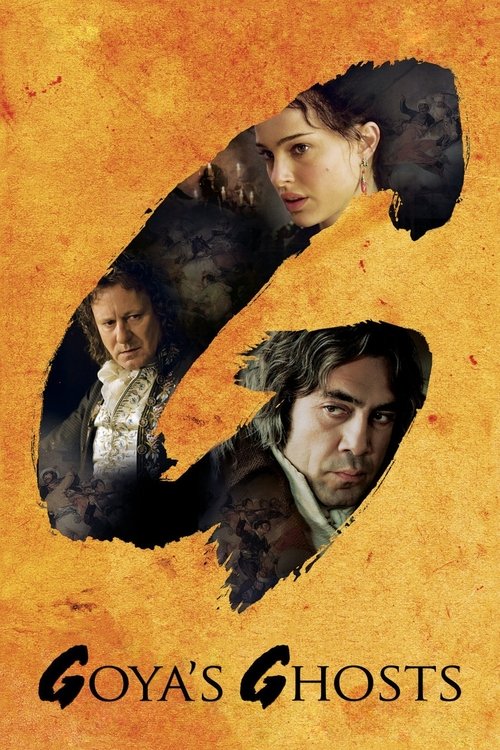
Goya's Ghosts (2006)
Directed by Miloš Forman
No — Goya's Ghosts is not woke, scoring 8 out of 100 on our wokeness meter.
Miloš Forman's final feature arrives in a Spanish setting, financed by Spanish money, and performed entirely in English, which remains the most transgressive choice anyone involved made.
Consciousness Markers
A Spanish production authentically cast with Spanish and European actors in Spanish roles, but this reflects period-appropriate casting rather than any deliberate modern diversity initiative.
The dinner-table debate over the morality of torture carries some thesis-stating dialogue, but the film remains a character drama rather than a sermon.
Inés is brutalized by the Inquisition and raped by Lorenzo, and the film lingers on her victimization, but it offers no feminist critique or agency-driven framing.
The film is explicitly a fictionalized history with invented characters woven into real events, but it does not reinterpret the past through a modern ideological lens.
The 'Judaizing' charge against Inés touches on the persecution of conversos, but it is treated as religious heresy within a historical drama rather than as modern racial commentary.
The Church's greed is depicted via gold 'donations' and corrupt inquisitors, but this is anticlerical period critique rather than a modern eat-the-rich polemic.
No LGBTQ+ characters, themes, or subtext appear anywhere in the film.
No environmental or climate themes of any kind.
No body-positivity themes; the film's nudity and torture scenes serve period drama, not body acceptance messaging.
Inés's descent into madness and the asylum setting are plot devices of tragedy, not a neurodivergence-affirming narrative.
Why it received this score
Miloš Forman's final feature arrives in a Spanish setting, financed by Spanish money, and performed entirely in English, which remains the most transgressive choice anyone involved made. The film follows Francisco Goya through the Inquisition, the Napoleonic invasion, and the restoration of the same old machinery of piety and cruelty, and it does so at a pace that suggests the director had nowhere else to be. Ornate costumes, handsome light, and a cast doing serious work in a story nobody quite assembled. The Iberian setting is populated by Iberian and European performers, which reads as period-appropriate authenticity, not as a diversity initiative. Nobody is holding a placard.
At the center is Inés, arrested for refusing pork on the charge of Judaizing. She is stripped, tortured, raped by her would-be savior, imprisoned for fifteen years, and left deranged. The film watches all of this with the patience of a portraitist and offers no critique of the men or the institutions arranging it. The heresy charge brushes against the persecution of conversos, though it is handled as religious doctrine, a matter for the Holy Office, not as commentary on ancestry or blood. The Church's appetite for gold donations gets a wry glance, and a dinner argument about the morality of torture lets the screenplay state its thesis aloud. The film then returns to being a character drama, which it does not exactly excel at.
The absences are notable. No same-sex currents, no environmental lament, no celebration of bodies in any form besides the painterly. Inés's collapse into madness is tragedy, not a neurodivergence narrative, and the asylum exists to be grim. The history is invented around real events without any modern reinterpretation. This is a costume drama of the old school, and the old school had no syllabus.
Analysis generated by our Consciousness Algorithm


Synopsis
Painter Francisco Goya becomes involved with the Spanish Inquisition after his muse, Inés, is arrested by the church for heresy. Her family turns to him, hoping that his connection with fanatical Inquisitor Lorenzo, whom he is painting, can secure her release.
Questions about Goya's Ghosts
Is Goya's Ghosts woke?
No — Goya's Ghosts is not woke, scoring 8 out of 100 on our wokeness meter. That earns it a verdict of Ultra Based.
Does Goya's Ghosts have any woke elements?
Very few. None of the 10 markers reaches 30, the level where a marker counts as present; the highest is Lecture Energy at 15.
How does Goya's Ghosts compare to other 2006 movies?
It ranks #89 of the 211 films from 2006 we've scored; their average is 11. The wokest is An Inconvenient Truth (92).
How is the Woke Score calculated?
An AI-assisted process researches the film and its reception, scores it 0–100 on ten markers, then combines those into one 0–100 Woke Score. It measures a specific set of 2020s cultural themes, not film quality.