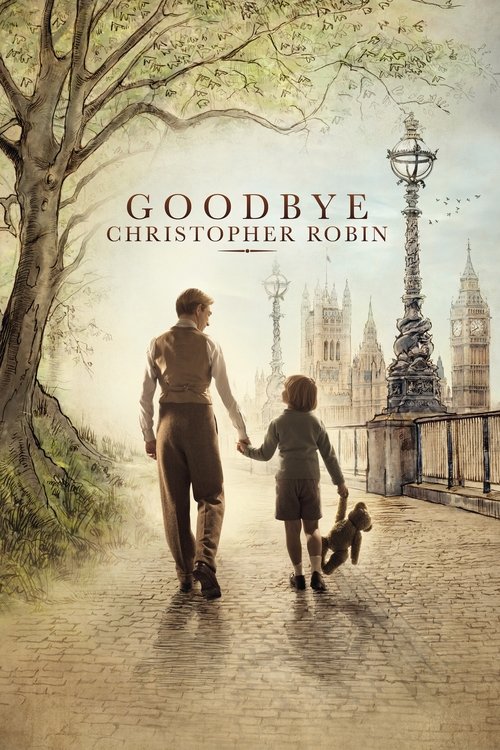
Goodbye Christopher Robin (2017)
Directed by Simon Curtis
No — Goodbye Christopher Robin is not woke, scoring 5 out of 100 on our wokeness meter.
Goodbye Christopher Robin arrives as a heritage drama with the polished sheen of a museum exhibit, tracing how A.A. Milne turned his son's childhood into a merchandising empire and then watched the boy resent every plush bear of it.
Consciousness Markers
The film delivers its message about exploiting a child for fame through sentimental period-drama beats rather than direct lecturing.
The film criticizes the commercialization of Christopher Robin through Pooh merchandise and publicity, but frames it as a family tragedy rather than a systemic anti-capitalist argument.
The film gives Daphne a few barbed lines about women's wartime roles and her own resentment, but it offers no feminist framework or critique of patriarchy.
The cast is an almost entirely white British ensemble in a period drama; no diverse characters exist with any narrative function or comment.
No LGBTQ+ characters, relationships, or subtext appear anywhere in the film. Daphne's remark about unmarried women is pre-war spinster commentary, not queer content.
The film is a white aristocratic English story with no engagement with race, colonialism, or racial consciousness of any kind.
There is no environmental theme or climate content in the film whatsoever.
No body positivity themes or diverse body representation are present.
Milne's shell shock is depicted as war trauma, not neurodivergence in the contemporary autism/ADHD sense; no neurodivergent framing exists.
The film dramatizes a real behind-the-scenes story but does not revise history toward a modern ideological reinterpretation.
Why it received this score
Goodbye Christopher Robin arrives as a heritage drama with the polished sheen of a museum exhibit, tracing how A.A. Milne turned his son's childhood into a merchandising empire and then watched the boy resent every plush bear of it. The film takes genuine aim at the machinery of fame, the way Daphne Milne sells her son's name for tea appearances and stuffed toys, but it treats the whole affair as a domestic wound, a family tragedy of mismatched affections. There is a critique of commerce here, a small one, aimed at parents who cash in on their children, and it never widens into anything systemic. The target is the Milnes, not the market.
The women in the frame get a few sharp lines about their limited options, most notably the nanny Olive and Daphne's chilly observation that the war left plenty of unmarried women available for service. This is period-accurate bitterness, not a feminist reckoning, and the film has no interest in interrogating the structures that produced it. Daphne remains a cold wife and a colder mother, which the screenplay treats as a character flaw instead of a symptom. The pathos is reserved for the father and son, two men undone by a bear.
What the film does deliver, and delivers gently, is a lesson about exploiting a child for public consumption. It arrives wrapped in warm light and piano, so the sermonizing never feels like sermonizing, which is its own quiet achievement. Otherwise the picture is a white, upper-class English idyll with no interest in race, no environmental conscience, no queer subtext, and no curiosity about bodies or minds that deviate from the norm. Milne's shell shock is treated as war damage, full stop. The result is a tasteful, well-acted piece of heritage product, moving in the way a good museum label is moving, and about as socially conscious as a display case.
Analysis generated by our Consciousness Algorithm
Part of


Synopsis
The behind the scenes story of the life of A.A. Milne and the creation of the Winnie the Pooh stories inspired by his son Christopher Robin.
Questions about Goodbye Christopher Robin
Is Goodbye Christopher Robin woke?
No — Goodbye Christopher Robin is not woke, scoring 5 out of 100 on our wokeness meter. That earns it a verdict of Ultra Based.
Does Goodbye Christopher Robin have any woke elements?
Very few. None of the 10 markers reaches 30, the level where a marker counts as present; the highest is Lecture Energy at 15.
How does Goodbye Christopher Robin compare to other 2017 movies?
It ranks #241 of the 309 films from 2017 we've scored; their average is 19. The wokest is I Am Not Your Negro (92).
How is the Woke Score calculated?
An AI-assisted process researches the film and its reception, scores it 0–100 on ten markers, then combines those into one 0–100 Woke Score. It measures a specific set of 2020s cultural themes, not film quality.