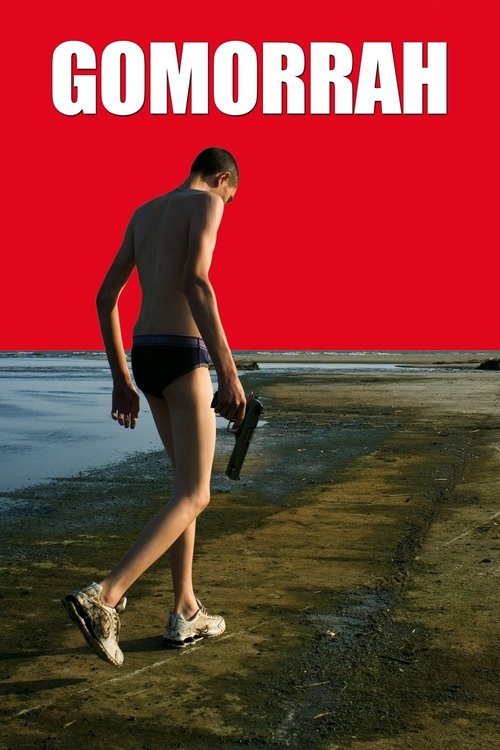
Gomorrah (2008)
Directed by Matteo Garrone
No — Gomorrah is not woke, scoring 16 out of 100 on our wokeness meter.
Matteo Garrone's Gomorrah arrives from 2008 with the grim confidence of a documentary and the patience of a census taker.
Consciousness Markers
The film links Camorra profit to toxic-waste disposal for northern industry and exploitative garment production, offering a systemic critique of criminal capitalism without explicit anti-capitalist rhetoric.
The toxic-waste storyline shows illegal dumping poisoning the countryside and a character quitting in moral disgust, but it is environmental crime rather than a climate crusade.
The film is moralizing in its portrait of organized crime, but it avoids preachy modern lecture energy.
The cast consists largely of Italian locals and non-professionals chosen for gritty realism, not for a modern diversity or representation agenda.
There are no LGBTQ+ characters, themes, or subtexts in the film.
Women appear mainly as family members or victims within the Camorra's violence; the film does not advance a feminist agenda.
Immigrant characters appear in the criminal economy, but the film offers no racial-consciousness commentary or social-justice framing.
There is no body-positivity theme or related messaging.
There is no depiction or discussion of neurodivergence.
The film is based on real Camorra events and a non-fiction book, but it does not revise or reinterpret history in a modern ideological sense.
Why it received this score
Matteo Garrone's Gomorrah arrives from 2008 with the grim confidence of a documentary and the patience of a census taker. Five stories unspool across Naples and Caserta, bound together by the Camorra and by the ordinary people who feed it, serve it, or die beside it. The cast is drawn largely from locals and non-professionals, chosen for texture and authenticity, not to satisfy any contemporary accounting of who ought to appear on screen. The result plays like an autopsy performed in real time.
The film's sharpest structural observation concerns money. Franco runs a disposal service that lets northern industrialists bury chromium and asbestos in the southern countryside, while the tailor Pasquale stitches haute couture by night for Chinese workers who hide him in a car trunk. This is a systemic critique of criminal enterprise and its respectable customers, delivered without a slogan. The poisoned land and the poisoned garment trade register as crimes, not as a cause. Roberto quits when he cannot stomach peaches he knows are contaminated, and the film lets that small refusal stand alone.
Elsewhere the film is conspicuously uninterested in the cultural preoccupations of a later decade. Women appear as mothers, widows, and targets, and the film builds no feminist architecture around them. Immigrants drift through the criminal economy without a word of commentary. There is no romantic subplot of any orientation, no celebration of bodies, no arc of neurodivergence, no rewriting of the historical record to flatter the present. Garrone moralizes, certainly. Jonah Weiner called the film deeply moralizing, and he was right. But the sermon is old and bleak, aimed at complicity and greed, and it never turns from the screen to address us about our own virtue. For a work so steeped in poison, it is remarkably free of contemporary pieties. The ledger comes up thin.
Analysis generated by our Consciousness Algorithm


Synopsis
An inside look at Italy's modern-day crime families, the Camorra in Naples and Caserta. Based on a book by Roberto Saviano. Power, money and blood: these are the "values" that the residents of the Province of Naples and Caserta have to face every day. They hardly ever have a choice and are forced to obey the rules of the Camorra. Only a lucky few can even think of leading a normal life.
Questions about Gomorrah
Is Gomorrah woke?
No — Gomorrah is not woke, scoring 16 out of 100 on our wokeness meter. That earns it a verdict of Ultra Based.
Does Gomorrah have any woke elements?
Very few. None of the 10 markers reaches 30, the level where a marker counts as present; the highest is Eat the Rich at 25.
How does Gomorrah compare to other 2008 movies?
It ranks #51 of the 212 films from 2008 we've scored; their average is 12. The wokest is Milk (68).
How is the Woke Score calculated?
An AI-assisted process researches the film and its reception, scores it 0–100 on ten markers, then combines those into one 0–100 Woke Score. It measures a specific set of 2020s cultural themes, not film quality.