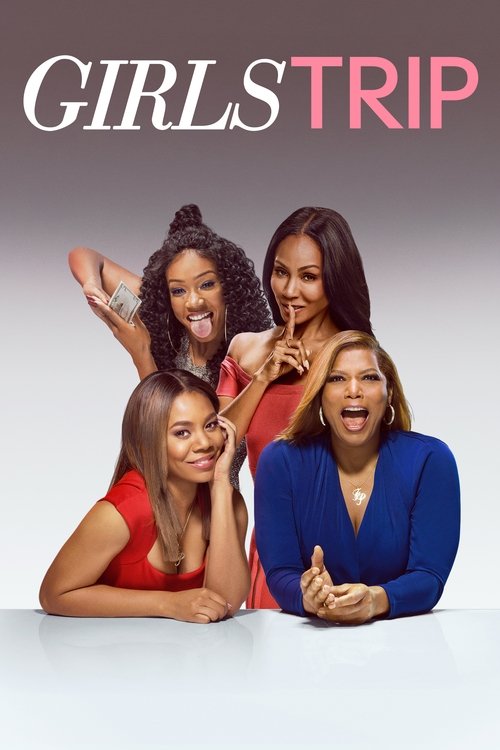
Girls Trip (2017)
Directed by Malcolm D. Lee
Yes — Girls Trip is woke, scoring 60 out of 100 on our wokeness meter.
Girls Trip arrives with a premise that could have been assembled from a studio comedy kit: four college friends, one festival, a cheating husband, and a quantity of absinthe sufficient to render a lamp romantically attractive.
Consciousness Markers
Centers a four-woman Black ensemble with a Black director and Black female screenwriters, a landmark for mainstream studio representation.
Foregrounds Black women's joy, culture, and respectability-politics-defying freedom at Essence Fest, though it is not a film about systemic racism.
Celebrates female friendship, sexual agency, and women's professional and personal autonomy, earning a ReFrame gender-parity stamp.
Mostly a raunchy comedy; its messages about friendship and authenticity are delivered through character arcs rather than preachy lectures.
No LGBTQ+ characters or themes are present.
No environmental or climate themes.
No systemic critique of capitalism; the gossip-blog and brand-deal subplots are personal, not anti-capitalist.
No body-positivity themes or messaging.
No neurodivergent characters or themes.
No historical revisionism.
Why it received this score
Girls Trip arrives with a premise that could have been assembled from a studio comedy kit: four college friends, one festival, a cheating husband, and a quantity of absinthe sufficient to render a lamp romantically attractive. What distinguishes it is the casting, which places four Black women at the center of a mainstream R-rated comedy and hands the script to Black writers. The film's commercial performance, over one hundred million dollars domestic on a modest budget, made a quiet argument to an industry that had spent years insisting such pictures could not travel.
The cultural awareness sits mostly in a refusal to apologize. Tracy Oliver spoke of breaking down respectability politics, and the film does so by letting its characters be messy, horny, and professionally ambitious without a lecture attached. Female friendship here is not a slogan but a mechanism: the women fight, scatter, and reassemble because the plot requires it. The ReFrame stamp for gender parity acknowledges what the production actually accomplished. Essence Fest functions as a setting and a community, not a thesis.
Where the film declines to preach, it also declines to reach for broader themes. There is no environmental conscience, no structural critique of the gossip economy, no meditation on bodily self-acceptance. The subplot about a floundering blog resolves as a personal choice, not an indictment. The humor is raunchy and the morals arrive through character arcs, which keeps the sermonizing to a minimum. It is a comedy that knows exactly what it is, and that restraint is its own kind of discipline.
Analysis generated by our Consciousness Algorithm
Part of


Synopsis
Four girlfriends take a trip to New Orleans for an annual festival and, along the way, rediscover their wild sides and strengthen the bonds of sisterhood.
Questions about Girls Trip
Is Girls Trip woke?
Yes — Girls Trip is woke, scoring 60 out of 100 on our wokeness meter. That earns it a verdict of Woke.
What makes Girls Trip woke?
3 of the 10 markers register at 30 or above, led by Representation Casting (88), Racial Consciousness (72) and Feminist Agenda (70). On Representation Casting: Centers a four-woman Black ensemble with a Black director and Black female screenwriters, a landmark for mainstream studio representation.
How does Girls Trip compare to other 2017 movies?
It ranks #18 of the 309 films from 2017 we've scored; their average is 19. The wokest is I Am Not Your Negro (92).
How is the Woke Score calculated?
An AI-assisted process researches the film and its reception, scores it 0–100 on ten markers, then combines those into one 0–100 Woke Score. It measures a specific set of 2020s cultural themes, not film quality.