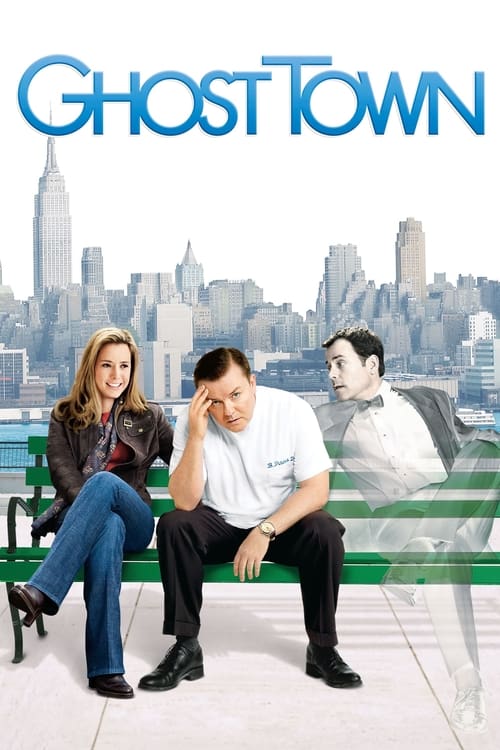
Ghost Town (2008)
Directed by David Koepp
No — Ghost Town is not woke, scoring 7 out of 100 on our wokeness meter.
Ghost Town (2008) is a studio romantic comedy about a misanthropic Manhattan dentist, Bertram Pincus, who dies for seven minutes and wakes to find ghosts demanding favors.
Consciousness Markers
The cast includes Aasif Mandvi as Dr. Prashar and Michael-Leon Wooley as a medical attorney, but these are incidental roles with no commentary on identity, typical of colorblind 2000s casting.
The film carries a gentle moral about helping others and letting go, delivered through Dr. Prashar's advice, but it stays light and comedic rather than preachy.
Téa Leoni's Gwen is a professional Egyptologist and the emotional anchor, but the plot revolves around men (a ghost husband and a suitor) managing her romantic life, offering no feminist critique.
There are no LGBTQ+ characters, themes, or subtext anywhere in the film.
Race is never addressed or thematized; the film is a white-centered Manhattan romantic comedy.
No environmental or climate content of any kind.
Richard is described as a human-rights lawyer, but this is a plot device to make him seem suspicious, not an economic critique; the film is a mainstream studio comedy.
No body-positivity themes; Gervais's self-deprecating jokes about his own appearance are gags, not a movement.
Bertram's misanthropy is framed as a character flaw to be overcome, not as neurodivergence.
The Egyptian mummy and pharaoh material is set dressing for a rom-com, not a historical revision.
Why it received this score
Ghost Town (2008) is a studio romantic comedy about a misanthropic Manhattan dentist, Bertram Pincus, who dies for seven minutes and wakes to find ghosts demanding favors. Ricky Gervais plays the misanthrope with dry precision. Téa Leoni plays Gwen, an Egyptologist and widow. Greg Kinnear floats through as her dead husband. The film is pleasant, lightly supernatural, and almost entirely uninterested in the cultural battles that would later define the decade's discourse.
In the matter of representation, Aasif Mandvi appears as Dr. Prashar and Michael-Leon Wooley as a medical attorney. These are incidental roles, played without any commentary on identity. The casting is colorblind in the 2000s manner. Racial consciousness is absent. So are LGBTQ themes, climate concerns, anti-capitalist critique, body positivity, neurodivergence, and historical revision. Richard the human-rights lawyer exists to seem suspicious, not to indict an economic system. Gervais's jokes about his own appearance are gags, not a movement. The Egyptian mummy is set dressing for a meet-cute. Gwen has a profession and serves as the emotional anchor, but the plot still has two men, one dead and one alive, arranging her romantic life. The feminist reading stalls there.
The film's only real sermon is a gentle one. Dr. Prashar tells Bertram to stop being cynical and start helping people. Bertram then assists ghosts with their unfinished business. The moral arrives softly, wrapped in jokes about dentists and dead people. It never preaches. It never lectures. It simply suggests that kindness is better than isolation. For a 2008 DreamWorks comedy, this is a modest aspiration. The result is a charming, harmless artifact. Its social consciousness is faint, incidental, and mostly pre-2015 humanism. We file it under comedy, romance, and low cultural alarm.
Analysis generated by our Consciousness Algorithm


Synopsis
Bertram Pincus, a cranky, people-hating Manhattan dentist, develops the unwelcome ability to see dead people. Really annoying dead people. Even worse, they all want something from him, particularly Frank Herlihy, a smooth-talking ghost, who pesters him into a romantic scheme involving his widow Gwen. They are soon entangled in a hilarious predicament between the now and the hereafter!
Questions about Ghost Town
Is Ghost Town woke?
No — Ghost Town is not woke, scoring 7 out of 100 on our wokeness meter. That earns it a verdict of Ultra Based.
Does Ghost Town have any woke elements?
Very few. None of the 10 markers reaches 30, the level where a marker counts as present; the highest is Representation Casting at 18.
How does Ghost Town compare to other 2008 movies?
It ranks #122 of the 212 films from 2008 we've scored; their average is 12. The wokest is Milk (68).
How is the Woke Score calculated?
An AI-assisted process researches the film and its reception, scores it 0–100 on ten markers, then combines those into one 0–100 Woke Score. It measures a specific set of 2020s cultural themes, not film quality.