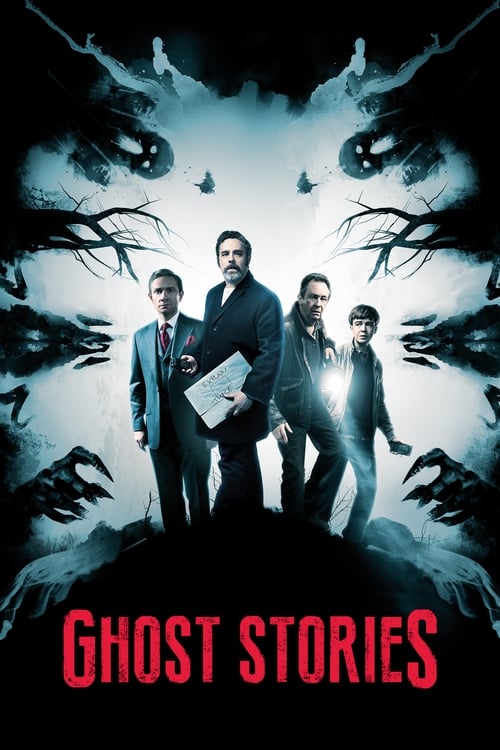
Ghost Stories (2018)
Directed by Andy Nyman
No — Ghost Stories is not woke, scoring 5 out of 100 on our wokeness meter.
Ghost Stories arrives from 2017, a British anthology horror picture adapted from a stage play, and it conducts itself with the tidy gloom of a rep cinema matinee.
Consciousness Markers
A backstory beat involves Goodman's Jewish father disowning his sister for dating an Asian man, gesturing at prejudice, but it is a plot device rather than a sustained racial-consciousness theme.
The narrative features a character with locked-in syndrome and a mentally disabled boy, but these are deployed as horror/guilt devices rather than neurodivergence advocacy.
The cast is overwhelmingly white British, with only a fleeting reference to an Asian man and a minor supporting player. No meaningful diverse casting effort is present.
There are no LGBTQ+ characters, themes, or subtext anywhere in the film.
Women appear only as victims, ghosts, or background figures; there is no feminist framing or commentary.
The film contains no environmental or climate-related content whatsoever.
A City financier appears as a character, but the film draws no economic critique or anti-capitalist message from him.
There is no engagement with body positivity or body-image themes.
The film is a supernatural horror anthology with no historical revisionism or reframing of past events.
Ghost Stories is a mood-driven horror anthology that aims to unsettle rather than preach; it carries no didactic social messaging.
Why it received this score
Ghost Stories arrives from 2017, a British anthology horror picture adapted from a stage play, and it conducts itself with the tidy gloom of a rep cinema matinee. Philip Goodman debunks fraudulent psychics on television. Three case files follow. A night watchman in a women's asylum, a teenager in the woods, a City financier awaiting a child. The whole thing resolves into a hospital room and a man with locked-in syndrome after a suicide attempt. For our purposes, the inventory is thin. The cast is white British throughout, with an Asian man surfacing in a single backstory and a minor player or two drifting past the edges. There is no queer presence, no feminist framing, no environmental sermon, no body-image discourse. The film has other business.
The disability material deserves a note. Locked-in syndrome and a mentally disabled boy both appear, and both arrive as instruments of dread and guilt. The drain sequence, the recurring ghoul, the finger in the mouth. These are horror mechanics. Nobody is advocating for anything. The 1979 flashback gives us a Jewish father expelling his sister for dating an Asian man, which gestures toward prejudice and then drops it, because the plot needs a wound, not a thesis. A financier wanders through the third segment carrying his wealth like luggage. The film never opens the suitcase. No economic critique is offered, and none is wanted.
What remains is craft. The film unsettles, it does not lecture. It has no interest in instructing the audience on how to live. In an era when the multiplex doubles as a seminar room, that restraint reads as almost antique. The social consciousness here is close to nil, and the film is content with that. It is a haunted house with the lights kept low and the sermons left at the door, and it asks nothing of us beyond a willingness to be frightened in the dark. We can respect the economy of it while noting there is simply nothing here for the auditors to measure. The ledger comes back empty, and for a film of this vintage, that is the expected result.
Thematic tags: none apply. It is not a sequel, remake, superhero picture, true story, Oscar winner, or box office champion. Its source is a stage play, which falls outside the book adaptation category.
{"thematic_tags": []}
Analysis generated by our Consciousness Algorithm


Synopsis
Professor Philip Goodman devotes his life to exposing phony psychics and fraudulent supernatural shenanigans. His skepticism soon gets put to the test when he receives news of three chilling and inexplicable cases -- disturbing visions in an abandoned asylum, a car accident deep in the woods and the spirit of an unborn child. Even scarier -- each of the macabre stories seems to have a sinister connection to the professor's own life.
Questions about Ghost Stories
Is Ghost Stories woke?
No — Ghost Stories is not woke, scoring 5 out of 100 on our wokeness meter. That earns it a verdict of Ultra Based.
Does Ghost Stories have any woke elements?
Very few. None of the 10 markers reaches 30, the level where a marker counts as present; the highest is Neurodivergence at 10.
How does Ghost Stories compare to other 2018 movies?
It ranks #259 of the 325 films from 2018 we've scored; their average is 20. The wokest is Return (92).
How is the Woke Score calculated?
An AI-assisted process researches the film and its reception, scores it 0–100 on ten markers, then combines those into one 0–100 Woke Score. It measures a specific set of 2020s cultural themes, not film quality.