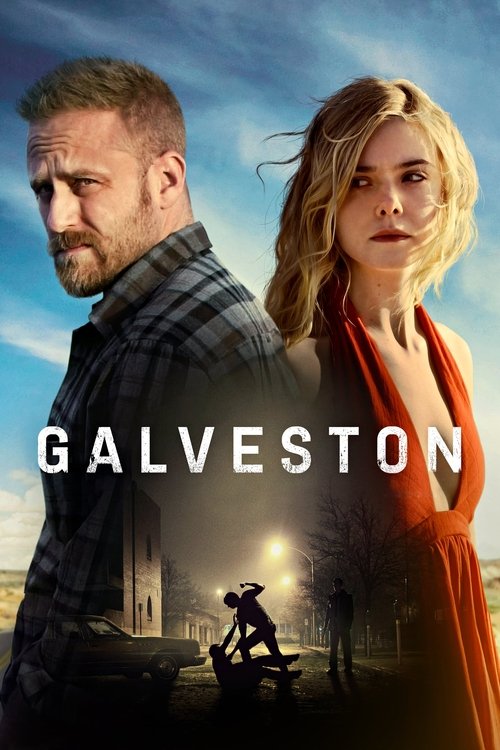
Galveston (2018)
Directed by Mélanie Laurent
No — Galveston is not woke, scoring 9 out of 100 on our wokeness meter.
Mélanie Laurent's Southern noir crime drama, Galveston, presents a landscape of nihilism rendered in muted, coastal tones.
Consciousness Markers
The cast includes a few non-white performers (Adepero Oduye, María Valverde) in supporting roles, but the leads are white and diversity is incidental rather than a stated goal.
Directed by a woman (Mélanie Laurent), and it treats Rocky's exploitation and the trauma of her rape with some gravity, but it makes no explicit feminist argument.
A Black woman (Loraine) frees Roy and advances the plot, but her race is never remarked upon and no racial themes are engaged.
Roy's plea that Rocky go to school and become something is the closest thing to a moral, but the film is far more atmospheric than preachy.
No LGBTQ+ characters or themes appear anywhere in this Southern noir crime drama.
Hurricane Ike serves as a moody final-act backdrop but carries no environmental or climate messaging.
The criminal underworld and violence are presented as personal and moral failings, with no critique of capitalism or wealth.
No body positivity themes are present.
No neurodivergent characters or themes are depicted.
Set in 1988 and drawn from a 2010 novel, the film makes no attempt to revise or reinterpret historical events.
Why it received this score
Mélanie Laurent's Southern noir crime drama, Galveston, presents a landscape of nihilism rendered in muted, coastal tones. The film functions less as a social commentary and more as a meditation on professional failure and unavoidable trauma. The narrative attempts a modest exploration of exploitation, particularly regarding its female characters, but it stops short of making any explicit progressive argument. Its progressive sensibilities are best found in the subtle inclusion of varied casting, which serves as a background hum rather than a central thematic preoccupation. The film allows certain supporting figures to exist with a degree of cultural awareness, yet the racial themes remain entirely unengaged, relegated to atmospheric texture. It is a somber mood that emphasizes personal decay over any systemic critique, for the capitalist underpinnings of the criminal underworld are left largely unaddressed.
The central relationship, Roy and Rocky, offers the most substantial progressive moment. Roy’s insistence that Rocky seek education and self improvement is a quiet nod toward empowerment, though the film leans heavily on mood over messaging. This is a rare moment of instruction within a picture that otherwise prefers to let its characters drown in a pervasive sense of fatalism. The story is a slow burn, a heavy, damp thing that lingers after the final frame. It is not a movie for those seeking immediate, declarative statements about society. Instead, it is a study of fractured lives set against a backdrop of inevitable disaster.
Ultimately, the film succeeds as a grim piece of atmosphere. It lacks the sharp edges of a true cultural manifesto. It is a deeply felt, though intellectually light, examination of ruin. We watch characters grapple with their messy, unresolved histories, and the film offers them a somber, if minimal, degree of acknowledgment. It is a quiet endurance of the human condition, punctuated by the inevitable arrival of a hurricane.
Analysis generated by our Consciousness Algorithm


Synopsis
After a violent encounter, Roy finds Rocky and sees something in her eyes that prompts a fateful decision. He takes her with him as he flees to Galveston, an action as ill-advised as it is inescapable.
Questions about Galveston
Is Galveston woke?
No — Galveston is not woke, scoring 9 out of 100 on our wokeness meter. That earns it a verdict of Ultra Based.
Does Galveston have any woke elements?
Very few. None of the 10 markers reaches 30, the level where a marker counts as present; the highest is Representation Casting at 28.
How does Galveston compare to other 2018 movies?
It ranks #203 of the 325 films from 2018 we've scored; their average is 20. The wokest is Return (92).
How is the Woke Score calculated?
An AI-assisted process researches the film and its reception, scores it 0–100 on ten markers, then combines those into one 0–100 Woke Score. It measures a specific set of 2020s cultural themes, not film quality.