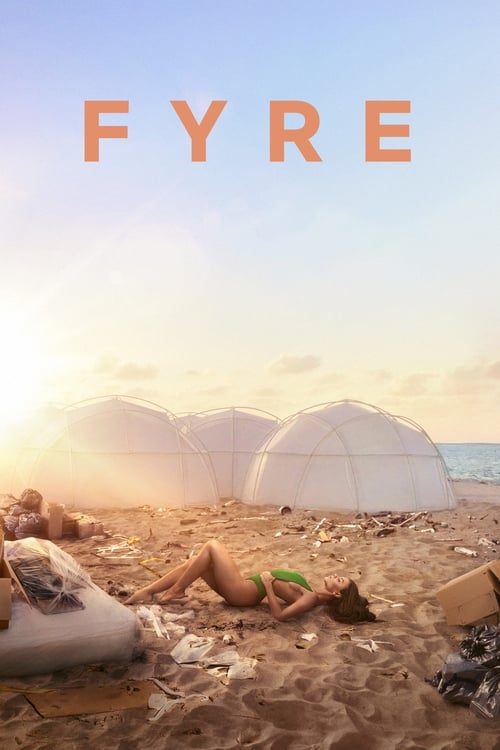
FYRE: The Greatest Party That Never Happened (2018)
Directed by Chris Smith
No — FYRE: The Greatest Party That Never Happened is not especially woke, scoring 24 out of 100 on our wokeness meter.
Chris Smith's documentary recounts the collapse of a music festival sold to affluent young people as a luxury experience in the Bahamas and delivered as tents and cheese sandwiches.
Consciousness Markers
The film's central thrust is a damning portrait of greed, influencer FOMO economics, and the callous excess of the wealthy, though it stops short of an explicit systemic anti-capitalist argument.
The documentary carries a moralizing tone about the dangers of wealth and influencer culture, but it is largely observational and narrative-driven rather than preachy.
The cast is a natural cross-section of organizers, journalists, and Bahamian workers; diversity is incidental to the fraud narrative rather than a deliberate representational statement.
The stiffing of Bahamian laborers and the contrast between wealthy white influencers and local workers is present, but the film frames it as fraud and labor abuse rather than racial consciousness.
Journalist Gabrielle Bluestone features prominently and the promo's use of models is noted, but the film never advances a feminist argument or critique of patriarchy.
No LGBTQ+ characters, themes, or storylines appear in this documentary about a festival fraud.
No environmental or climate themes are present in this story of a music festival collapse.
No body positivity themes or messaging appear in the documentary.
No neurodivergence themes or characters are present.
The film documents real, recent events rather than reinterpreting established history.
Why it received this score
Chris Smith's documentary recounts the collapse of a music festival sold to affluent young people as a luxury experience in the Bahamas and delivered as tents and cheese sandwiches. The method is observational. Promoters, contractors, and journalists narrate the unraveling while the promotional footage does its own damning work. Billy McFarland emerges as a salesman of pure atmosphere, a man who understood that the appetite for being seen somewhere outranked any appetite for music.
The organizing passion here is greed. The film lingers on the influencer economy, on the calculus of paying models to post, on the strange eagerness of wealthy customers to be fleeced so long as the fleece looked good on camera. That is the nearest the project comes to a systemic argument, and it stops at the doorstep of one man's fraud instead of walking into the room. The Bahamian laborers left unpaid and the island residents who absorbed the chaos register as collateral damage in a story about money, not as a racial reckoning. Gabrielle Bluestone, a journalist, supplies sharp commentary, though the film never assembles a broader case about gender or power. Diversity appears in the interview roster the way it appears in life: present, unremarked, not the point.
Smith's tone is rueful and controlled, moralizing only in the manner a well-edited montage moralizes. Jerry Media, which promoted the festival and then helped produce the film about its failure, is a complication the documentary declines to examine. We are left with a brisk autopsy of excess, entertaining and faintly smug. It condemns the rich for their gullibility and their indifference, and it does so with a straight face and a good soundtrack. The lesson arrives, but it arrives softly.
Analysis generated by our Consciousness Algorithm


Synopsis
He promised supermodels and yachts, but delivered tents and cheese sandwiches. How one man engineered a music festival disaster.
Questions about FYRE: The Greatest Party That Never Happened
Is FYRE: The Greatest Party That Never Happened woke?
No — FYRE: The Greatest Party That Never Happened is not especially woke, scoring 24 out of 100 on our wokeness meter. That earns it a verdict of Based.
Does FYRE: The Greatest Party That Never Happened have any woke elements?
2 of the 10 markers register at 30 or above, led by Eat the Rich (60) and Lecture Energy (35). On Eat the Rich: The film's central thrust is a damning portrait of greed, influencer FOMO economics, and the callous excess of the wealthy, though it stops short of an explicit systemic anti-capitalist argument.
How does FYRE: The Greatest Party That Never Happened compare to other 2018 movies?
It ranks #87 of the 325 films from 2018 we've scored; their average is 20. The wokest is Return (92).
How is the Woke Score calculated?
An AI-assisted process researches the film and its reception, scores it 0–100 on ten markers, then combines those into one 0–100 Woke Score. It measures a specific set of 2020s cultural themes, not film quality.