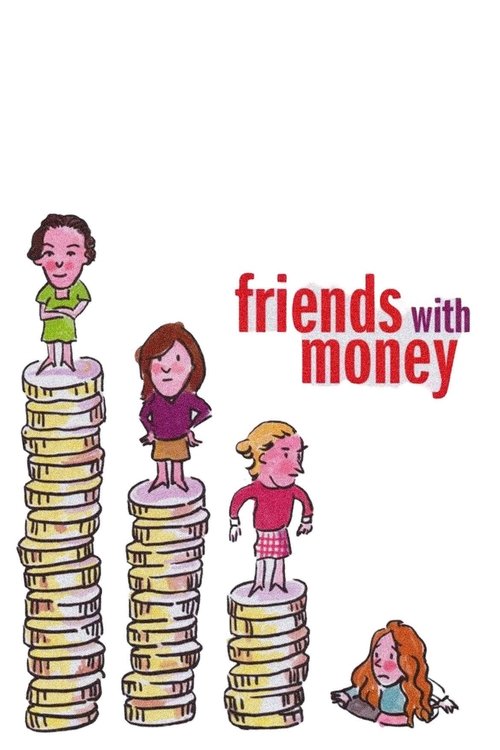
Friends with Money (2006)
Directed by Nicole Holofcener
No — Friends with Money is not woke, scoring 17 out of 100 on our wokeness meter.
Friends with Money is a 2006 Nicole Holofcener dramedy about four Los Angeles women and the husbands, trainers, and inherited fortunes orbiting them.
Consciousness Markers
Written and directed by Nicole Holofcener and centered on the interior lives, friendships, and money anxieties of four women, the film is a genuine female-centric dramedy, though it observes rather than argues a feminist thesis.
The film's central tension is the discomfort of money inequality among friends, contrasting broke Olivia with her trust-funded and wealthy peers, but it treats this as personal awkwardness rather than systemic critique or 'eat the rich' polemic.
The ensemble is almost entirely white, with no meaningful racial diversity in the cast; the only representational distinction is that it is a female-led ensemble, which is not the same as diverse casting.
A running subplot has the character Aaron repeatedly assumed to be gay by friends and strangers, but he is straight, so the film toys with the perception of queerness rather than presenting actual LGBTQ+ themes or characters.
Holofcener's style is wry, observational, and understated, with no preachy monologues or moral instruction; the film shows rather than lectures.
The film contains no engagement with race, racial identity, or racial dynamics whatsoever; its social texture is entirely about class and gender among affluent white Angelenos.
There is no environmental or climate-related content in the film.
No body-positivity themes are present; Jane's refusal to wash her hair is framed as a symptom of depression, not a statement about appearance or body acceptance.
Jane's depression and irritability are depicted as emotional malaise, not framed through any neurodivergence lens such as autism or ADHD.
The film is a contemporary character study with no historical subject matter to revise.
Why it received this score
Friends with Money is a 2006 Nicole Holofcener dramedy about four Los Angeles women and the husbands, trainers, and inherited fortunes orbiting them. The camera stays close to Olivia's diminished bank account and the low hum of envy among friends who can afford renovations and charity tables. The ensemble is female-led and almost entirely white. That detail matters for classification. The film examines money and manners inside a narrow social stratum and never pretends otherwise.
The film's social consciousness is real but modest. It notices the awkwardness of being the broke friend among trust-fund mothers and screenwriters, yet it treats that inequality as a private itch, not a systemic indictment. Aaron's recurring misread as gay supplies the only brush with queer perception, and the joke depends on his straightness. Jane's depression and refusal to wash her hair are framed as emotional malaise, not as statements about bodies or neurodivergence. Race and climate do not enter the frame. There is no historical revision here, only the present tense of brunch and real estate. These are affluent white Angelenos negotiating marriages, house additions, and blind dates.
Holofcener's direction is wry, observational, and allergic to sermons. The film shows Christine's marital chill and Olivia's self-confidence without turning either into a lesson. That restraint keeps the lecture energy low and the feminist reading observational instead of argumentative. The result is a sharp, minor-key comedy of manners that knows its territory is class and gender among the comfortable, and it declines to inflate that territory into a manifesto. We are left with a film that is socially alert in a quiet register, which is not the same as being a cultural battering ram.
Analysis generated by our Consciousness Algorithm
Part of


Synopsis
As she reaches her mid-thirties and quits her lucrative job, singleton Olivia finds herself unsure about her future and her relationships with her successful and wealthy friends. She begins to envy the security of her richer friends and, although their lives may seem easier, Olivia's friends have their problems too: screenwriters Christine and Patrick are unable to collaborate on their latest project, Jane and Aaron have lost the romance in their relationship, and Franny and Matt have difficulties handling the demands of parenthood.
Questions about Friends with Money
Is Friends with Money woke?
No — Friends with Money is not woke, scoring 17 out of 100 on our wokeness meter. That earns it a verdict of Ultra Based.
Does Friends with Money have any woke elements?
1 of the 10 markers register at 30 or above, led by Feminist Agenda (40). On Feminist Agenda: Written and directed by Nicole Holofcener and centered on the interior lives, friendships, and money anxieties of four women, the film is a genuine female-centric dramedy, though it observes rather than argues a feminist thesis.
How does Friends with Money compare to other 2006 movies?
It ranks #44 of the 211 films from 2006 we've scored; their average is 11. The wokest is An Inconvenient Truth (92).
How is the Woke Score calculated?
An AI-assisted process researches the film and its reception, scores it 0–100 on ten markers, then combines those into one 0–100 Woke Score. It measures a specific set of 2020s cultural themes, not film quality.