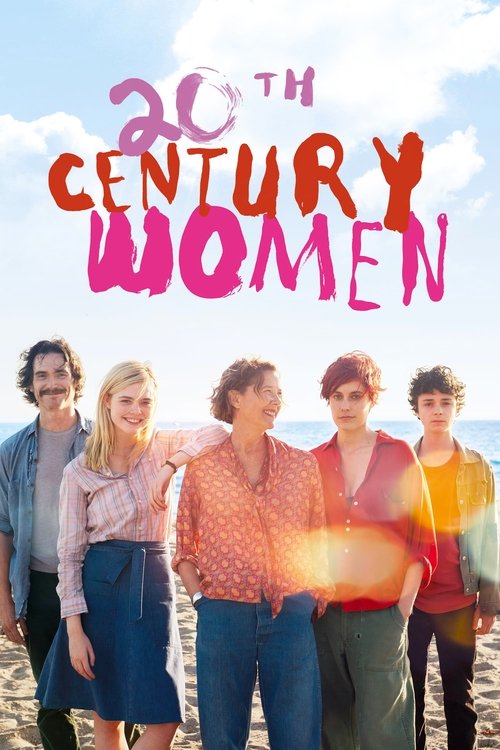
20th Century Women (2016)
Directed by Mike Mills
Yes — 20th Century Women is woke, scoring 60 out of 100 on our wokeness meter.
Mike Mills returns to the territory of his own upbringing with a 1979 Santa Barbara household in which a 55-year-old single mother, Dorothea, recruits a cancer-surviving punk photographer and a restless teenage neighbor to help raise her adolescent son.
Consciousness Markers
Feminism is a central, explicit concern: Abbie gives Jamie feminist books, the dinner party confronts menstruation stigma, and the story is built around women raising a boy and defining their own lives. The film is a love letter to the women who shaped the director.
The film includes explicit feminist dialogue, feminist reading material, and a scene that forces dinner guests to say 'menstruation,' giving it a moderate didactic charge. It remains character-driven rather than preachy.
The film centers a female-led ensemble, including an older single mother, a young punk artist, and a teenage girl, giving women substantial narrative space. However, the cast is almost entirely white and lacks broader racial or LGBTQ+ representation.
There are no LGBTQ+ characters, relationships, or themes in the film.
The film does not engage with racial identity, racism, or racial justice themes.
There is no environmental or climate-related content.
While punk culture appears, the film does not advance an anti-capitalist or eat-the-rich critique.
The film discusses menstruation and cervical cancer, but it does not promote body positivity as a distinct theme.
No neurodivergent characters or themes are present.
The film is a semi-autobiographical period piece, not a revisionist historical narrative.
Why it received this score
Mike Mills returns to the territory of his own upbringing with a 1979 Santa Barbara household in which a 55-year-old single mother, Dorothea, recruits a cancer-surviving punk photographer and a restless teenage neighbor to help raise her adolescent son. The arrangement is unusual, the execution is gentle, and the film's true subject is the women themselves: their marriages, their illnesses, their ambivalence about children, their private definitions of a life well spent. Mills has called it a love letter to the women who raised him, and the sincerity of that gesture is legible in every frame. This is a film organized around feminine interiority, and it does not apologize for the fact.
The social consciousness here is explicit and specific. Abbie hands Jamie books on feminism. A dinner party turns into a small insurrection when she forces the table to say the word menstruation aloud. Dorothea's authority as a mother is examined, defended, and finally honored. The convictions are real, and they are spoken. The film declines to extend that consciousness outward. The cast is white, the neighborhood is white, and race is simply not a subject. There is no queer thread, no economic argument beneath the punk costuming, no environmental concern, no reckoning with how bodies are judged beyond the medical facts of cervical cancer and the fertility drug DES. The punk is a wardrobe and a soundtrack, not a politics.
The result is a period piece with a strong point of view and a light touch. Its sermonizing is intermittent and always in service of character. We are left with a warm, unhurried elegy for a particular kind of 1970s progressive household, one that believed in self-examination and assumed the examining would be done by white people in California.
Analysis generated by our Consciousness Algorithm


Synopsis
In 1979 Santa Barbara, California, Dorothea Fields is a determined single mother in her mid-50s who is raising her adolescent son, Jamie, at a moment brimming with cultural change and rebellion. Dorothea enlists the help of two younger women – Abbie, a free-spirited punk artist living as a boarder in the Fields' home and Julie, a savvy and provocative teenage neighbour – to help with Jamie's upbringing.
Questions about 20th Century Women
Is 20th Century Women woke?
Yes — 20th Century Women is woke, scoring 60 out of 100 on our wokeness meter. That earns it a verdict of Woke.
What makes 20th Century Women woke?
3 of the 10 markers register at 30 or above, led by Feminist Agenda (85), Lecture Energy (45) and Representation Casting (40). On Feminist Agenda: Feminism is a central, explicit concern: Abbie gives Jamie feminist books, the dinner party confronts menstruation stigma, and the story is built around women raising a boy and defining their own lives.
How does 20th Century Women compare to other 2016 movies?
It ranks #9 of the 285 films from 2016 we've scored; their average is 16. The wokest is 13th (92).
How is the Woke Score calculated?
An AI-assisted process researches the film and its reception, scores it 0–100 on ten markers, then combines those into one 0–100 Woke Score. It measures a specific set of 2020s cultural themes, not film quality.