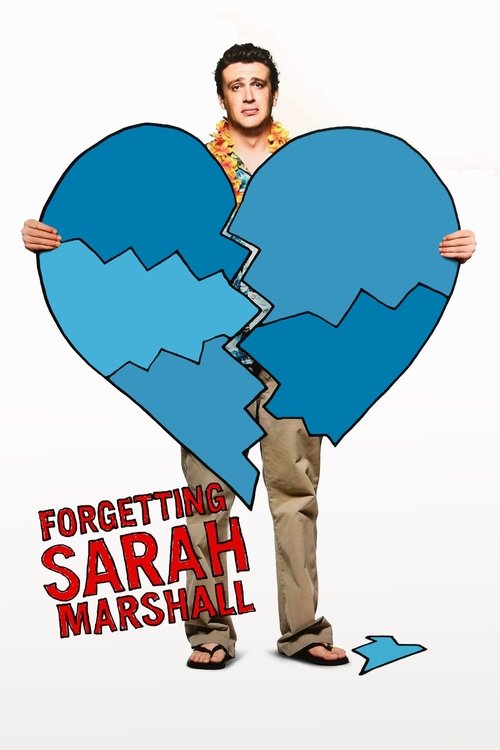
Forgetting Sarah Marshall (2008)
Directed by Nicholas Stoller
No — Forgetting Sarah Marshall is not woke, scoring 0 out of 100 on our wokeness meter.
Forgetting Sarah Marshall arrives in 2008 with no agenda beyond the placement of one naked man in a series of increasingly awkward rooms.
Consciousness Markers
The cast is overwhelmingly white and the film makes no deliberate effort at inclusive or representative casting.
There are no LGBTQ+ characters, relationships, or themes in the story.
The film is a conventional heterosexual romantic comedy and does not advance or engage with feminist themes.
Race is not a subject of the film, and no racial consciousness or commentary is present.
The Hawaiian setting is purely scenic; climate change or environmental activism is absent.
The film contains no critique of capitalism, wealth inequality, or corporate power.
Nudity is played for comedy rather than as a body-positivity statement, and no body-positive themes are developed.
No neurodivergent characters or themes are present.
The film is a contemporary romantic comedy with no historical revisionism.
The film aims to entertain rather than lecture the audience on social or political issues.
Why it received this score
Forgetting Sarah Marshall arrives in 2008 with no agenda beyond the placement of one naked man in a series of increasingly awkward rooms. Jason Segel wrote the script and plays Peter Bretter, a composer of television cues who is discarded by the title character and retreats to Oahu, where he promptly discovers his ex and her new boyfriend sharing the same resort. The film belongs to the Apatow school, which is to say it is preoccupied with humiliation, bodily function, and the slow rehabilitation of a sad man's ego. There is no thesis here. There is only Hawaii, and hurt feelings, and a puppet opera about Dracula.
The cast is white, the romance is heterosexual, and the politics are absent. The nudity in the opening scene is deployed for laughter, not for any statement about bodies or their acceptability. The island setting supplies sunsets and snorkeling and nothing resembling environmental concern. Race goes unmentioned. Class goes unmentioned. The closest thing to a social idea involves Peter retrieving a topless photograph of Rachel from a bar's restroom collage without her consent having been sought, an act that reads as common decency and not as commentary. The film wants to be funny. It is frequently funny, which is its own small achievement and the whole of its ambition.
What remains is a well-made entertainment with a soft heart and no interest in instructing anyone. It won no major awards, spawned a spin-off about the rock star, and made a great deal of money. Future cultural historians will find in it a document of 2008's comic tastes, its improv-heavy rhythms, its willingness to let a man weep openly and then joke about it. They will find nothing else. This is a film that asks nothing of its audience except attention and a tolerance for prolonged male nudity. A clean slate, then. Rare, and almost restful.
Analysis generated by our Consciousness Algorithm
Part of


Synopsis
When actress Sarah Marshall dumps aspiring musician Peter Bretter for rock star Aldous Snow, Peter's world comes crashing down. His best friend Brian suggests that Peter should get away from everything and to fly off to Hawaii to escape all his problems. After arriving in Hawaii and meeting the beautiful receptionist Rachel Jansen, Peter is shocked to see not only Aldous in Hawaii, but also Sarah.
Questions about Forgetting Sarah Marshall
Is Forgetting Sarah Marshall woke?
No — Forgetting Sarah Marshall is not woke, scoring 0 out of 100 on our wokeness meter. That earns it a verdict of Ultra Based.
Does Forgetting Sarah Marshall have any woke elements?
No. All 10 markers score zero.
How does Forgetting Sarah Marshall compare to other 2008 movies?
It ranks #175 of the 212 films from 2008 we've scored; their average is 12. The wokest is Milk (68).
How is the Woke Score calculated?
An AI-assisted process researches the film and its reception, scores it 0–100 on ten markers, then combines those into one 0–100 Woke Score. It measures a specific set of 2020s cultural themes, not film quality.