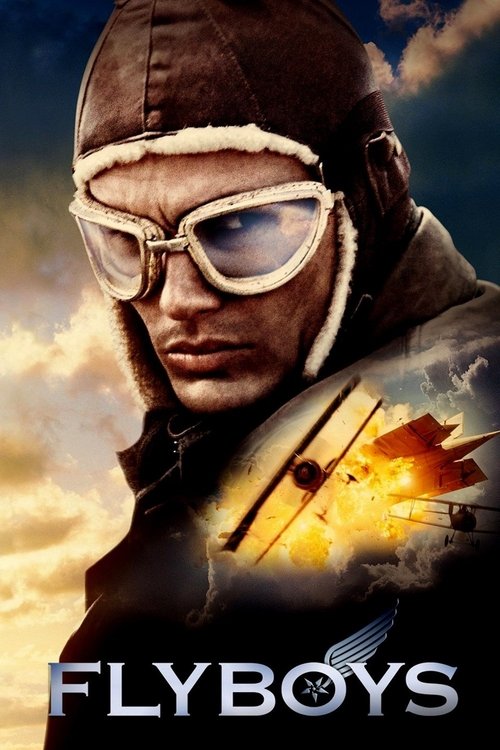
Flyboys (2006)
Directed by Tony Bill
No — Flyboys is not especially woke, scoring 21 out of 100 on our wokeness meter.
Flyboys arrives with the solemn bearing of a picture that believes it has something to say about courage, then spends two hours saying it about airplanes.
Consciousness Markers
The cast is overwhelmingly white and male, but the film includes Eugene Skinner, an African-American pilot based on Eugene Bullard, and a French female love interest.
Skinner's race is explicitly acknowledged: he is accepted in France as an athlete and later kept from flying in the U.S. Army because of his race.
The film is mostly an old-fashioned war drama, with only a brief racial injustice note regarding Skinner's postwar treatment.
No LGBTQ+ characters, themes, or subtext are present.
Lucienne exists primarily as a love interest and rescue object; the film has no feminist agenda or gender-conscious framing.
No environmental or climate themes appear.
A ranch foreclosure motivates one character, but the film does not advance an anti-capitalist or eat-the-rich argument.
No body-positivity themes or body-diversity messaging are present.
Jensen suffers an emotional breakdown, but the film does not frame this as neurodivergence or disability representation.
The film has historical inaccuracies, but they are not modern ideological revisionism; it is a conventional wartime dramatization.
Why it received this score
Flyboys arrives with the solemn bearing of a picture that believes it has something to say about courage, then spends two hours saying it about airplanes. Tony Bill, a pilot himself, fills the frame with Nieuports banking through flak and young men in leather helmets squinting at the horizon. James Franco plays a Texan whose family ranch is being foreclosed, which is as close as the screenplay comes to a political thought. The rest is dogfights, a French girl named Lucienne, and a German ace in a black Fokker who salutes before flying away. The year is 2006. The film is 1930 in its bones.
The cast is white and male to a man, with a single exception. Abdul Salis plays Eugene Skinner, a boxer who found acceptance in France as an athlete and was later kept from flying by his own army because of his race. The film states this plainly, then moves along. That is the whole of its social accounting. Lucienne exists to be loved and, in the final act, to be rescued from a village the Germans have entered. She is wounded in transit and serves as the occasion for a medal. Nobody in this squadron has an inner life the war has not already assigned him.
What the film does not contain is nearly as instructive as what it does. There is no environmental conscience, no economic grievance beyond one foreclosure, no interest in the body except as a thing that can be shot or amputated. Jensen breaks down after a battle and cannot fly again. The screenplay treats this as shell shock, full stop, and never reaches for a diagnostic vocabulary. The historical errors are plentiful and entirely innocent of ideology: wrong helmets, wrong engines, the wrong squadron entirely for the real Eugene Bullard. Sloppy, not seditious. It lectures exactly once, near the end, when Skinner is barred from the air at home, and even that lands softly. A film of modest ambitions and fewer convictions, which is its own kind of honesty.
Analysis generated by our Consciousness Algorithm


Synopsis
The adventures of the Lafayette Escadrille, young Americans who volunteered for the French military before the U.S. entered World War I, and became the country's first fighter pilots.
Questions about Flyboys
Is Flyboys woke?
No — Flyboys is not especially woke, scoring 21 out of 100 on our wokeness meter. That earns it a verdict of Based.
Does Flyboys have any woke elements?
2 of the 10 markers register at 30 or above, led by Racial Consciousness (35) and Representation Casting (35). On Racial Consciousness: Skinner's race is explicitly acknowledged: he is accepted in France as an athlete and later kept from flying in the U.S.
How does Flyboys compare to other 2006 movies?
It ranks #32 of the 211 films from 2006 we've scored; their average is 11. The wokest is An Inconvenient Truth (92).
How is the Woke Score calculated?
An AI-assisted process researches the film and its reception, scores it 0–100 on ten markers, then combines those into one 0–100 Woke Score. It measures a specific set of 2020s cultural themes, not film quality.