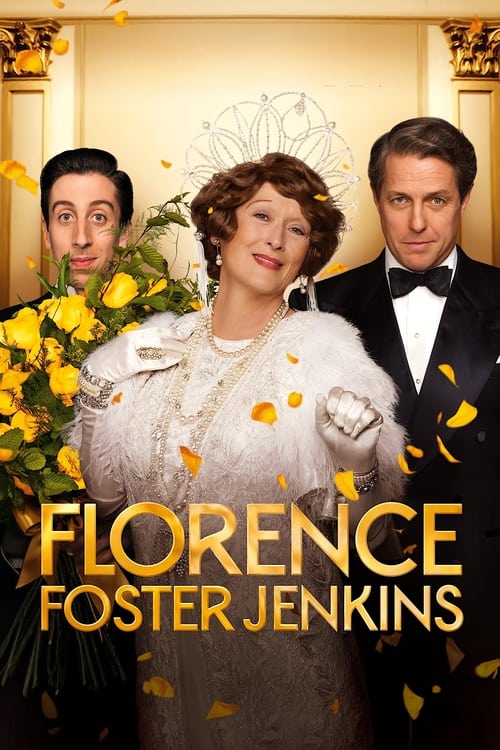
Florence Foster Jenkins (2016)
Directed by Stephen Frears
No — Florence Foster Jenkins is not woke, scoring 2 out of 100 on our wokeness meter.
Stephen Frears has assembled a handsomely upholstered period piece about a woman who could not sing and did so anyway, and the film asks nothing of us beyond a warm chuckle and a lump in the throat.
Consciousness Markers
Florence is a woman pursuing her artistic passion against social ridicule, but the film frames this as personal eccentricity and self-delusion rather than a feminist statement.
The film is a warm, crowd-pleasing dramedy that invites sympathy rather than delivering any explicit social or political sermon.
The cast is almost entirely white, reflecting the 1940s New York high-society milieu; no deliberate diverse or color-conscious casting is present.
No LGBTQ+ characters, relationships, or themes appear anywhere in the film.
The film engages no racial themes or commentary; its world is a uniformly white society milieu.
There is no environmental or climate-related content in the film.
Florence is a wealthy heiress whose generosity is celebrated rather than critiqued; the film has no anti-capitalist or class-warfare message.
No body-positivity themes or messaging are present.
No neurodivergence is depicted or discussed.
The film is a straightforward biographical account of a real person and does not revise or reinterpret history for ideological purposes.
Why it received this score
Stephen Frears has assembled a handsomely upholstered period piece about a woman who could not sing and did so anyway, and the film asks nothing of us beyond a warm chuckle and a lump in the throat. The New York of 1944 on display is a uniformly white drawing room of socialites, hotel suites, and Carnegie Hall boxes, and the film regards that world as a given, an aesthetic to be recreated with care. No color-conscious casting interrupts the historical tableau. No character pauses to explain an identity. The camera is interested in hats and chandeliers.
The moral engine here is not justice but loyalty. Florence is rich, and her riches are spent on recitals, on friends, on a thousand free tickets for soldiers. The film treats this generosity as a virtue and never as a symptom. There is no argument about class, no accounting of where the money came from, no suggestion that the arrangement is anything but charming. Her singing is a private delusion, lovingly protected by Hugh Grant's St. Clair Bayfield and Simon Helberg's increasingly haunted accompanist. We are invited to laugh, then to feel ashamed of laughing, then to weep. That is the whole transaction, and it is executed with skill.
A woman pursuing an impossible passion at forty-something, against the ridicule of strangers, carries a faint charge of self-assertion, but the film frames it as eccentricity, a medical condition of the spirit, not a manifesto. Nobody lectures. Nobody is corrected. The final concert, the newspaper review, the collapse, the deathbed vision: all of it is engineered for sympathy, and sympathy is not a political program. The result is a well-tailored, entirely harmless entertainment, and the sommelier's verdict is that this vintage is pleasant, uncomplicated, and leaves no message on the palate.
Analysis generated by our Consciousness Algorithm


Synopsis
The story of Florence Foster Jenkins, a New York heiress, who dreamed of becoming an opera singer, despite having a terrible singing voice.
Questions about Florence Foster Jenkins
Is Florence Foster Jenkins woke?
No — Florence Foster Jenkins is not woke, scoring 2 out of 100 on our wokeness meter. That earns it a verdict of Ultra Based.
Does Florence Foster Jenkins have any woke elements?
Very few. None of the 10 markers reaches 30, the level where a marker counts as present; the highest is Feminist Agenda at 10.
How does Florence Foster Jenkins compare to other 2016 movies?
It ranks #260 of the 285 films from 2016 we've scored; their average is 16. The wokest is 13th (92).
How is the Woke Score calculated?
An AI-assisted process researches the film and its reception, scores it 0–100 on ten markers, then combines those into one 0–100 Woke Score. It measures a specific set of 2020s cultural themes, not film quality.