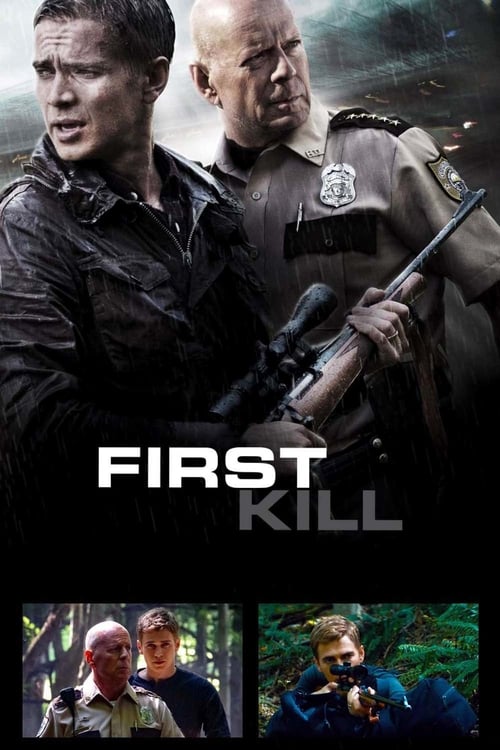
First Kill (2017)
Directed by Steven C. Miller
No — First Kill is not woke, scoring 0 out of 100 on our wokeness meter.
First Kill arrives with the grim efficiency of a direct-to-video thriller, which is to say it arrives, fulfills a contractual obligation, and departs.
Consciousness Markers
The cast is overwhelmingly white, with only minor supporting roles filled by non-white actors and no evident diversity-driven casting agenda.
No LGBTQ+ characters, relationships, or themes appear anywhere in the film.
Laura is a surgeon and a mother, but the film makes no feminist argument or commentary; she functions as a conventional hostage/leverage device.
The film engages no racial themes or commentary whatsoever; it is a straightforward crime thriller.
There is no environmental or climate-related content in the film.
A bank heist occurs, but it is driven by personal desperation (a girlfriend's dying mother) and police corruption, not by any anti-capitalist or class-warfare message. The protagonist is a Wall Street broker portrayed sympathetically.
No body positivity themes or messaging are present.
No neurodivergent characters or themes are depicted.
The film is a fictional crime thriller with no historical revisionism or recontextualization of real events.
The film delivers no social or political sermonizing; it is a by-the-numbers action thriller with no didactic messaging.
Why it received this score
First Kill arrives with the grim efficiency of a direct-to-video thriller, which is to say it arrives, fulfills a contractual obligation, and departs. Hayden Christensen plays a Wall Street broker who takes his family to rural Ohio to bond with a son who is being bullied at school. Bruce Willis plays the local police chief. A hunting trip goes wrong. A wounded bank robber takes the boy hostage, and the plot proceeds through double crosses, a stashed key, and a mailbox full of stolen cash. It is competent, joyless, and entirely without ideas beyond the next gunshot.
For the purposes of this classification, the film offers almost nothing to examine. The cast is white and the story is white, not as an argument but as a default. No character's identity is interrogated, celebrated, or even mentioned. The one female figure of consequence is Laura, a surgeon, and she spends most of the running time bandaged, abducted, or held at gunpoint, which is a function of screenwriting laziness, not ideology. The bank robbery that sets everything in motion is motivated by a dying mother's medical bills and police greed, not by any critique of capital; the protagonist is a broker, and the film regards him with mild sympathy throughout.
There is a bully subplot, and a lesson about standing up for oneself that the film delivers through a dying criminal bonding with a child over video games. That is as close as we come to a thesis, and it is closer to a fortune cookie than a sermon. The violence is functional, the villains are corrupt cops, and the resolution involves a boy pushing a man off a ladder and a father shooting a police chief in the head. Nothing in it argues for a better world or scolds us for the current one. It simply wants to be over, and by the final scene, when the family surrenders its rifle and drives home, we want the same thing.
Analysis generated by our Consciousness Algorithm
Part of


Synopsis
A police chief tries to solve a kidnapping that involves a bank robber holding a young boy hostage.
Questions about First Kill
Is First Kill woke?
No — First Kill is not woke, scoring 0 out of 100 on our wokeness meter. That earns it a verdict of Ultra Based.
Does First Kill have any woke elements?
No. All 10 markers score zero.
How does First Kill compare to other 2017 movies?
It ranks #281 of the 309 films from 2017 we've scored; their average is 19. The wokest is I Am Not Your Negro (92).
How is the Woke Score calculated?
An AI-assisted process researches the film and its reception, scores it 0–100 on ten markers, then combines those into one 0–100 Woke Score. It measures a specific set of 2020s cultural themes, not film quality.