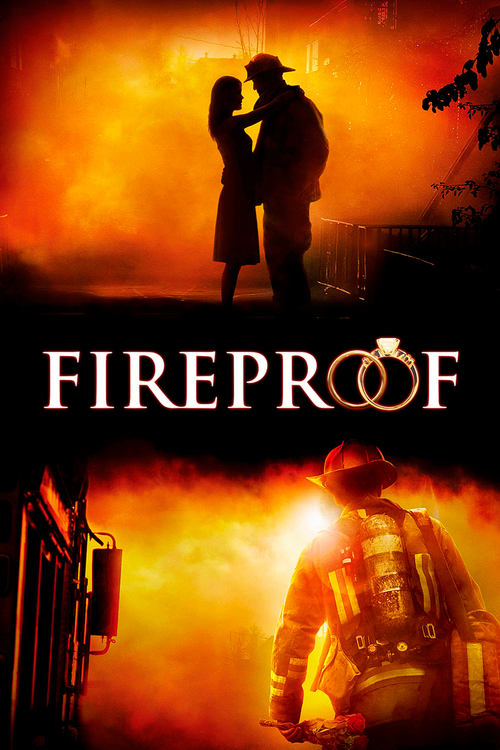
Fireproof (2008)
Directed by Alex Kendrick
No — Fireproof is not woke, scoring 9 out of 100 on our wokeness meter.
Fireproof arrives from Sherwood Baptist Church in Albany, Georgia, a congregation that supplied roughly 1,200 volunteers to fill out its cast and crew, along with donated fire stations, trucks, a train, and a hospital wing.
Consciousness Markers
The film is essentially a feature-length sermon, built around the didactic 'Love Dare' program and an explicit Christian conversion, with its message stated rather than dramatized.
The cast is overwhelmingly white, with Ken Bevel (Michael) providing a notable Black supporting presence, but there is no deliberate diversity-casting agenda at work.
No LGBTQ+ characters, themes, or subtext appear anywhere in the film.
The film advances an explicitly traditional, complementarian view of marriage in which the husband wins back his wife through sacrificial service; it is the opposite of a feminist text.
Race is never addressed or thematized; the story is entirely concerned with marital faith and personal redemption.
No environmental or climate themes are present.
The film contains no critique of wealth or capitalism; its moral economy is about personal sacrifice within a marriage, not class or economics.
No body-positivity themes or messaging appear.
No neurodivergent characters or themes are present.
The film is a contemporary fictional story with no historical subject matter to revise.
Why it received this score
Fireproof arrives from Sherwood Baptist Church in Albany, Georgia, a congregation that supplied roughly 1,200 volunteers to fill out its cast and crew, along with donated fire stations, trucks, a train, and a hospital wing. The film concerns Caleb Holt, a fire captain whose professional creed of never leaving a partner behind does not extend to his own marriage. His wife Catherine, a hospital administrator, wants a divorce. His father hands him a journal called the Love Dare, forty days of prescribed gestures, and the machinery of the plot begins to turn. Critics were unmoved, with a Metacritic score of 28, though the film opened at number four and earned $33 million, which suggests the audience it was made for was waiting.
The Love Dare is less a narrative device than a curriculum, and the film treats it as such, with Bible verses printed on the page and a conversion scene that lands with the weight of a scheduled appointment. Caleb's transformation is announced, then demonstrated, then announced again. The film's view of marriage is complementarian and unapologetic about it: the husband wins back his wife through sacrificial service, and the wife is won. Any viewer arriving with contemporary expectations about gender roles will find the door politely closed, and the film will not be troubled by the knocking.
The cast is almost entirely white, and race never enters the conversation. Neither does anything else from the current cultural conversation. There is a Black supporting presence in Michael, played by Ken Bevel, but the film has no interest in what that might mean, and neither does the film have any interest in what it might not. This is a picture about one thing, and it pursues that thing with a single-mindedness that is, in its own austere way, respectable. It is a sermon with a budget, and it never once pretends otherwise.
Analysis generated by our Consciousness Algorithm


Synopsis
A heroic fire captain values dedication and service to others above all else, but the most important partnership in his life, his marriage, is about to go up in smoke.
Questions about Fireproof
Is Fireproof woke?
No — Fireproof is not woke, scoring 9 out of 100 on our wokeness meter. That earns it a verdict of Ultra Based.
Does Fireproof have any woke elements?
1 of the 10 markers register at 30 or above, led by Lecture Energy (75). On Lecture Energy: The film is essentially a feature-length sermon, built around the didactic 'Love Dare' program and an explicit Christian conversion, with its message stated rather than dramatized.
How does Fireproof compare to other 2008 movies?
It ranks #102 of the 212 films from 2008 we've scored; their average is 12. The wokest is Milk (68).
How is the Woke Score calculated?
An AI-assisted process researches the film and its reception, scores it 0–100 on ten markers, then combines those into one 0–100 Woke Score. It measures a specific set of 2020s cultural themes, not film quality.