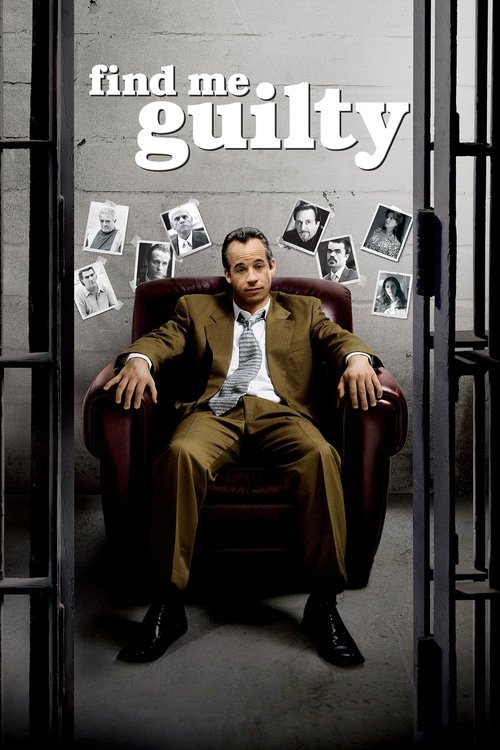
Find Me Guilty (2006)
Directed by Sidney Lumet
No — Find Me Guilty is not woke, scoring 5 out of 100 on our wokeness meter.
Sidney Lumet spent a career in courtrooms, and Find Me Guilty finds him back in familiar chambers with a defendant who insists on representing himself.
Consciousness Markers
The cast is overwhelmingly Italian-American, which is period- and story-appropriate rather than a diversity mandate. Peter Dinklage appears as defense attorney Ben Klandis in a non-stereotypical role, a mild note of inclusive casting, but nothing is made of it.
The courtroom setting invites some moralizing about loyalty and family, but the film stays a character-driven drama rather than a sermon on social issues.
Annabella Sciorra and other women appear in supporting roles, but the film is a male-dominated mobster courtroom drama with no feminist framing or commentary.
No LGBTQ+ characters, themes, or subtext appear anywhere in the trial or the mob storyline.
The film concerns Italian-American organized crime and the federal prosecution of it; race as a social-justice theme is entirely absent.
No environmental or climate themes whatsoever.
The story is about mobsters and prosecutors, not economic critique; the mafia is depicted as a criminal enterprise, not a metaphor for capitalism.
No body-positivity themes or messaging.
No neurodivergence themes or characters.
The film faithfully adapts the real DiNorscio trial, drawing dialogue from actual court transcripts; it revises nothing for ideological purposes.
Why it received this score
Sidney Lumet spent a career in courtrooms, and Find Me Guilty finds him back in familiar chambers with a defendant who insists on representing himself. Vin Diesel plays Jackie DiNorscio, a New Jersey mobster folded into the longest racketeering trial in American history, and the film lifts its dialogue from the actual transcripts. The result is a talky, overlong, oddly endearing piece of work that arrived in 2006 to a shrug and a domestic gross of roughly one million dollars. Lumet, as ever, knew how to point a camera at a man talking.
Assessing the film's cultural temperature yields little heat. The cast is Italian-American almost to a person, which the story demands and nobody bothers to interrogate. Peter Dinklage turns up as a defense attorney, playing the role straight, and the film makes no remark upon it. Women appear in supporting capacities and are then dismissed by the narrative. Race, class, climate, and the body as a political site are absent entirely. What remains is a modest strain of sermonizing about loyalty and family, delivered from the witness stand, which the film treats as character instead of doctrine. Nobody here is being taught a lesson about the wider world.
Find Me Guilty reads as a relic of a pre-2015 sensibility, when a movie could concern mobsters and prosecutors and nothing else. It is not hostile to progressive values. It simply never considers them. The film's only agenda belongs to Jackie, and Jackie's agenda is Jackie. For a viewer cataloguing the era's moral commitments, the picture is a dry well, and a pleasant one. The verdict, in the end, is not guilty of the charges before us.
Analysis generated by our Consciousness Algorithm


Synopsis
Based on the true story of Jack DiNorscio, a mobster who defended himself in court for what would be the longest mafia trial in U.S. history.
Questions about Find Me Guilty
Is Find Me Guilty woke?
No — Find Me Guilty is not woke, scoring 5 out of 100 on our wokeness meter. That earns it a verdict of Ultra Based.
Does Find Me Guilty have any woke elements?
Very few. None of the 10 markers reaches 30, the level where a marker counts as present; the highest is Representation Casting at 12.
How does Find Me Guilty compare to other 2006 movies?
It ranks #132 of the 211 films from 2006 we've scored; their average is 11. The wokest is An Inconvenient Truth (92).
How is the Woke Score calculated?
An AI-assisted process researches the film and its reception, scores it 0–100 on ten markers, then combines those into one 0–100 Woke Score. It measures a specific set of 2020s cultural themes, not film quality.