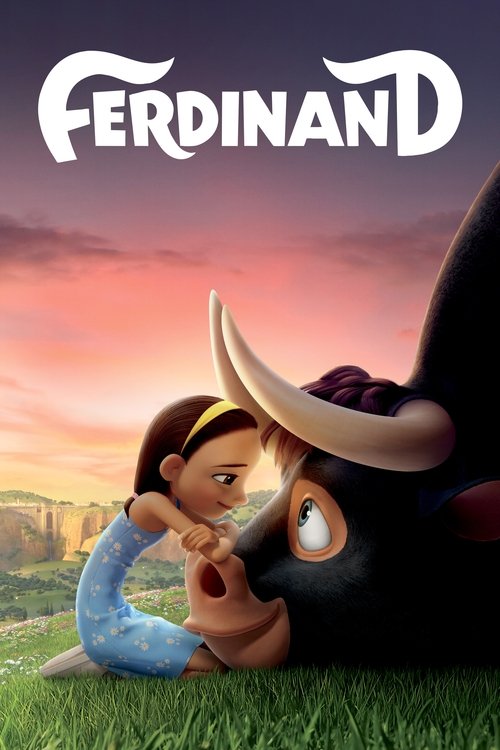
Ferdinand (2017)
Directed by Carlos Saldanha
No — Ferdinand is not woke, scoring 19 out of 100 on our wokeness meter.
Ferdinand arrives as a soft-spoken adaptation of Munro Leaf and Robert Lawson's 1936 children's book, following a pacifist bull through a Spain rendered in bright, harmless animation.
Consciousness Markers
A notably multiethnic voice cast (Anthony Anderson, Gina Rodriguez, Daveed Diggs, Gabriel Iglesias, Boris Kodjoe, Flula Borg) anchors a Spain-set story, though the diversity is never remarked upon within the film itself.
The film wears its moral plainly — pacifism over violence, be yourself, don't conform to expectations — and delivers it through repeated speeches and a climactic arena stand, though the sermon is gentle and aimed at children.
The film indicts the bullfighting industry as a commercial spectacle that discards animals as product, with non-fighters literally sent to the chop house, but the critique is aimed at animal cruelty rather than economic systems.
Ferdinand is enormous yet gentle, Bones is undersized, and the misfit herd is celebrated for what it is, offering a mild 'your body doesn't dictate your nature' message without any explicit body-acceptance framing.
Lupe the goat serves as a sharp-tongued female mentor and Nina is a sympathetic girl, but the film advances no feminist argument and the bulls' arc is entirely male-driven.
No LGBTQ+ characters, relationships, or subtext appear in the film; a Spanish critic's reading of the anti-bullying message as an 'implicit defense of sexual and gender diversity' is an external interpretation, not content.
The film contains no engagement with racial identity, racism, or racial justice themes whatsoever.
No environmental or climate themes are present; the flower farm is scenery, not a cause.
Maquina the silent, grunting lab-cloned bull and Ferdinand's non-conformity are quirks of character rather than any depiction or discussion of neurodivergence.
The film is a loose adaptation of a 1936 children's book, not a revisionist account of historical events.
Why it received this score
Ferdinand arrives as a soft-spoken adaptation of Munro Leaf and Robert Lawson's 1936 children's book, following a pacifist bull through a Spain rendered in bright, harmless animation. The voice cast is notably multiethnic, with Anthony Anderson, Gina Rodriguez, Daveed Diggs, Gabriel Iglesias, and Boris Kodjoe among the players, yet the film never remarks on this fact. A Spanish setting populated by a polyglot American ensemble is simply the arrangement. The film's social consciousness is mild and old-fashioned, rooted in pacifism, anti-bullying, and the refusal to conform. It has no interest in racial identity, no climate concerns, and no LGBTQ characters or subtext. A critic's reading of the anti-bullying message as an implicit defense of sexual and gender diversity remains an external interpretation, not content.
The strongest progressive gesture here is the indictment of bullfighting as commercial spectacle. Casa del Toro treats animals as product, and non-fighters are sent to the chop house. That critique aims at animal cruelty, not economic systems. The body-positive note is equally gentle: Ferdinand is enormous yet gentle, Bones is undersized, and the misfit herd is accepted for what it is. A feminist argument does not appear. Lupe, the sharp-tongued goat, and Nina, the sympathetic girl, are welcome presences, but the bulls' arc is male-driven. Maquina's silence and Ferdinand's nonconformity read as character quirks, not any depiction of neurodivergence.
The film wears its moral plainly. Be yourself. Refuse violence. Do not conform to expectations. It repeats these lessons through speeches and a climactic arena stand, though the sermon is soft and aimed at children. Revisionist history is absent; this is a loose adaptation of a children's fable, not a reworking of historical events. The result is pleasant, mildly preachy, and content to be small. It earns a modest measure of cultural awareness without ever becoming a lecture. The film asks only to be loved for its gentleness. For the most part, it is.
Analysis generated by our Consciousness Algorithm


Synopsis
Ferdinand, a little bull, prefers sitting quietly under a cork tree just smelling the flowers versus jumping around, snorting, and butting heads with other bulls. As Ferdinand grows big and strong, his temperament remains mellow. But one day five men come to choose the "biggest, fastest, roughest bull" for the bullfights in Madrid— and Ferdinand is mistakenly chosen.
Questions about Ferdinand
Is Ferdinand woke?
No — Ferdinand is not woke, scoring 19 out of 100 on our wokeness meter. That earns it a verdict of Ultra Based.
Does Ferdinand have any woke elements?
2 of the 10 markers register at 30 or above, led by Representation Casting (45) and Lecture Energy (35). On Representation Casting: A notably multiethnic voice cast (Anthony Anderson, Gina Rodriguez, Daveed Diggs, Gabriel Iglesias, Boris Kodjoe, Flula Borg) anchors a Spain-set story, though the diversity is never remarked upon within the film itself.
How does Ferdinand compare to other 2017 movies?
It ranks #96 of the 309 films from 2017 we've scored; their average is 19. The wokest is I Am Not Your Negro (92).
How is the Woke Score calculated?
An AI-assisted process researches the film and its reception, scores it 0–100 on ten markers, then combines those into one 0–100 Woke Score. It measures a specific set of 2020s cultural themes, not film quality.