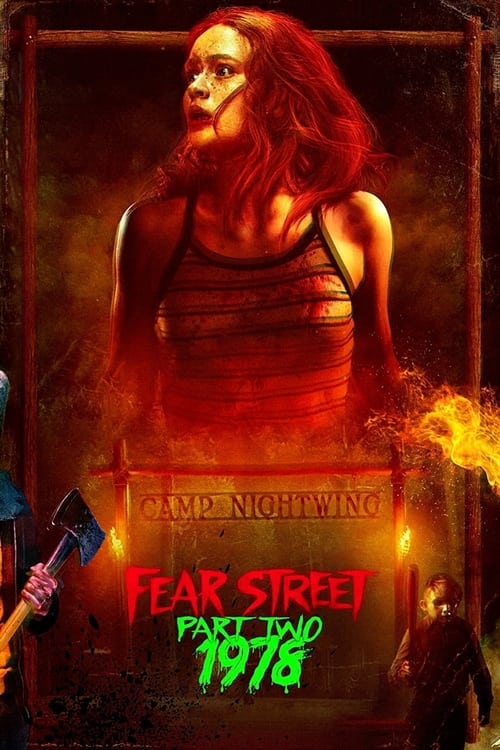
Fear Street: 1978 (2021)
Directed by Leigh Janiak
No — Fear Street: 1978 is not woke, scoring 16 out of 100 on our wokeness meter.
Fear Street: 1978, the second panel in Leigh Janiak's Netflix triptych, returns to Camp Nightwing for a summer of curses, counselors, and creative slaughter.
Consciousness Markers
The trilogy's central lesbian relationship (Deena and Sam) appears in the framing device, and the 1978 segment includes a romantic confession from Alice to Cindy, but LGBTQ+ themes are secondary to the slasher plot.
The film features actors of color in its 1994 framing sequences (Kiana Madeira, Benjamin Flores Jr.), but the 1978 main cast is predominantly white, so representation is present but limited.
The film centers on two sisters and features a female director, but its feminist elements are largely confined to the final-girl trope and sisterly bond rather than an explicit agenda.
No racial themes or commentary are present in the film.
No environmental themes.
No anti-capitalist message.
No body positivity themes.
No neurodivergence themes.
No revisionist history.
The film does not lecture or preach; it is a straightforward slasher.
Why it received this score
Fear Street: 1978, the second panel in Leigh Janiak's Netflix triptych, returns to Camp Nightwing for a summer of curses, counselors, and creative slaughter. The film knows its slasher grammar well. It also carries a small amount of cultural baggage from its parent trilogy. The 1994 framing device gives us Kiana Madeira and Benjamin Flores Jr. in key roles, so representation exists at the edges. The 1978 main cast is overwhelmingly white, which limits the claim. The trilogy's central lesbian relationship remains in the framing story, and Alice's confession to Cindy adds a secondary queer thread, but the camp massacre stays the main event. A female director and a sisterly bond between Ziggy and Cindy supply a feminist undertow. It is not a manifesto. It is a final girl with a lighter burn and a grudge.
Elsewhere, the film keeps its social concerns in the shallow end. Race is not examined. The climate is not a character. Capitalism is not the monster. Body image, neurodivergence, and historical revisionism are absent. The screenplay does not pause for sermons. The class divide between Shadyside and Sunnyvale provides friction, yet it functions as tribal cruelty and plot mechanics, not as a sustained indictment of economic hierarchy. The horror comes from possession, witchcraft, and a town's rotten inheritance. Audiences are invited to flinch, not to reeducate themselves. That restraint is worth respecting, even if the mythology sometimes sags under its own seriousness. The kills are nasty. The nostalgia is thick. The moral instruction is minimal.
As a cultural artifact, this is a light vintage. It belongs to the streaming era's appetite for rebooted horror with a few inclusive gestures, yet it refuses to turn those gestures into a thesis. The lesbian romance and the multiracial framing cast keep it from being a total absence on the representation front. The sisterhood at the center gives it a faint feminist shimmer. Everything else is blood, synth, and summer camp. The film is most alive when it lets Sadie Sink snarl and the axe fall. It is least alive when it explains the curse. For the connoisseur of social consciousness, this is not a challenging pour. It is a pleasant slasher with a conscience that stays mostly offscreen.
Analysis generated by our Consciousness Algorithm


Synopsis
In 1978, two rival groups at Camp Nightwing must band together to solve a terrifying mystery when horrors from their towns' history come alive.
Questions about Fear Street: 1978
Is Fear Street: 1978 woke?
No — Fear Street: 1978 is not woke, scoring 16 out of 100 on our wokeness meter. That earns it a verdict of Ultra Based.
Does Fear Street: 1978 have any woke elements?
1 of the 10 markers register at 30 or above, led by LGBTQ+ Themes (35). On LGBTQ+ Themes: The trilogy's central lesbian relationship (Deena and Sam) appears in the framing device, and the 1978 segment includes a romantic confession from Alice to Cindy, but LGBTQ+ themes are secondary to the slasher plot.
How does Fear Street: 1978 compare to other 2021 movies?
It ranks #127 of the 242 films from 2021 we've scored; their average is 23. The wokest is The Forever Purge (83).
Is Fear Street: 1978 the most woke Fear Street movie?
No. It ranks #3 of the 3 Fear Street films we've scored; the wokest is Fear Street: 1994 (60).