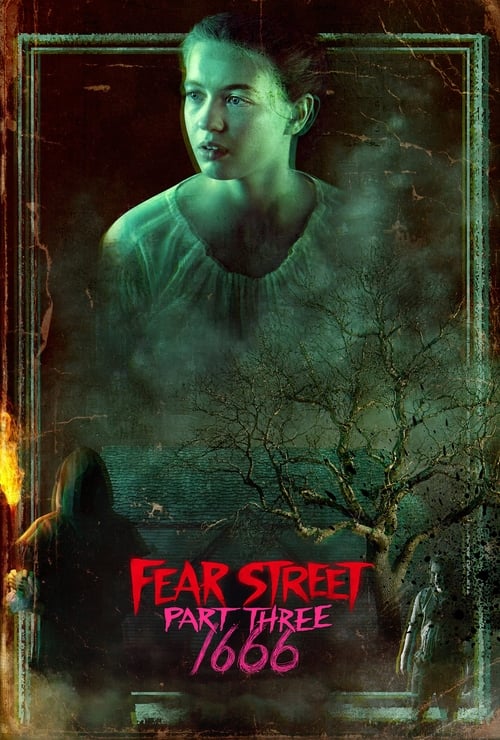
Fear Street: 1666 (2021)
Directed by Leigh Janiak
Partly — Fear Street: 1666 is somewhat woke, scoring 53 out of 100 on our wokeness meter.
Fear Street: 1666 arrives as the third and final installment of a trilogy that spent two films building toward a colonial flashback, and it delivers that flashback with the solemnity of a historical epic and the accents of a community theater production of The Crucible.
Consciousness Markers
The central romance between Sarah and Hannah in 1666 is a same-sex love story whose persecution drives the plot, and the 1994 thread centers Deena and Sam's relationship.
The film revises the witch-trial narrative by making the accused witch, Sarah Fier, a victim and revealing the real evil as Solomon Goode's ritual sacrifice of Shadyside.
The cast is notably diverse for both the 1666 and 1994 segments, including actors of color and queer leads, though the film does not foreground representation as a theme.
A female director and female protagonist frame the witch hunt as a patriarchal accusation against women, but the film is more a genre thriller than an explicit feminist statement.
The Shadyside/Sunnyvale divide and the Goode family's prosperity built on sacrificing Shadyside residents give the film a class-exploitation undercurrent.
Themes of homophobia, witch hunts, and class injustice are present but mostly delivered through horror plotting rather than direct moral lecturing.
The film has a diverse cast but does not engage with racial themes or racial consciousness in its plot or dialogue.
There is no environmental or climate-related content in the film.
There is no body-positive theme or commentary in the film.
There is no exploration of neurodivergence in the film.
Why it received this score
Fear Street: 1666 arrives as the third and final installment of a trilogy that spent two films building toward a colonial flashback, and it delivers that flashback with the solemnity of a historical epic and the accents of a community theater production of The Crucible. The central revision is tidy. Sarah Fier, long remembered as the witch who cursed Shadyside, was in fact a young woman in love with Hannah Miller, executed by neighbors who needed someone to blame. The real monster is Solomon Goode, a landowner who traded a possessed pastor and a string of dead children for prosperity. It is a clean inversion, and the film commits to it.
The same-sex romance sits at the center of the 1666 half, and the 1994 half returns to Deena and Sam, so the trilogy's emotional engine runs on a relationship the Puritans would have hanged. The casting is diverse across both time periods without making a spectacle of itself, which is the more durable approach. Beneath the witchcraft there is a class grievance: Sunnyvale prospers while Shadyside bleeds, generation after generation, because one family found a business model in human sacrifice. That is an old complaint dressed in period linen, and it lands with modest force.
Where the film holds back is in the sermon. The themes are present, the homophobia and the scapegoating and the inherited poverty, but they arrive through stabbings and possession and a mall full of reanimated killers, not through a lecture. The result is a finale that prefers spectacle to argument, and the trilogy is better for it. Janiak keeps the proceedings brisk, the gore generous, and the moral ledger legible without underlining it. A satisfying conclusion, and a restrained one.
Analysis generated by our Consciousness Algorithm


Synopsis
In 1666, a colonial town is gripped by a hysterical witch-hunt that has deadly consequences for centuries to come, and it's up to teenagers in 1994 to finally put an end to their town's curse, before it's too late.
Questions about Fear Street: 1666
Is Fear Street: 1666 woke?
Partly — Fear Street: 1666 is somewhat woke, scoring 53 out of 100 on our wokeness meter. That earns it a verdict of Woke-Adjacent.
What makes Fear Street: 1666 woke?
6 of the 10 markers register at 30 or above, led by LGBTQ+ Themes (75), Revisionist History (60) and Representation Casting (55). On LGBTQ+ Themes: The central romance between Sarah and Hannah in 1666 is a same-sex love story whose persecution drives the plot, and the 1994 thread centers Deena and Sam's relationship.
How does Fear Street: 1666 compare to other 2021 movies?
It ranks #24 of the 242 films from 2021 we've scored; their average is 23. The wokest is The Forever Purge (83).
Is Fear Street: 1666 the most woke Fear Street movie?
No. It ranks #2 of the 3 Fear Street films we've scored; the wokest is Fear Street: 1994 (60).