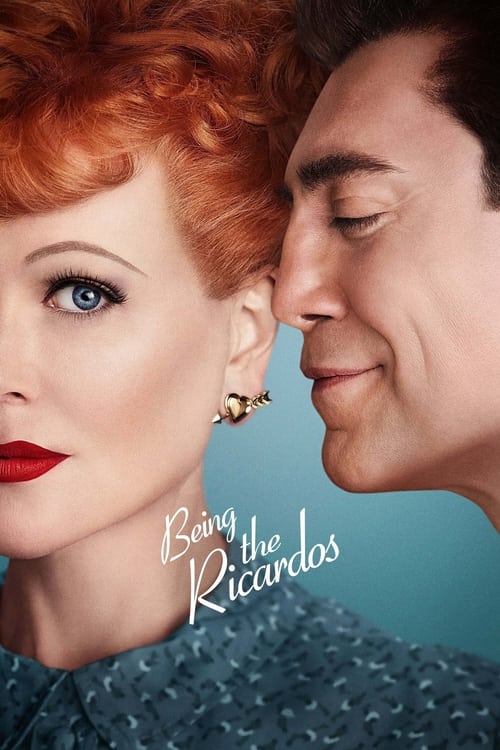
Being the Ricardos (2021)
Directed by Aaron Sorkin
Yes — Being the Ricardos is woke, scoring 65 out of 100 on our wokeness meter.
Aaron Sorkin turns his attention to the marriage and working lives of Lucille Ball and Desi Arnaz, two people who built a television empire while slowly dismantling each other.
Consciousness Markers
The film explores the Cuban-American experience in Hollywood and the inherent tensions surrounding ethnic representation and casting choices.
It centers on Lucille Ball's struggle against the patriarchal studio system, highlighting her professional demands and creative agency in a male-dominated industry.
The film tackles the complexities of interracial marriage and the fraught casting of a Spanish actor in a Cuban-American role, generating significant cultural discourse.
Aaron Sorkin's signature rapid-fire, highly articulate dialogue frequently delivers dense exposition and political commentary, bordering on a dramatic lecture.
It attempts to revise the history of Hollywood and McCarthyism, though the research indicates significant factual inaccuracies regarding the timeline and events.
While it critiques the studio machine, the film operates within the capitalist framework of Hollywood, offering no genuine anti-establishment ideology.
The narrative focuses entirely on heterosexual marriage and professional rivalry, offering no commentary on LGBTQ+ themes.
The environmental impact of the 1950s studio system is entirely absent from the narrative focus.
The film does not engage with body image or challenge conventional standards of physical appearance.
There is no evidence of characters or plot points related to neurodivergence.
Why it received this score
Aaron Sorkin turns his attention to the marriage and working lives of Lucille Ball and Desi Arnaz, two people who built a television empire while slowly dismantling each other. The film moves between present-day interviews, courtship flashbacks, and a single fraught week of production in 1953, when a Communist accusation, a pregnancy, and a tabloid photograph all converge on the same soundstage. Nicole Kidman does the heavy lifting, finding the rasp in the writers' room and the squawk on camera, and Javier Bardem brings a coiled charm to Arnaz even when the resemblance is purely spiritual.
The picture carries a substantial quantity of progressive freight. Ball's fight against a studio system that treats her as a chattel object is rendered with real conviction, and the casting of a Spanish actor to play a Cuban-American man generated the kind of discourse that accompanies such decisions for years afterward. The film is aware of the ethnic frictions in its own premise, even as it declines to resolve them. What it does not do is question the machinery it depicts; Hollywood remains a business to be navigated, not dismantled. Sorkin's dialogue remains his dialogue, which means that characters explain their own subtext at a velocity that verges on the professorial. The historical record has been rearranged in places, most notably around the timing of the Cuban Revolution and a phone call from J. Edgar Hoover that never happened.
The emotional content is largely heterosexual, corporeal, and conventional, which is presumably the point of a period piece about a 1950s marriage. Some concerns simply do not apply here, and it would be dishonest to invent them. What remains is a well-acted, well-dressed chamber drama about ambition, infidelity, and the cost of being the funniest person in the room. Sommelier's note: medium body, notes of cigarette smoke and contract law, finishes with a divorce filing. It pairs adequately with a streaming queue and requires no decanting.
Analysis generated by our Consciousness Algorithm


Synopsis
Lucille Ball and Desi Arnaz face a crisis that could end their careers and another that could end their marriage.
Questions about Being the Ricardos
Is Being the Ricardos woke?
Yes — Being the Ricardos is woke, scoring 65 out of 100 on our wokeness meter. That earns it a verdict of Woke.
What makes Being the Ricardos woke?
5 of the 10 markers register at 30 or above, led by Racial Consciousness (80), Feminist Agenda (75) and Representation Casting (65). On Racial Consciousness: The film explores the Cuban-American experience in Hollywood and the inherent tensions surrounding ethnic representation and casting choices.
How does Being the Ricardos compare to other 2021 movies?
It ranks #8 of the 242 films from 2021 we've scored; their average is 23. The wokest is The Forever Purge (83).
How is the Woke Score calculated?
An AI-assisted process researches the film and its reception, scores it 0–100 on ten markers, then combines those into one 0–100 Woke Score. It measures a specific set of 2020s cultural themes, not film quality.