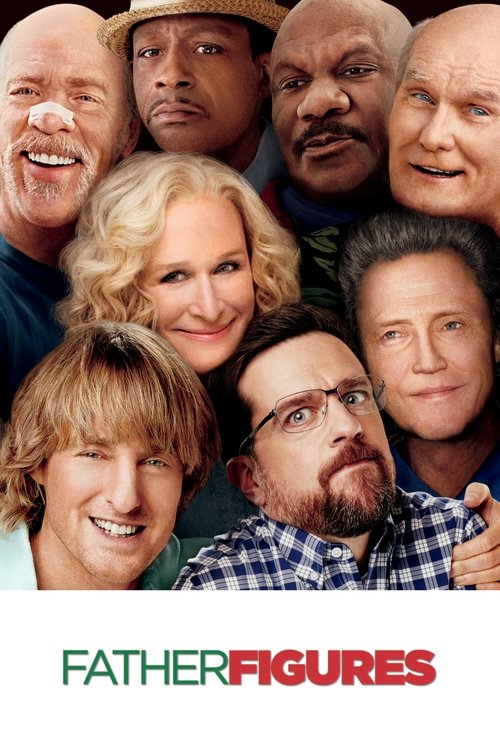
Father Figures (2017)
Directed by Lawrence Sher
No — Father Figures is not woke, scoring 5 out of 100 on our wokeness meter.
Father Figures arrives with the modest ambition of making us laugh at two grown men hunting for a biological father across the eastern seaboard, and it achieves perhaps a third of that ambition.
Consciousness Markers
The cast includes several minority performers (Katt Williams, Ving Rhames, Retta, Ali Wong), but they occupy conventional comedic roles with no commentary on their presence. This is natural casting, not representation casting.
No LGBTQ+ characters, themes, or subtext appear anywhere in the film.
Glenn Close's character is a sexually active older woman, but this is played for bawdy comedy rather than any feminist statement. No feminist agenda is present.
The film engages no racial themes or consciousness whatsoever; minority characters exist without any racial commentary.
No environmental or climate themes appear in the film.
Wealth (BBQ sauce royalties) and a petty-criminal subplot exist as plot devices, but the film offers no critique of capitalism or the wealthy.
No body positivity themes or messaging are present.
No neurodivergent characters or themes are depicted.
The film is a fictional road-trip comedy with no historical revisionism.
This is a lowbrow R-rated comedy that aims only to amuse; it contains no preachy or lecturing energy.
Why it received this score
Father Figures arrives with the modest ambition of making us laugh at two grown men hunting for a biological father across the eastern seaboard, and it achieves perhaps a third of that ambition. Lawrence Sher, a distinguished cinematographer stepping behind the camera, directs with the energy of a man filling out paperwork. The premise (fraternal twins, a promiscuous mother played by Glenn Close, a parade of possible sires) is a road-trip engine that sputters from Miami to Worcester without ever finding a gear. Critics were unkind. Audiences were indifferent. The film grossed less than its budget and finished ninth on its opening weekend, which is its own kind of review.
The cast is studded with minority performers: Katt Williams as a philosophizing hitchhiker, Ving Rhames as a retired football player, Retta as a wedding planner, Ali Wong as a nurse. Their presence is unremarked upon, which is to say the film casts them and then asks nothing of them. This is ordinary comedic hiring, not a statement. Close's Helen, a woman of a certain age with an enthusiastic romantic history, is played for bawdy laughs. Nobody in the production appears to have consulted a manifesto. The screenplay contains no thesis on race, class, gender, or the environment, and no character pauses the action to instruct the audience on how to live.
What the film does contain is a hitchhiker who dispenses fortune-cookie wisdom, a proctologist's midlife crisis, and a final act that reveals an adoption, a dead mother, and a satisfying vacation in Maui. The cultural ledger here is close to blank. Father Figures is not a lecture. It is not a sermon. It is a comedy that was shot in 2015, sat on a shelf, was reshot to improve an ending, and then released into a marketplace that had moved on. We can respect it for its refusal to preach. We cannot respect much else.
Analysis generated by our Consciousness Algorithm
Part of


Synopsis
Upon learning that their mother has been lying to them for years about their allegedly deceased father, two fraternal twin brothers hit the road in order to find him.
Questions about Father Figures
Is Father Figures woke?
No — Father Figures is not woke, scoring 5 out of 100 on our wokeness meter. That earns it a verdict of Ultra Based.
Does Father Figures have any woke elements?
Very few. None of the 10 markers reaches 30, the level where a marker counts as present; the highest is Representation Casting at 12.
How does Father Figures compare to other 2017 movies?
It ranks #241 of the 309 films from 2017 we've scored; their average is 19. The wokest is I Am Not Your Negro (92).
How is the Woke Score calculated?
An AI-assisted process researches the film and its reception, scores it 0–100 on ten markers, then combines those into one 0–100 Woke Score. It measures a specific set of 2020s cultural themes, not film quality.