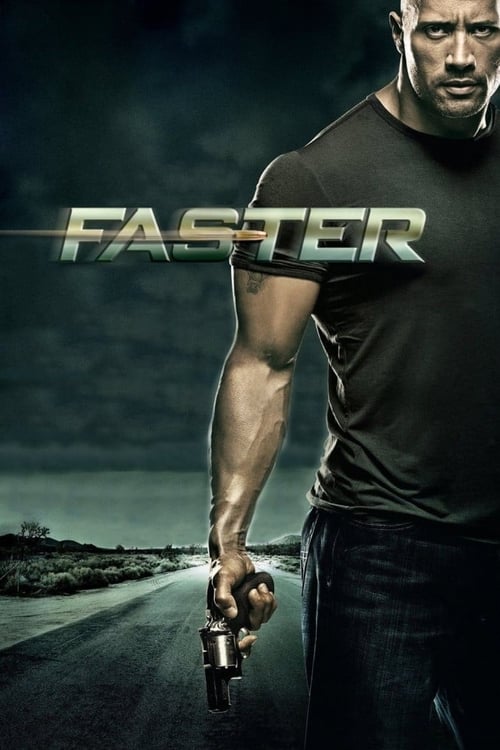
Faster (2010)
Directed by George Tillman Jr.
No — Faster is not woke, scoring 14 out of 100 on our wokeness meter.
Faster arrives with the grim efficiency of a man who has already decided what he is going to do and sees no reason to discuss it.
Consciousness Markers
The cast is notably diverse, with Dwayne Johnson as the lead, a Black director, and supporting players including Adewale Akinnuoye-Agbaje, Mike Epps, and Moon Bloodgood, though the diversity is not framed as a message.
Carla Gugino plays a capable female detective and several women have supporting roles, but the film has no feminist thesis or gender-focused critique.
No LGBTQ+ characters, themes, or subtext are present.
Race is not a thematic concern; the diverse cast exists without racial commentary.
No environmental or climate-related content.
The revenge plot involves criminals and police but offers no critique of capitalism or wealth.
No body-positivity themes or messaging.
No neurodivergence themes or characters.
Not a historical film and makes no revisionist historical claims.
The film is a straightforward revenge thriller and does not pause for social or political lecturing.
Why it received this score
Faster arrives with the grim efficiency of a man who has already decided what he is going to do and sees no reason to discuss it. Dwayne Johnson, playing a character credited only as Driver, leaves prison and works through a list of names, and the film treats the whole business as an administrative matter. There is no montage of moral hesitation. No scene in which a wise friend explains that vengeance is corrosive. Roger Ebert observed that with a period change and sharper dialogue this could have passed for 1940s noir. He was right, and he meant it as the faintest possible compliment.
The cast is diverse in a way that nobody on screen feels compelled to mention. A Black director, a Samoan-American star, and supporting turns from Adewale Akinnuoye-Agbaje, Mike Epps, and Moon Bloodgood form a genuinely mixed ensemble, and the film simply uses them. Carla Gugino's Detective Cicero is competent, dogged, and entirely uninterested in making a point about her gender. Race never becomes a subject. Money never becomes a subject, though everyone in the story is chasing it. The villains are individuals with names and grievances, not a system, and the screenplay has no ambition to pretend otherwise.
The closest the film comes to a sermon is the evangelist Alexander Jarod, a former criminal who found religion and begs for his life in a church. That scene concerns grace and forgiveness, which are old concerns, not new ones. It plays as histrionic, as several critics noted at the time, but it is not a lecture about society. Left over is a lean, joyless machine of a movie that wants only to move forward. It offers nothing to the cultural moment and asks nothing of it. In 2010 that read as a limitation. Viewed now, it reads as a small mercy.
Analysis generated by our Consciousness Algorithm


Synopsis
After 10 years in prison, Driver is now a free man with a single focus - hunting down the people responsible for brutally murdering his brother.
Questions about Faster
Is Faster woke?
No — Faster is not woke, scoring 14 out of 100 on our wokeness meter. That earns it a verdict of Ultra Based.
Does Faster have any woke elements?
1 of the 10 markers register at 30 or above, led by Representation Casting (30). On Representation Casting: The cast is notably diverse, with Dwayne Johnson as the lead, a Black director, and supporting players including Adewale Akinnuoye-Agbaje, Mike Epps, and Moon Bloodgood, though the diversity is not framed as a message.
How does Faster compare to other 2010 movies?
It ranks #57 of the 238 films from 2010 we've scored; their average is 11. The wokest is My Name Is Khan (84).
How is the Woke Score calculated?
An AI-assisted process researches the film and its reception, scores it 0–100 on ten markers, then combines those into one 0–100 Woke Score. It measures a specific set of 2020s cultural themes, not film quality.