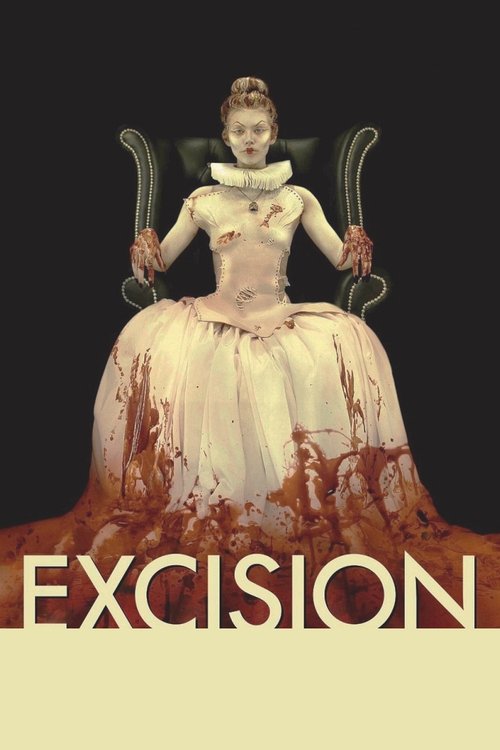
Excision (2012)
Directed by Richard Bates Jr.
No — Excision is not woke, scoring 4 out of 100 on our wokeness meter.
Excision arrives from 2012, a year that now reads as the final exhale before the culture acquired a conscience.
Consciousness Markers
The cast includes deaf actress Marlee Matlin and an eclectic ensemble, but this is organic casting rather than a deliberate diversity-forward statement.
The film centers a teenage girl and her domineering mother, but its focus is body horror and pathology rather than any feminist thesis.
No LGBTQ+ themes or characters appear; Pauline's psychosexual fixations are heterosexual in nature.
Race is entirely absent as a theme or concern.
No environmental or climate content whatsoever.
No economic or class critique; the antagonist is mental illness, not capital.
The film is a body-horror exercise in mutilation and self-harm, the antithesis of body-positivity messaging.
Pauline's delusions and psychosis are framed as monstrous horror, not as affirming neurodivergent representation.
No historical subject matter to revise.
The film provokes and disturbs but never lectures the audience on social issues.
Why it received this score
Excision arrives from 2012, a year that now reads as the final exhale before the culture acquired a conscience. Richard Bates Jr.'s debut concerns Pauline, a high school outcast who fantasizes about surgery and blood and who eventually performs an operation on her sister that no sane person would attempt. The film is nasty, funny in a way that leaves a mark, and wholly uninterested in instructing anybody. It wants to disturb. It disturbs.
The cast is a curiosity cabinet: Marlee Matlin, John Waters, Malcolm McDowell, Traci Lords, Ray Wise. Their presence reads as enthusiasm, an auteur assembling the faces he grew up watching, not a diversity initiative with a memo attached. The film does sit inside the relationship between a teenage girl and her overbearing Christian mother, and the claustrophobia of that household has teeth. The interest, though, is pathological. Pauline's fantasies are heterosexual and violent. Race never enters the frame. Money never enters the frame.
Body horror is the engine here, and body horror is the opposite of a body-positive message. This is a film about cutting, stitching, and the urge to open people up. Pauline's psychosis is staged as monstrous, which is the genre's prerogative and also the reason it offers no affirming framework for anyone hoping to see themselves reflected kindly. There is no history to revise, no climate to mourn, no capital to devour, no sermon to deliver. The final scene, a mother screaming and then embracing her daughter in a garage, lands as tragedy, not lesson. Some films are artifacts of their moment. This one is an artifact of a moment that had not yet arrived.
Analysis generated by our Consciousness Algorithm


Synopsis
Pauline, a disturbed, outcast teenager, has a fascination with surgery and experiences violent, psychosexual fantasies, all while aspiring to a career in medicine.
Questions about Excision
Is Excision woke?
No — Excision is not woke, scoring 4 out of 100 on our wokeness meter. That earns it a verdict of Ultra Based.
Does Excision have any woke elements?
Very few. None of the 10 markers reaches 30, the level where a marker counts as present; the highest is Representation Casting at 15.
How does Excision compare to other 2012 movies?
It ranks #152 of the 230 films from 2012 we've scored; their average is 12. The wokest is Killing Them Softly (92).
How is the Woke Score calculated?
An AI-assisted process researches the film and its reception, scores it 0–100 on ten markers, then combines those into one 0–100 Woke Score. It measures a specific set of 2020s cultural themes, not film quality.