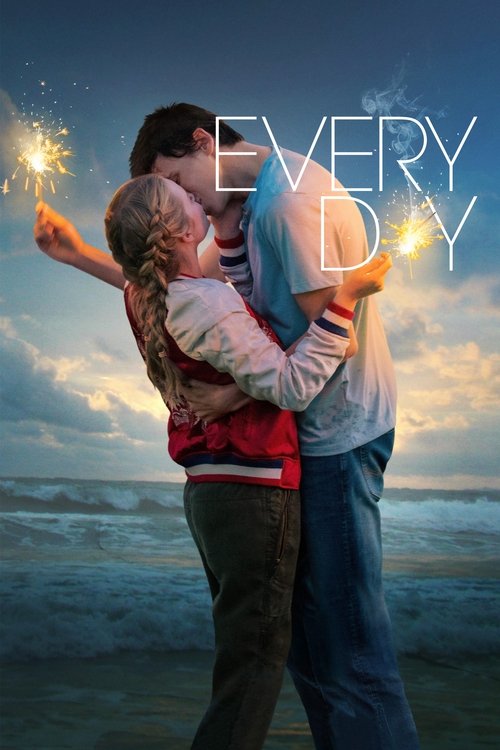
Every Day (2018)
Directed by Michael Sucsy
Yes — Every Day is woke, scoring 60 out of 100 on our wokeness meter.
Every Day is a 2018 romantic fantasy about A, a traveling soul who wakes each morning in a different teenage body, and Rhiannon, the girl who loves the soul inside.
Consciousness Markers
A is a genderless, pansexual spirit whose love for Rhiannon transcends physical form, and the story explicitly includes a transgender teen character and themes of identity beyond the body.
The film's premise requires a diverse young cast, with the spirit 'A' inhabiting bodies of different races, genders, and appearances, and the cast includes actors of color and a transgender actor.
Rhiannon is the central protagonist with agency, including breaking up with a neglectful boyfriend, but the film does not foreground a feminist agenda.
The film gently promotes a message about love beyond physical form and identity, but it remains a teen romance rather than a preachy or didactic lecture.
The body-switching premise places A in bodies of different races, and the cast is diverse, but race is not explicitly discussed or made a thematic focus.
The film's message that the soul matters more than the body lightly touches on body-positive themes, but it does not engage with body size, ability, or appearance acceptance in a substantive way.
There is no environmental or climate-related content in the film.
The film contains no critique of capitalism, wealth inequality, or economic systems.
There is no depiction or discussion of neurodivergence such as autism, ADHD, or related conditions.
The film is a contemporary fantasy romance and does not reinterpret historical events or figures.
Why it received this score
Every Day is a 2018 romantic fantasy about A, a traveling soul who wakes each morning in a different teenage body, and Rhiannon, the girl who loves the soul inside. The film is based on David Levithan's novel, and its central conceit forces a rotating cast of bodies across race, gender, and appearance. That structural commitment gives the film an unusually high quotient of representation casting. The presence of a transgender teen, played by Ian Alexander, and A's own genderless, pansexual attachment to Rhiannon place the story in contemporary identity-conscious territory. The love story does not merely tolerate difference. It makes difference the mechanism of romance. This is not a sermon, but it is a thesis.
The feminist dimension is present but modest. Rhiannon has agency. She discards the neglectful Justin, pursues A, and sets terms for their encounters. Yet the film is more interested in the metaphysics of devotion than in dismantling patriarchy. Racial consciousness is ambient. A inhabits bodies of different races, and the cast is diverse, but the screenplay rarely pauses to examine race as a lived social force. The body positivity register flickers when A insists the soul matters more than the vessel, though the film avoids any sustained engagement with size, ability, or appearance politics. The preachiness is low but detectable, a gentle homily on loving the person inside, delivered with the softest possible touch.
Elsewhere, the ledger is blank. No climate crusade. No eat-the-rich agitation. No neurodivergence arc. No revisionist history. This is a teen romance with a metaphysical gimmick, and it knows it. The result is culturally aware in its casting and its central romance, but not militant about it. It wants to be sweet, and it mostly is. The classification is clear: a mild progressive artifact, heavy on representation and LGBTQ themes, light on ideology, and entirely free of any desire to make the audience feel guilty for existing. That is either a limitation or a mercy, depending on the viewer's appetite for homework with their love story.
Analysis generated by our Consciousness Algorithm


Synopsis
16-year old Rhiannon falls in love with a mysterious spirit named “A” that inhabits a different body every day. Feeling an unmatched connection, Rhiannon and “A” work each day to find each other, not knowing what the next day will bring.
Questions about Every Day
Is Every Day woke?
Yes — Every Day is woke, scoring 60 out of 100 on our wokeness meter. That earns it a verdict of Woke.
What makes Every Day woke?
4 of the 10 markers register at 30 or above, led by LGBTQ+ Themes (82), Representation Casting (78) and Feminist Agenda (35). On LGBTQ+ Themes: A is a genderless, pansexual spirit whose love for Rhiannon transcends physical form, and the story explicitly includes a transgender teen character and themes of identity beyond the body.
How does Every Day compare to other 2018 movies?
It ranks #21 of the 325 films from 2018 we've scored; their average is 20. The wokest is Return (92).
How is the Woke Score calculated?
An AI-assisted process researches the film and its reception, scores it 0–100 on ten markers, then combines those into one 0–100 Woke Score. It measures a specific set of 2020s cultural themes, not film quality.