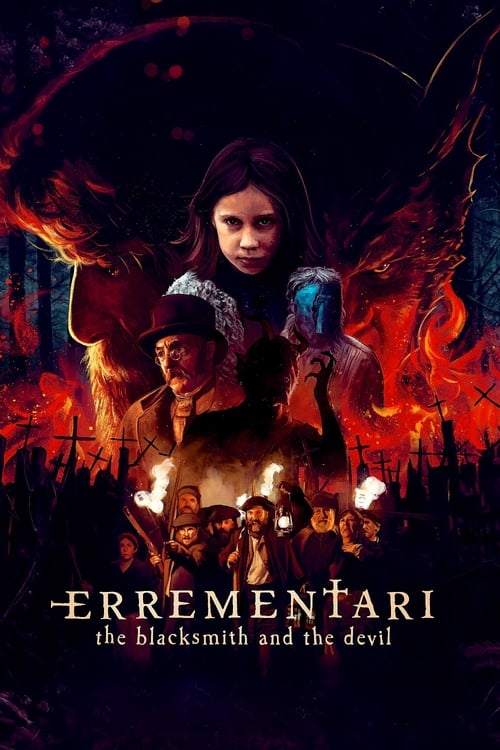
Errementari: The Blacksmith and the Devil (2018)
Directed by Paul Urkijo Alijo
No — Errementari: The Blacksmith and the Devil is not woke, scoring 5 out of 100 on our wokeness meter.
Errementari arrives as a dense piece of regional folklore, a Basque period piece where modern progressive sensibilities struggle to find purchase.
Consciousness Markers
Usue's burn-scarred face makes her a bullied outcast who is ultimately declared a saint and respected, a mild acceptance-of-disfigurement arc, though framed through religious redemption rather than modern body-positivity messaging.
An entirely Basque-language production with a Basque cast and crew, but this reflects regional cultural specificity rather than the modern diversity-casting impulse; no deliberate inclusive casting agenda is present.
The orphan girl Usue is a resourceful central protagonist who outwits demons, but the film offers no feminist thesis or gendered critique; she functions as a folkloric child hero.
A minor thread notes the government melting down villagers' metal and church bells for the war effort, but this is period war grievance, not an eat-the-rich economic critique.
The film is a straightforward folk horror narrative that tells its story without moralizing or preaching to the audience.
No LGBTQ+ characters, themes, or subtext appear anywhere in the film.
The film engages no racial themes or commentary whatsoever.
No environmental or climate concerns are present in this 19th-century folk horror tale.
No neurodivergent characters or themes are depicted.
The Carlist War setting is backdrop for a supernatural folktale, not a revisionist reinterpretation of historical events.
Why it received this score
Errementari arrives as a dense piece of regional folklore, a Basque period piece where modern progressive sensibilities struggle to find purchase. We observe a localized cultural specificity here rather than an explicit agenda of global representation. The film centers on Usue, an orphan whose character provides a modest platform for female agency. She is a resourceful protagonist who outwits supernatural threats, yet her existence remains rooted in the tradition of the folkloric hero. Her acceptance despite her burn scars is a small acknowledgment of difference, a narrative arc that operates within the framework of religious redemption, not contemporary discourse on bodily autonomy.
The film is remarkably free of the kind of social commentary we expect from current cinematic output. It contains no engagement with modern issues of climate change or racial identity. The only hint of large scale systemic critique is a minor subplot involving the government’s wartime seizure of metal, a detail which functions as historical grievance, not as an anti-capitalist statement. We find the narrative remarkably unlecturing, favoring atmosphere over moralizing sermonizing. The social consciousness here is entirely embedded in the specifics of Basque regional history.
It is a serious piece of genre work. The supernatural elements are handled with a heavy-handed commitment to the established folktale, preventing any attempt at a revisionist interpretation of its setting. We view this production as a cultural document of its time, or rather, a document of a specific cultural tradition that has little interest in modern political maneuvering. It is a competent, if culturally narrow, exercise in atmospheric horror.
Analysis generated by our Consciousness Algorithm


Synopsis
Basque Country, Spain, 1843. A police constable arrives at a small village in Álava to investigate a mysterious blacksmith who lives alone deep in the woods.
Questions about Errementari: The Blacksmith and the Devil
Is Errementari: The Blacksmith and the Devil woke?
No — Errementari: The Blacksmith and the Devil is not woke, scoring 5 out of 100 on our wokeness meter. That earns it a verdict of Ultra Based.
Does Errementari: The Blacksmith and the Devil have any woke elements?
Very few. None of the 10 markers reaches 30, the level where a marker counts as present; the highest is Body Positivity at 12.
How does Errementari: The Blacksmith and the Devil compare to other 2018 movies?
It ranks #259 of the 325 films from 2018 we've scored; their average is 20. The wokest is Return (92).
How is the Woke Score calculated?
An AI-assisted process researches the film and its reception, scores it 0–100 on ten markers, then combines those into one 0–100 Woke Score. It measures a specific set of 2020s cultural themes, not film quality.