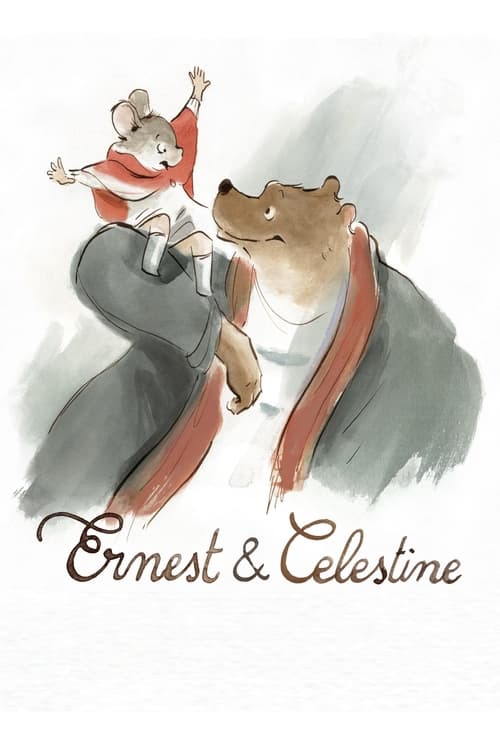
Ernest & Celestine (2012)
Directed by Stéphane Aubier
No — Ernest & Celestine is not especially woke, scoring 27 out of 100 on our wokeness meter.
Ernest & Celestine arrives from 2012 with the soft authority of a watercolor album and the moral architecture of a fable.
Consciousness Markers
The entire plot is built on prejudice between mice and bears, with the keyword 'racial prejudice' and a trial where both species' bigotry is exposed. It is a children's allegory of discrimination, though not tied to real-world racial politics.
The trial climax has Ernest and Celestine denouncing the judges and the upper class for their cruelty to common folk, and critics noted the screenplay's 'political unease.' A class critique exists but is gentle and secondary.
The film carries a tolerance-and-friendship moral, and the courtroom scene delivers a fairly direct speech about prejudice and class, but it is woven into a warm children's fable rather than a sermon.
Celestine is a female protagonist who resists the assigned dentistry career in favor of art, a mild subversion of expectation, but the film never frames this as a gender-justice argument.
The cast is entirely anthropomorphic animals voiced by a French ensemble; the English dub's diverse roster is incidental and not framed as representation. No human casting politics apply.
No LGBTQ+ characters, themes, or subtext appear anywhere in the story of a mouse and a bear.
No environmental or climate themes are present.
No body-positivity themes or messaging.
No neurodivergence themes or characters.
No historical revisionism; the story is a fictional fable.
Why it received this score
Ernest & Celestine arrives from 2012 with the soft authority of a watercolor album and the moral architecture of a fable. A mouse and a bear overcome inherited enmity, rob a dentist, and stand trial in a courthouse where both societies expose their own bigotries. The film treats prejudice as a structural inheritance, passed down through scary stories and professional expectations. That gives its social consciousness a genuine pulse, though the pulse belongs to an imagined animal kingdom, not to any real racial history. The allegory is broad enough for children and tidy enough for adults who prefer their lessons illustrated.
Celestine is a female protagonist who would rather draw than drill teeth, a small rebellion against assigned roles. The film does not press this into a gender-justice argument. It simply lets her choose art over dentistry and lets the plot agree. The courtroom climax has more bite. Ernest and Celestine scold the judges and the comfortable classes for their cruelty toward common folk, and the screenplay carries a mild political unease beneath the plush textures. This is class critique as nursery rhyme: present, legible, secondary. The tolerance-and-friendship moral lands with a direct speech or two, yet the film wraps the sermon in warm animation and gentle comedy. It lectures, but it also tucks you in.
The remaining cultural markers are absent. No LGBTQ themes, no climate crusade, no body-positivity messaging, no neurodivergent characters, no revisionist history. The English dub's diverse cast is incidental, a matter of voice work, not representation politics. The remainder is a charming, humane film about two outcasts who find each other. It earns its warmth without claiming a modern ideological program. The result is socially aware in the oldest sense: kindness against prejudice, friendship against custom. That is not a bad vintage. It is simply a mild one.
Analysis generated by our Consciousness Algorithm


Synopsis
Celestine is a little mouse trying to avoid a dental career while Ernest is a big bear craving an artistic outlet. When Celestine meets Ernest, they overcome their natural enmity by forging a life of crime together.
Questions about Ernest & Celestine
Is Ernest & Celestine woke?
No — Ernest & Celestine is not especially woke, scoring 27 out of 100 on our wokeness meter. That earns it a verdict of Based.
Does Ernest & Celestine have any woke elements?
2 of the 10 markers register at 30 or above, led by Racial Consciousness (55) and Eat the Rich (30). On Racial Consciousness: The entire plot is built on prejudice between mice and bears, with the keyword 'racial prejudice' and a trial where both species' bigotry is exposed.
How does Ernest & Celestine compare to other 2012 movies?
It ranks #29 of the 230 films from 2012 we've scored; their average is 12. The wokest is Killing Them Softly (92).
How is the Woke Score calculated?
An AI-assisted process researches the film and its reception, scores it 0–100 on ten markers, then combines those into one 0–100 Woke Score. It measures a specific set of 2020s cultural themes, not film quality.