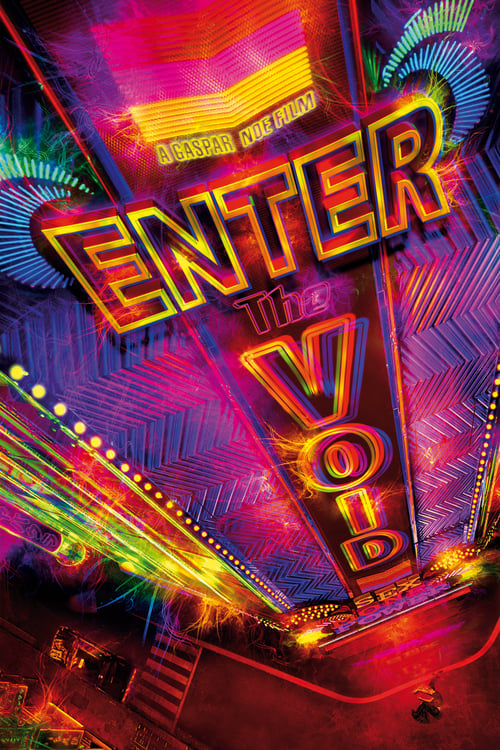
Enter the Void (2010)
Directed by Gaspar Noé
No — Enter the Void is not woke, scoring 9 out of 100 on our wokeness meter.
Gaspar Noé's Enter the Void remains a neon-lit endurance test, a first-person death trip through Tokyo's nightlife that treats the afterlife as a strobe-lit anecdote.
Consciousness Markers
A mixed international cast (Japanese, French, and American actors) populates a Tokyo-set story, but the leads are white and the diversity is organic to the location rather than a casting statement.
A brief incidental scene depicts Victor performing fellatio on a man in a love-hotel montage, but it carries no thematic weight or advocacy.
The Tibetan Book of the Dead is used as dream logic and atmosphere rather than a thesis delivered to the audience; the film is experiential, not preachy.
Linda is defined largely as a stripper and prostitute whose body is used for voyeuristic spectacle, including a vaginal point-of-view shot, with no feminist argument attached.
The Japanese setting is decorative and atmospheric; race is never a subject of the film's consciousness.
No environmental or climate themes appear in the film.
Drug dealing and exploitation appear as milieu, not as a critique of capitalism or wealth.
Nudity is deployed for shock and erotic spectacle rather than any message of body acceptance.
Drug use and hallucinogenic states are central, but they are not framed as neurodivergence or a condition of identity.
The film is fictional and makes no claim to reinterpreting historical events.
Why it received this score
Gaspar Noé's Enter the Void remains a neon-lit endurance test, a first-person death trip through Tokyo's nightlife that treats the afterlife as a strobe-lit anecdote. Oscar, a drug dealer, is shot during a raid and spends the rest of the running time hovering over his sister Linda, his friends, and various hotel rooms. The film has a mixed international cast, with Japanese, French, and American performers moving through the city, but the arrangement feels organic to the setting. The white leads carry the emotional load, and no casting statement announces itself. A brief moment of same-sex activity appears in a love-hotel montage, yet it passes without advocacy or thematic weight. The film is not trying to educate anyone about identity.
Linda's arc is where contemporary social reading goes to die. She is a stripper and prostitute, defined by her body and by the camera's appetite for it. The vaginal point-of-view shot near the end is not a feminist argument; it is a spectacle. Race in Tokyo is atmosphere, not consciousness. The Japanese locations supply color and danger, not a subject. Drug dealing exists as milieu, not as a critique of capital. Nudity is deployed for shock and erotic display, not body acceptance. Hallucinogens drive the form, but the film never frames them as neurodivergence or identity. There is no climate crusade, no revisionist history, no sermon about wealth.
The closest thing to a thesis is the Tibetan Book of the Dead, used as dream logic and atmosphere. It floats through the film as a texture, not a lecture. The result is experiential, often tedious, occasionally hypnotic, and largely innocent of the modern cultural agenda. It wants to overwhelm the senses, not correct them. In the taxonomy of social consciousness, this is a curious artifact: international in cast, indifferent in politics, and committed only to its own hallucinatory rhythm.
Analysis generated by our Consciousness Algorithm


Synopsis
This psychedelic tour of life after death is seen entirely from the point of view of Oscar, a young American drug dealer and addict living in Tokyo with his prostitute sister, Linda. When Oscar is killed by police during a bust gone bad, his spirit journeys from the past -- where he sees his parents before their deaths -- to the present -- where he witnesses his own autopsy -- and then to the future, where he looks out for his sister from beyond the grave.
Questions about Enter the Void
Is Enter the Void woke?
No — Enter the Void is not woke, scoring 9 out of 100 on our wokeness meter. That earns it a verdict of Ultra Based.
Does Enter the Void have any woke elements?
Very few. None of the 10 markers reaches 30, the level where a marker counts as present; the highest is Representation Casting at 18.
How does Enter the Void compare to other 2010 movies?
It ranks #88 of the 238 films from 2010 we've scored; their average is 11. The wokest is My Name Is Khan (84).
How is the Woke Score calculated?
An AI-assisted process researches the film and its reception, scores it 0–100 on ten markers, then combines those into one 0–100 Woke Score. It measures a specific set of 2020s cultural themes, not film quality.