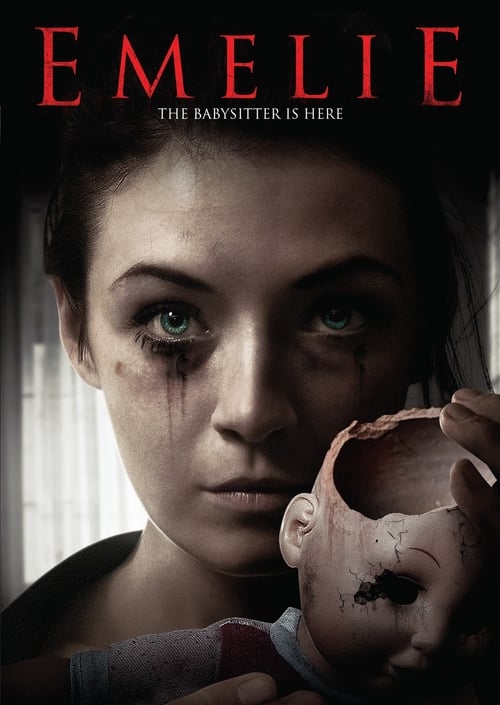
Emelie (2016)
Directed by Michael Thelin
No — Emelie is not woke, scoring 0 out of 100 on our wokeness meter.
Emelie arrives with the unassuming manner of a film that has no interest in current affairs.
Consciousness Markers
The cast is overwhelmingly white with no deliberate diversity casting; the film makes no comment on representation.
No LGBTQ+ characters, themes, or subtext appear anywhere in the film.
A female antagonist exists, but the film offers no feminist critique or commentary; her gender is incidental to the horror premise.
Race is entirely absent as a theme; the film engages no racial dynamics whatsoever.
No environmental or climate-related content of any kind.
No economic critique or class commentary; the suburban setting is mere backdrop for a home-invasion thriller.
No body-positive messaging; the film's use of a tampon scene is shock horror, not body affirmation.
The antagonist's mental instability is framed as villainous pathology, not as neurodivergent representation or advocacy.
No historical events or figures are reinterpreted; the story is entirely fictional and contemporary.
The film is a lean genre thriller with no moralizing or didactic messaging directed at the audience.
Why it received this score
Emelie arrives with the unassuming manner of a film that has no interest in current affairs. A 2015 Tribeca premiere that reached theaters the following March, it concerns a babysitter who is not the babysitter, and three children who discover this at the worst possible hour. Sarah Bolger plays the impostor with a pleasant blankness that curdles by degrees. The camera stays close, the house stays dark, and the running time is spent on suspense instead of sentiment. It is a home-invasion picture with a small cast and a smaller budget, and it knows exactly what it is.
On the matter of social consciousness, the ledger is empty, and the emptiness has a certain purity. The cast is white and suburban and the film never pauses to remark on the fact. The female antagonist is a grieving mother, but her gender is a plot mechanism, not a thesis. Her instability is presented as derangement, which is the horror genre's oldest and least fashionable instinct. The infamous tampon scene is designed to make an eleven-year-old boy squirm, and it succeeds, without a single gesture toward bodily affirmation. A hamster is fed to a python. A parents' sex tape is screened for children. These are provocations, not arguments.
No character lectures anyone about the climate, the economy, or the arrangement of history. The suburbs here are a stage set for menace, not a symbol of bourgeois decay. There is no lesson at the end, only a boy in a Corvette and a woman limping into the dark. We encounter a film that wants nothing from us but our pulse. In an era of cinema that keeps stopping to explain itself, this one simply locks the door.
Analysis generated by our Consciousness Algorithm


Synopsis
After their regular babysitter cancels, the Thompson family turns to her friend, Anna to supervise their children while the parents go out to celebrate their anniversary. At first Anna seems like a dream come true to the kids, allowing them to eat extra cookies and play with things that are usually off-limits, but as her behaviour becomes increasingly odd, the kids soon find out that her intentions are dark and twisted—and she is not who she seems to be.
Questions about Emelie
Is Emelie woke?
No — Emelie is not woke, scoring 0 out of 100 on our wokeness meter. That earns it a verdict of Ultra Based.
Does Emelie have any woke elements?
No. All 10 markers score zero.
How does Emelie compare to other 2016 movies?
It ranks #264 of the 285 films from 2016 we've scored; their average is 16. The wokest is 13th (92).
How is the Woke Score calculated?
An AI-assisted process researches the film and its reception, scores it 0–100 on ten markers, then combines those into one 0–100 Woke Score. It measures a specific set of 2020s cultural themes, not film quality.