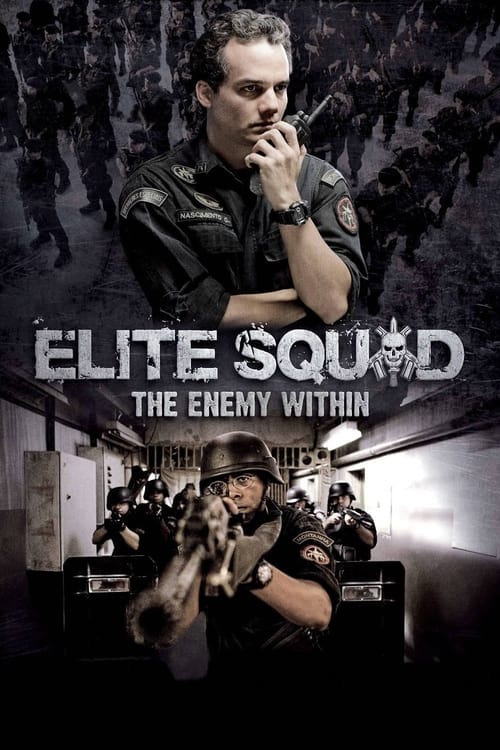
Elite Squad: The Enemy Within (2010)
Directed by José Padilha
No — Elite Squad: The Enemy Within is not woke, scoring 18 out of 100 on our wokeness meter.
The sequel to Elite Squad returns to Rio with a heavier heart and a longer memory.
Consciousness Markers
Nascimento's heavy voiceover narration is persistently didactic, explicitly explaining the corrupt system to the audience and closing on a thesis statement about systemic rot.
The film indicts a corrupt nexus of politicians, police, militias, and money, and its closing line blames 'the system' itself — a systemic critique, though aimed at state corruption rather than capitalism as such.
The cast is a naturally diverse Brazilian ensemble (Seu Jorge, Irandhir Santos, André Ramiro), but this reflects authentic local casting rather than any deliberate representation agenda; no marker of casting-as-message.
The film engages favela poverty, police violence, and class stratification, but frames these through systemic corruption and politics rather than racial consciousness or racial justice.
The film is a semi-fictional dramatization of real Rio militia politics (with Fraga inspired by Marcelo Freixo), but it presents itself as contemporary fiction rather than reinterpreting history through an ideological lens.
A female journalist (Clara) and Nascimento's ex-wife Rosane have functional roles, but the film is a hyper-masculine macho narrative with no feminist framing or critique of patriarchy.
No LGBTQ+ characters, themes, or subtext appear anywhere in the film.
No environmental or climate themes whatsoever.
No body-positivity themes; the film's physicality is entirely about violence and combat.
No neurodivergent characters or themes are present.
Why it received this score
The sequel to Elite Squad returns to Rio with a heavier heart and a longer memory. José Padilha's camera still moves like a raid, but the target has shifted from the drug trade to the machinery that feeds on it. Wagner Moura's Nascimento, now a lieutenant colonel and briefly an undersecretary, narrates his own descent into the political swamp with the grim patience of a man reading a coroner's report. The cast is drawn from the working Brazilian ensemble this series has always used, Seu Jorge and Irandhir Santos among them, and their presence reads as ordinary casting, not as a statement.
On the ledger of contemporary social consciousness, the film is a modest entry. It has no interest in matters of sexuality, body image, or neurological difference, and none appear. Its women, a journalist and an ex-wife, occupy functional slots in a story built almost entirely from male bodies and male violence. The poverty it documents is a class problem, a corruption problem, a question of who owns the militia and who owns the governor. Race is present the way it is present in Rio, without comment. The environment does not come up.
Where the film does lean into a thesis, it does so with the subtlety of a battering ram. The villains are not merely criminals but a fused bloc of police, politicians, broadcasters, and money, and the closing narration delivers the moral outright: the system persists because the conditions for it persist. This is a critique of the state as much as of capital, delivered through Nascimento's relentless voiceover as instruction. The audience is told what to think, at length, twice. The film remains a superior crime epic, semi-fictionalized from real Rio militia politics, but it mistakes its own thesis for a revelation. Bold, tannic, and slightly over-explained.
Analysis generated by our Consciousness Algorithm

Synopsis
After a bloody invasion of the BOPE in the High-Security Penitentiary Bangu 1 in Rio de Janeiro to control a rebellion of interns, the Lieutenant-Colonel Roberto Nascimento and the second in command Captain André Matias are accused by the Human Right Aids member Diogo Fraga of execution of prisoners. Matias is transferred to the corrupted Military Police and Nascimento is exonerated from the BOPE by the Governor.
Questions about Elite Squad: The Enemy Within
Is Elite Squad: The Enemy Within woke?
No — Elite Squad: The Enemy Within is not woke, scoring 18 out of 100 on our wokeness meter. That earns it a verdict of Ultra Based.
Does Elite Squad: The Enemy Within have any woke elements?
2 of the 10 markers register at 30 or above, led by Lecture Energy (45) and Eat the Rich (35). On Lecture Energy: Nascimento's heavy voiceover narration is persistently didactic, explicitly explaining the corrupt system to the audience and closing on a thesis statement about systemic rot.
How does Elite Squad: The Enemy Within compare to other 2010 movies?
It ranks #43 of the 238 films from 2010 we've scored; their average is 11. The wokest is My Name Is Khan (84).
How is the Woke Score calculated?
An AI-assisted process researches the film and its reception, scores it 0–100 on ten markers, then combines those into one 0–100 Woke Score. It measures a specific set of 2020s cultural themes, not film quality.