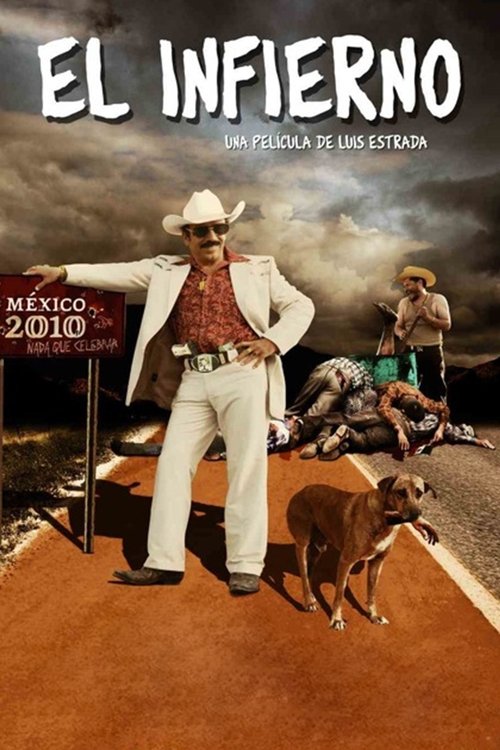
El Infierno (2010)
Directed by Luis Estrada
No — El Infierno is not woke, scoring 16 out of 100 on our wokeness meter.
Luis Estrada has spent a career poking at the machinery of Mexican institutional life, and El Infierno finds him in grim form.
Consciousness Markers
The satire indicts institutional corruption, the cartel-government nexus, and the economic desperation that drives ordinary people into crime, with the boss ascending to governor — a systemic critique rather than a class-warfare manifesto.
The film carries a clear political message about the cyclical futility of cartel violence and state complicity, but it delivers this through dark comedy and drama rather than direct moralizing.
A minor plot point reveals that J.R. hid his homosexuality from his father, but this functions as a narrative device for betrayal and shame rather than an LGBTQ+ advocacy theme.
The film critiques Mexican political corruption and the drug war from within Mexican society, but it is not organized around modern racial-justice consciousness.
Guadalupe is largely a motivating figure for Benny and is ultimately fridged; the film offers no feminist critique or gender-agenda framing.
An entirely Mexican cast in a Mexican production is the natural demographic of the story, not a deliberate modern representation-casting initiative. No comment is made on the casting itself.
No environmental or climate themes appear anywhere in the film.
No body-positivity themes are present.
No neurodivergence themes are present.
The film is a fictional narrative set against the contemporary drug war, not a revisionist retelling of historical events.
Why it received this score
Luis Estrada has spent a career poking at the machinery of Mexican institutional life, and El Infierno finds him in grim form. Benjamin Garcia returns to his hometown after two decades in the United States, deported into an economy where the only growth industry is narcotics. The descent that follows plays as black comedy, though the comedy curdles quickly. Estrada stacks corpses with the patience of an accountant. The film was released to coincide with the bicentennial of Mexican independence, a scheduling decision that reads today as either patriotic duty or a very dry joke, and the MPAA handed it an NC-17 for violence and sex, which tells you the tone was never going to be gentle.
The film's anger is aimed at institutions, not identities. Don Jose runs his cartel on honesty, loyalty and absolute silence, then ends the picture as county governor, a promotion that requires no explanation for anyone who has followed Mexican politics. Benny's climb is a study in economic desperation: Guadalupe's line about getting used to anything except starving does more work than any speech could. She exists to motivate him and is killed to wound him, a piece of narrative furniture the film never interrogates. J.R.'s hidden homosexuality surfaces only as a device for shame and posthumous deception, useful for the plot's machinery and nothing else. The bloodshed is cyclical, the nephew inherits the rifle, and the wheel turns.
This is a satire of state complicity delivered through farce and carnage, its politics economic and systemic. It has no interest in the cultural markers that define the present decade's discourse, and no obligation to acquire them. Estrada's target is corruption as a national pastime, and he hits it with a sledgehammer wrapped in a joke. The result is a film that feels like a hangover and a history lesson at once, though it never stops to explain itself. Twenty years on, it remains a sharp, ugly, effective piece of work. The cycle continues. So does the audience's discomfort.
Analysis generated by our Consciousness Algorithm


Synopsis
After being deported back to Mexico, a man has no choice but to join the vicious drug cartel that has corrupted his hometown in order to survive.
Questions about El Infierno
Is El Infierno woke?
No — El Infierno is not woke, scoring 16 out of 100 on our wokeness meter. That earns it a verdict of Ultra Based.
Does El Infierno have any woke elements?
2 of the 10 markers register at 30 or above, led by Eat the Rich (35) and Lecture Energy (30). On Eat the Rich: The satire indicts institutional corruption, the cartel-government nexus, and the economic desperation that drives ordinary people into crime, with the boss ascending to governor — a systemic critique rather than a class-warfare manifesto.
How does El Infierno compare to other 2010 movies?
It ranks #49 of the 238 films from 2010 we've scored; their average is 11. The wokest is My Name Is Khan (84).
How is the Woke Score calculated?
An AI-assisted process researches the film and its reception, scores it 0–100 on ten markers, then combines those into one 0–100 Woke Score. It measures a specific set of 2020s cultural themes, not film quality.