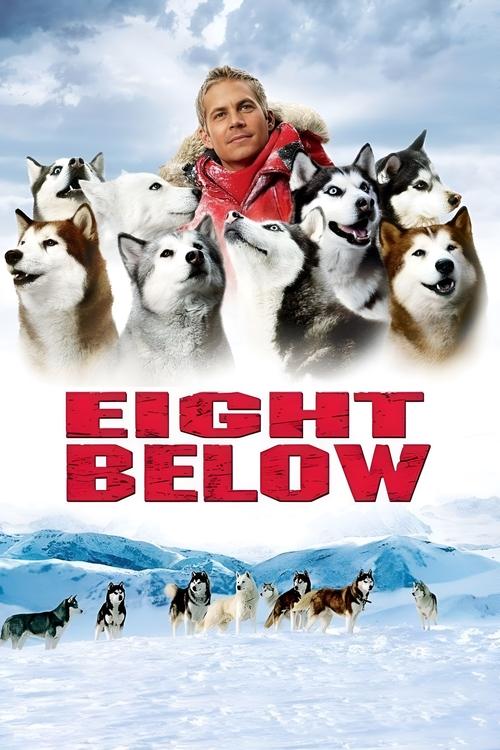
Eight Below (2006)
Directed by Frank Marshall
No — Eight Below is not woke, scoring 7 out of 100 on our wokeness meter.
Eight Below arrives from 2006, a Disney survival drama in which a sled dog trainer leaves eight dogs chained to a stake in Antarctica and then spends the back half of the running time feeling bad about it.
Consciousness Markers
Moon Bloodgood (mixed Korean/Irish) plays pilot Katie, and August Schellenberg (Mohawk) appears as Mindo, providing a modestly diverse supporting cast without explicit commentary.
Katie is a capable female pilot in a male-dominated setting, but the film has no feminist agenda or explicit gender politics.
No LGBTQ+ characters, relationships, or themes are present.
The story is a survival adventure with no engagement with racial consciousness or racial justice themes.
The Antarctic setting and harsh weather are backdrop for survival, not a climate-change crusade.
No critique of capitalism, class warfare, or anti-wealth themes appear.
No body-positivity themes or messaging are present.
No neurodivergent characters or themes are depicted.
The film is a fictionalized American remake of a Japanese film based on real events, but it does not engage in progressive historical revisionism.
The film is a straightforward family adventure and does not lecture the audience on social or political issues.
Why it received this score
Eight Below arrives from 2006, a Disney survival drama in which a sled dog trainer leaves eight dogs chained to a stake in Antarctica and then spends the back half of the running time feeling bad about it. It is a remake of the 1983 Japanese film Antarctica, itself drawn from the 1958 Showa Station expedition, so the bones are borrowed and the sentiment is inherited. The dogs are the point. They endure, they grieve, they eat an orca, and one of them dies under the southern lights. Frank Marshall directs with the sturdy efficiency of a man who understands his audience came for huskies and will accept Paul Walker as the toll.
On the matter of cultural instruction, the film is close to silent. There is no climate sermon, despite all that ice. No class critique, despite the grant money that must be pried loose from a university before anyone flies south. No discourse on race, gender, or the body. Moon Bloodgood plays Katie, a capable pilot, and August Schellenberg plays Mindo, and neither performance arrives freighted with annotation. Katie flies the helicopter and does her job. That is the entire accounting of her. A viewer hunting for ideological instruction will go hungry, and the film will not apologize for the empty plate.
What remains is craft and canine. Critics were kind, audiences kinder, and the picture opened at number one before quietly collecting its $120 million. Its moral universe is simple: loyalty, sacrifice, and the specific guilt of leaving a living thing behind. It never turns to face the audience. In an age when even a dog picture can be drafted into service as a civics lesson, this one only wants you to cry about Old Jack. It succeeds, and it asks nothing else of you.
Analysis generated by our Consciousness Algorithm
Part of


Synopsis
In the Antarctic, after an expedition with Dr. Davis McClaren, the sled dog trainer Jerry Shepherd has to leave the polar base with his colleagues due to the proximity of a heavy snow storm. He ties his dogs to be rescued after, but the mission is called-off and the dogs are left alone at their own fortune. For six months, Jerry tries to find a sponsor for a rescue mission.
Questions about Eight Below
Is Eight Below woke?
No — Eight Below is not woke, scoring 7 out of 100 on our wokeness meter. That earns it a verdict of Ultra Based.
Does Eight Below have any woke elements?
Very few. None of the 10 markers reaches 30, the level where a marker counts as present; the highest is Representation Casting at 15.
How does Eight Below compare to other 2006 movies?
It ranks #111 of the 211 films from 2006 we've scored; their average is 11. The wokest is An Inconvenient Truth (92).
How is the Woke Score calculated?
An AI-assisted process researches the film and its reception, scores it 0–100 on ten markers, then combines those into one 0–100 Woke Score. It measures a specific set of 2020s cultural themes, not film quality.