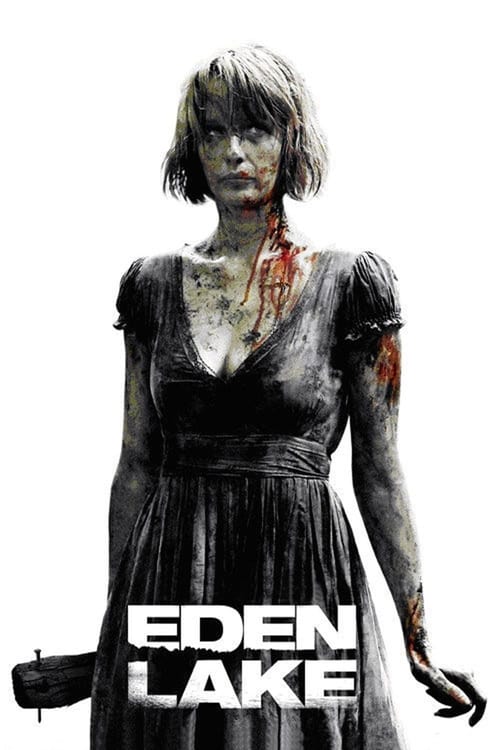
Eden Lake (2008)
Directed by James Watkins
No — Eden Lake is not woke, scoring 5 out of 100 on our wokeness meter.
James Watkins arrived in 2008 with a debut that treats the English countryside as a trap and the English teenager as the teeth inside it.
Consciousness Markers
Jenny is a resourceful survivor who outlasts the gang for much of the runtime, but this is the standard final-girl mechanic of the genre, not a feminist thesis.
The cast is overwhelmingly white British, with one Black actor in an unremarked gang role. Any diversity here reads as incidental to the setting rather than deliberate representation casting.
There is a thesis on offer about Broken Britain and feckless parenting, voiced early by Steve, but it is a reactionary lecture rather than a progressive one, so it registers only faintly here.
No LGBTQ+ characters, subtext, or themes of any kind.
No engagement with race or racial politics; the conflict is framed entirely around class and generational anxieties.
The woodland setting is scenery for a siege narrative, with no environmental argument attached.
The film's class politics run the other way: critics including Owen Jones cited it as demonisation of the white working class, not as an eat-the-rich parable.
No body-diversity themes or messaging; the cast is conventionally presented throughout.
Brett is portrayed as a psychopath and a bully, not as a neurodivergent character, and no diagnostic framing is offered.
No historical revisionism; the film is a contemporary-set fictional thriller.
Why it received this score
James Watkins arrived in 2008 with a debut that treats the English countryside as a trap and the English teenager as the teeth inside it. Jenny and Steve drive out to Eden Lake for a quiet weekend, and the film spends its first act accumulating small portents: a slapped child at a motel, a defensive waitress, a boy in the woods who says very little. Then the gang arrives. What follows is lean, mean, and ruthlessly efficient, a siege picture in the tradition of Straw Dogs and Deliverance, though Watkins keeps his camera closer and his sympathy narrower than either.
The film's cultural instincts reward untangling. Jenny, played by Kelly Reilly, is resourceful and outlasts the gang longer than anyone expects, but that is the standard final-girl arithmetic of the genre, not a thesis about anything. The cast is white British almost without exception, and the one Black gang member passes through unremarked. There is no engagement with racial politics, no environmental argument attached to the woodland, no body-diversity messaging, no diagnostic framing for Brett's cruelty. He is simply a psychopath with a dog. The class politics run the other way entirely. Critics at the time, and Owen Jones at length, read the film as a demonisation of the white working class, a provocation in the chav-horror cycle. Steve's early complaint about feckless parenting is a lecture, but a reactionary one, and the film never quite repudiates it.
The final movement, in which Jenny staggers into Brett's own home and finds the parents of her tormentors waiting there, is the film's real argument: the rot is domestic and it is hereditary. It is grim, effective, and entirely uninterested in the progressive pieties of a later decade. A product of its moment, and content to stay there.
Analysis generated by our Consciousness Algorithm


Synopsis
When a young couple goes to a remote wooded lake for a romantic getaway, their quiet weekend is shattered by an aggressive group of local kids. Rowdiness quickly turns to rage as the teens terrorize the couple in unimaginable ways, and a weekend outing becomes a bloody battle for survival.
Questions about Eden Lake
Is Eden Lake woke?
No — Eden Lake is not woke, scoring 5 out of 100 on our wokeness meter. That earns it a verdict of Ultra Based.
Does Eden Lake have any woke elements?
Very few. None of the 10 markers reaches 30, the level where a marker counts as present; the highest is Feminist Agenda at 12.
How does Eden Lake compare to other 2008 movies?
It ranks #137 of the 212 films from 2008 we've scored; their average is 12. The wokest is Milk (68).
How is the Woke Score calculated?
An AI-assisted process researches the film and its reception, scores it 0–100 on ten markers, then combines those into one 0–100 Woke Score. It measures a specific set of 2020s cultural themes, not film quality.