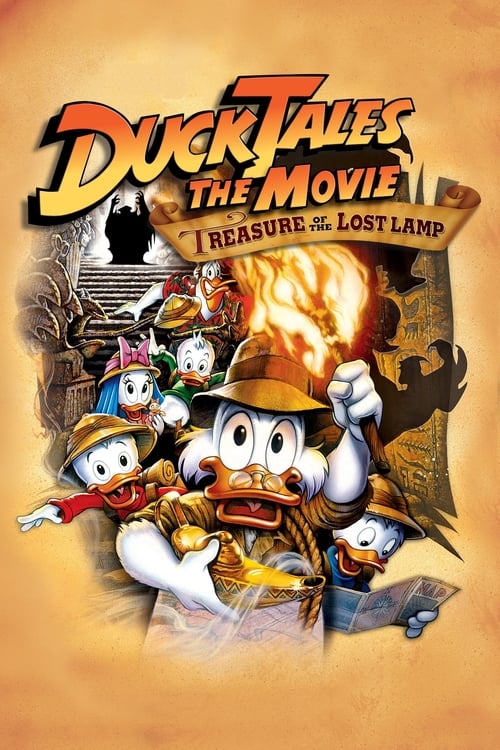
DuckTales: The Movie - Treasure of the Lost Lamp (1990)
Directed by Bob Hathcock
No — DuckTales: The Movie - Treasure of the Lost Lamp is not woke, scoring 5 out of 100 on our wokeness meter.
The summer of 1990 gave us a theatrical DuckTales, the last Disney feature finished in cel animation and the first entrusted to the television division.
Consciousness Markers
The film's gentle moral that friendship and personhood outweigh gold carries a faint anti-materialist note, but Scrooge's vast fortune is ultimately celebrated, not condemned. It is not an 'eat the rich' text.
A mild closing lesson about what matters more than money is delivered through the story rather than preached at the audience; the film is an adventure romp, not a sermon.
The voice cast and characters are almost entirely white-anchored Western production ducks; the Middle Eastern setting renders inhabitants (notably Dijon) as servile comic stereotypes rather than deliberate inclusive casting, which is the opposite of representation as the marker intends.
No LGBTQ+ characters, themes, or subtext of any kind appear in this 1990 animated adventure.
Webby and Mrs. Beakley exist as characters but the film advances no feminist argument; women function in traditional supporting roles with no gender-conscious framing.
The film has no racial consciousness. Its Middle Eastern backdrop leans on Orientalist comic conventions (the 'cringing stereotype' Dijon) rather than any commentary on race.
No environmental or climate themes whatsoever; the adventure concerns treasure and magic lamps.
No body-positive themes or diverse body types; the characters are conventionally designed cartoon ducks.
No depiction or discussion of neurodivergence anywhere in the film.
Loosely adapting the Aladdin lamp tale is folkloric borrowing, not politically revisionist history; the film does not reinterpret real historical events through an ideological lens.
Why it received this score
The summer of 1990 gave us a theatrical DuckTales, the last Disney feature finished in cel animation and the first entrusted to the television division. The premise sends Scrooge McDuck to the Middle East in search of the lost loot of Collie Baba, a journey that treats the region as a sandbox of pyramids, treasure maps, and comic locals. Dijon, the guide who cringes and grovels and is eventually transformed into a pig, drew criticism at the time as a cringing stereotype. The film is not thinking about that. It is thinking about the lamp.
What follows is a tidy adventure: a genie, three wishes each, a sorcerer named Merlock who destroyed Atlantis and Pompeii as though they were vacation rentals, and a Money Bin that takes flight. The children wish for an elephant and a giant sundae. Webby wishes her toys to life. The storytelling is brisk and the jokes land often enough. Along the way the film reaches a modest conclusion, that a friend made real is worth more than gold, and that Scrooge's hoard remains a fine and admirable thing so long as he stays fond of his family. The lesson is absorbed through the plot, not announced from a lectern. There is no argument here about gender, no commentary on race, no climate anxiety, no reconsideration of history's winners. The ducks are ducks.
To classify this film is to classify a warm bath. Its social consciousness extends to a faint tug against greed that it immediately forgives, since the fortune survives intact and the villain is dispatched by gravity. The voice cast is a pleasure, and the animation has a hand-drawn texture we will not see again. As a document of 1990 cultural priorities it is nearly inert, and that inertness carries a certain antique charm. We score it accordingly, with respect and without enthusiasm.
Analysis generated by our Consciousness Algorithm


Synopsis
With his nephews and niece, everyone's favorite rich uncle, Scrooge McDuck, treks from his mansion home in Duckburg in search of the long-lost loot of the thief Collie Baba. But finding the goods isn't quite what it's "quacked" up to be! Their thrilling adventure leads to comical chaos, magical mayhem, and a lesson about what is far more valuable than money, gold and jewels.
Questions about DuckTales: The Movie - Treasure of the Lost Lamp
Is DuckTales: The Movie - Treasure of the Lost Lamp woke?
No — DuckTales: The Movie - Treasure of the Lost Lamp is not woke, scoring 5 out of 100 on our wokeness meter. That earns it a verdict of Ultra Based.
Does DuckTales: The Movie - Treasure of the Lost Lamp have any woke elements?
Very few. None of the 10 markers reaches 30, the level where a marker counts as present; the highest is Eat the Rich at 8.
How does DuckTales: The Movie - Treasure of the Lost Lamp compare to other 1990 movies?
It ranks #34 of the 68 films from 1990 we've scored; their average is 9. The wokest is Nightbreed (60).
How is the Woke Score calculated?
An AI-assisted process researches the film and its reception, scores it 0–100 on ten markers, then combines those into one 0–100 Woke Score. It measures a specific set of 2020s cultural themes, not film quality.